
![[OC] The land footprint of food](https://www.byteseu.com/wp-content/uploads/2026/01/97eipmti3adg1-819x1024.jpeg "[OC] The land footprint of food")
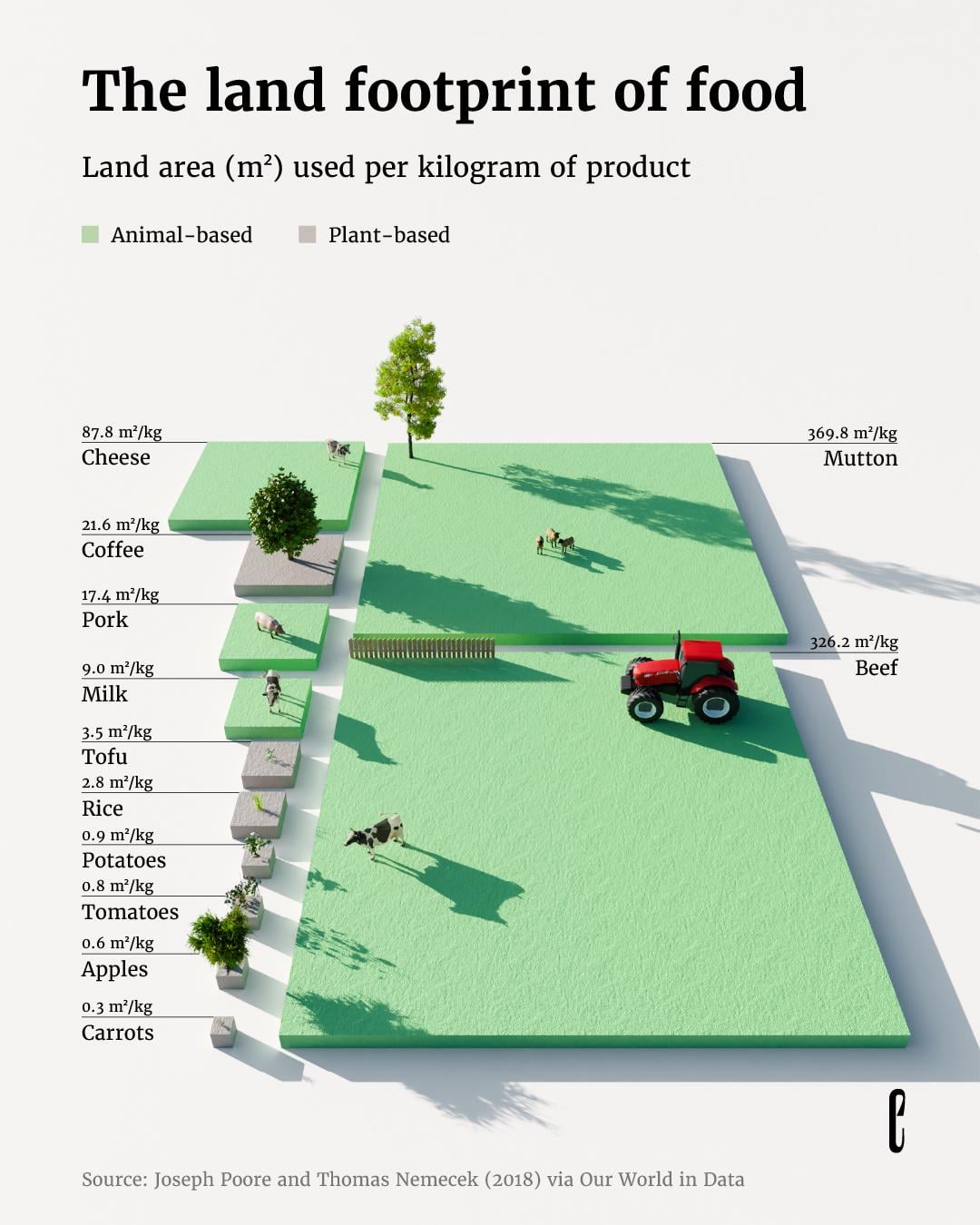
The land use of different foods, to scale, published with the European Correspondent.
Data comes from research by Joseph Poore and Thomas Nemecek (2018) that I accessed via Our World in Data.
I made the 3D scene with Blender and brought everything together in Illustrator. The tractor, animals and crops are sized proportionately to help convey the relative size of the different land areas.
Posted by t0on
19 Comments
Should be normalized to energy density and not weight imo
But livestock can often live on land too poor to farm on.
Coffee is surprisingly bad.
Pork assumes a very low welfare standard? I’m guessing any kind of vaguely ethical pork requires more than that.
I wonder is there data on processed vegan foods as well? Like oat milk, Violife “cheese”, that sort of stuff. They’re really good products actually but I wonder what their footprint is. And how it compares, exactly, to dairy alternatives.
Becoming vegetarian/vegan is the single most impactful individual action anyone can make.
Besides the obvious ethical concerns (hundreds of billions of animals saved per year), a meatless diet would allow us to re-nature/re-forest millions of acres of land used for cattle, save countless amounts of CO2/methane emissions, and would save governments hundreds of billions of USD in meat-industry subsidies that could be diverted to fund climate-change research, the energy transition, the development of lab-grown meat…
We need to wean ourselves from meat as a civilisation, but people attach such a personal, cultural weight to meat that I fear it is close to impossible (until it’ll be too late).
I have seen so much more aggression from meat-loving vegan-haters than from vegans, it is scary
except “beef” should include milk too. and the different kind of terrains it can be used for it.
Shows that meat is even space efficient!
An average human – 452 square meters per kg
Would be more interesting if it also took into consideration how long the land area needs to be used per kg
While this is really good, I’d prefer to see it by nutritional value, rather than kg. A kg of beef is 2500kcal while a kg of carrots is 410kcal (so even at equal calories carrots still use way less land, but is that true for everything?)
Also, if you go by kg of protein (another thing vital for good nutrition), things start looking very different.
Still, we need to eat a lot less beef, and be more considerate of animal welfare
Does the land area only focus on the end product or also what other land area could be used to make that product? I was expecting milk to be higher because a cow eats alot of food and I would expect the land area of the food it eats to be added to the cows land use.
Same thing with the plants, is the land fertilizers take up considered a part of the potatoes land or completely separate?
I’m curious what it’s like for eggs. On one hand a chicken is small, on the other hand an egg is small as well
Why is milk different from beef?
Chicken is the most consumed meat and it isn’t even represented?
as someone who had grown pork and beef- there’s no way to be that different for the two. 326m2 for one kg of beef calculates for 32ha for growing two cows and i find it very very wrong
Am i missing something here or should time taken be a consideration too? It doesn’t really make sense as presented
Would love to see corn and almonds
Where is chicken though? Seems like it would be one of the most consumed foods?
edit:
Had to google it, chicken is at 9 m2/kg