
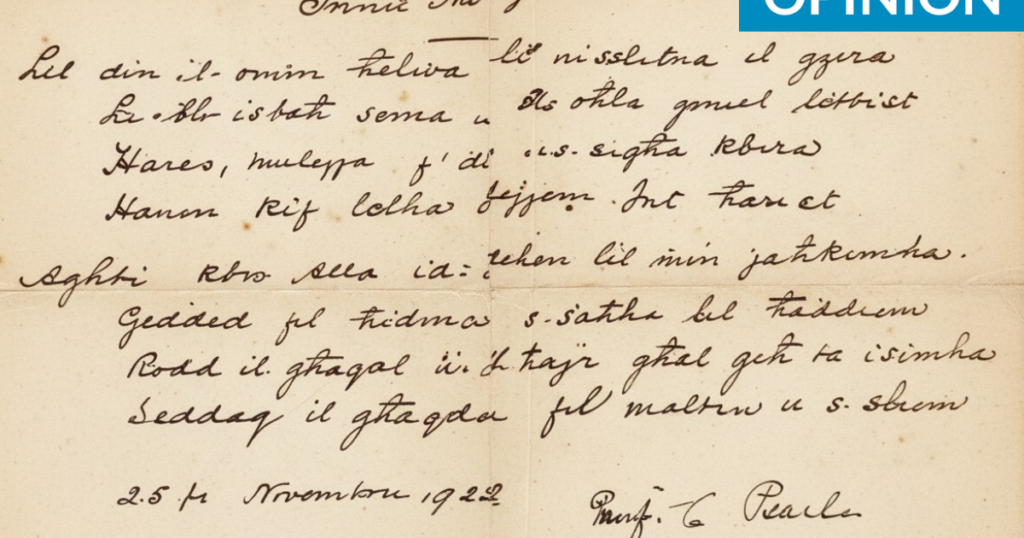
Michael Spagnol’s ‘On the national anthem’s words’ (Times of Malta, January 3), leads me to share some reflections elucidated from other academic viewpoints.
From the outset, I am of the opinion that after more than a century of public recognition – maybe due more to apathy than acceptance – the Maltese national anthem, albeit a colonial product, may endure as expeditiously legislated by our political representatives. However, I still argue that two politically incorrect instances in the lyrics of this hymn should have been amended.
First of all, when a poem is raised to national hymn status, it ceases to be just a piece of literature. It becomes an assertive manifestation and should thus pertain to socio-political discourse.
Spagnol declares that the 1922 lyrics denote “a political and symbolic statement” leading to the “identity and the making of a nation”. Alas, the verses do not concur with politicians’ aspirations of the time but only goad the faithful to perpetuate their colonial mindset.
Contrasting political hymns
The strongest defender of these lyrics, Oliver Friggieri, paradoxically provides us with evidence of contrasting political views of the 1920s. Writing about the hymns of the two major political parties – the same ones that recently legislated in favour of the national anthem – in It-Torċa of January 14, 2018, he states that the Nationalist and the Labour parties’ hymns contained “similar expressions of confrontation” in their membership militancy.
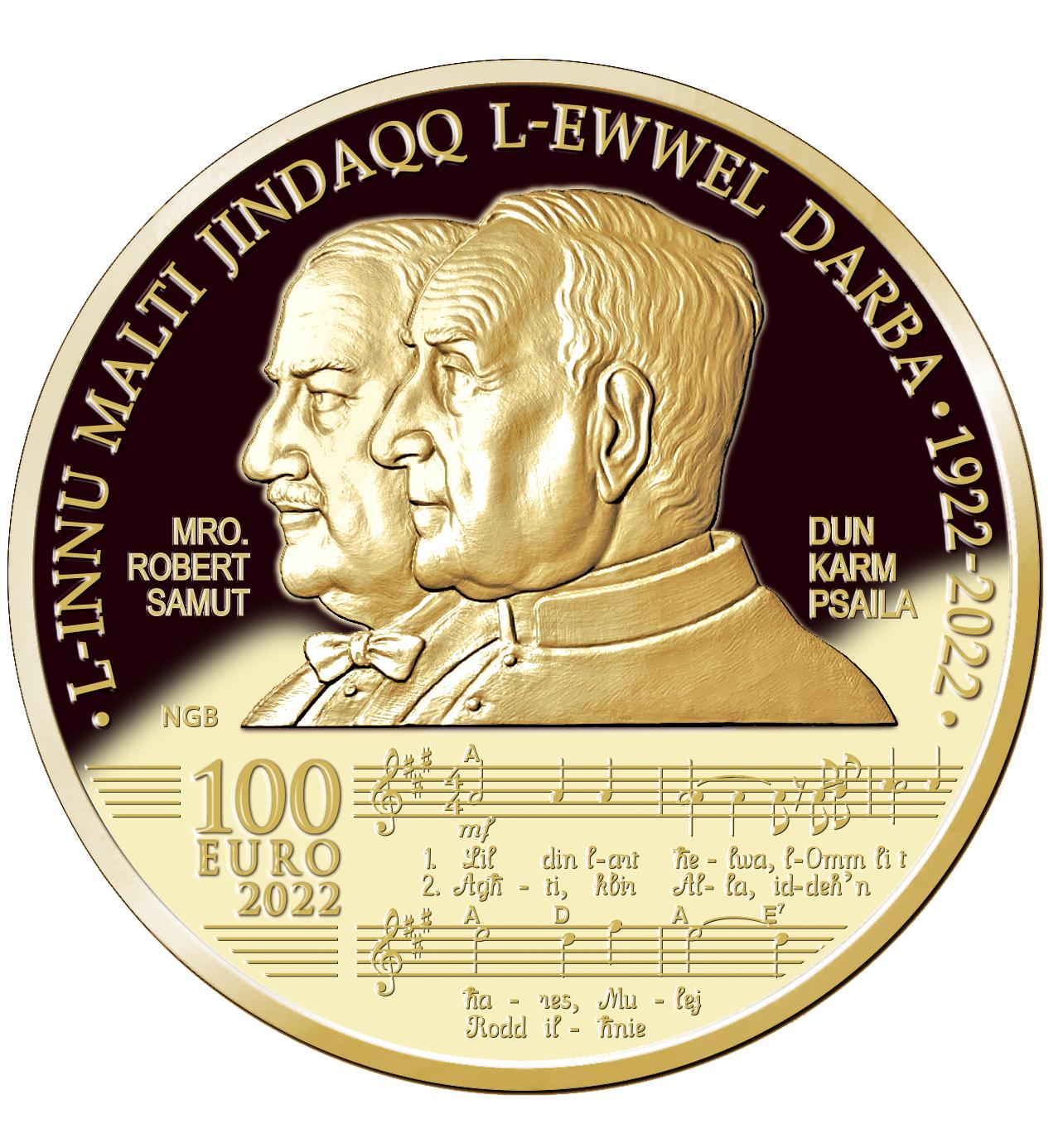 The Central Bank commemorative medal marking 100 years of the Innu Malti, depicting the composer and lyricist.
Friggieri maintains that the Nationalist hymn, penned by Carmelo Mifsud Bonnici, calls for the Maltese to struggle (inċarċru demmna) for liberty and constitutional rights. The Labour hymn, written by Manwel Pace and inspired by the Socialist International chant, calls for workers’ freedom. Friggieri concludes that both hymns seek victory on the road to making Malta “a sovereign state”.
These themes are totally absent in Dun Karm’s persuasions. As a priest and administrator at the National Library of Malta (1921-1936), his Innu Malti commends a religious and colonial vision for Maltese society, guided by a meek acquiescence, void of any political self-rule ambition. His main concern seems to be cautionary: bowing to colonial rule, he resorted to mysticism by praying for the foreigner (dehen lil min jaħkimha) and for the landlords’ mercy (ħniena lis-sid) towards their destitute employees.
It is bewildering how the same Maltese experts who normally and correctly advise that the language is morphed by the people are now resuscitating archaic vocabulary to justify the interpretation of the verb ħakem to mean ‘to govern’, evoking the medieval sense of feudal dominion. This verb survives today in its negative idiomatic use as in the expression naħkmek taħt idejja (I will control you without your consent).
In the 1920s, when a degree of local self-representation was attained, the Maltese language adopted a proper democratic verb, iggverna, loaned from both Italian and English. Dun Karm’s love for Semitic terminology, which I admit rhymes better in Maltese, cannot override national probity.
It is a pity that parliament felt it could legislate on this patriotic eulogy without wider research. It is also regrettable that, after politicians in 1964 and 1974 seemed to have understated the importance of identification, today’s counterparts felt that consulting literary critique could suffice.
Blocking Italianate national hymns for a colonial one
History also confirms the coloniality of the national anthem. Published research by the late Albert Ganado (The Sunday Times of Malta, February 24, 2019) elucidates at least two efforts from the Italianate elite to produce a national anthem. Both were thwarted by the British authorities.
In 1885, Maltese anti-reformist government councillor and later judge Zacaria Roncali wrote a hymn in Italian urging “lo straniero” to “va fuori” (go out) in the refrain.
In 1901, a second attempt occurred when a Maltese patriot in Italy sent the music score of a new proposed national anthem to be publicly performed at the Royal Opera House in January. Secretary to the Government Gerald Strickland, conniving with a Maltese magistrate, issued a jure imperii order to close the theatre on the day it was to be executed.
This proposed hymn was reproduced in La Gazzetta di Malta (January 8, 1902); however, the copy disappeared without trace from the Bibliotheca.
After blocking these two Italianate efforts – both during the Language Question – it must have been reactionally obvious for pro-British reformists to produce one from their own stable.
Maltese physician and music maestro Robert Samut, who studied in the UK and, in 1897, joined the King’s Own Malta Regiment, composed the music of the present Innu Malti, certainly inspired by the God Save, both as a prayer and in its solemnity. In the early 1920s, he was asked by another British devotee, Albert Laferla, his brother-in-law and then director of elementary schools, to compose a hymn for schoolchildren, after which he invited Dun Karm to provide the lyrics.
How about the music?
In this public debate, on which Malta’s parliament now seems to have poured water, the music score of the national anthem is hardly ever mentioned. Most Maltese – like myself – seem to have resigned, perhaps also out of patriotic duty, to having a prayer sombrely phrased in Romantic verse swathed in imperial harmony.
However, its popularity, or lack of, is quick to detect. Why is it that most Maltese adults do not sing it as often? Why are schoolchildren not regularly trained into learning to sing it by heart from a young age? Why are our football players and athletes shyly moving their lips before a match or event as if to feign its singing? Could we have legislated a special day on December 27 to honour a ghost national anthem?
Most probably, the answer to all these uncomfortable questions does not only come from apathy towards our national symbols in general – maybe with the exception of the ubiquitous eight-pointed Cross of Malta – but also because Samut’s music is too solemn, perhaps more compliant with a church hymn rather than a rallying call for nationhood.
L-Innu Malti is certainly not a heroic march such as the Marseillaise of France, Mameli’s in Italy, the Spanish La Marcha Real or the US Star-Spangled Banner, which feature among the top 10 popular national anthems. All these reflect the combats their forefathers struggled through in order to obtain freedom and sovereignty.
Amend the noxious phrases
In our hymn, both Samut and Dun Karm ignored the then recent Valletta protestations followed by the Sette Giugno 1919 victims of colonialism and the frustrating series of constitutional snubs to give Malta some form of self-government up to 1921. They also chose to forget Vassalli’s and Dimech’s visions of a future for a nation that was unfortunately herded into a loyal community of servile citizens, ready to appease in order to obtain portions of self-determination.
In the 1920s, the Maltese islands were not only caught between two world wars but the population was experiencing heavy unemployment and poverty caused by lack of colonial investment, forcing the native population to resort to emigration. Lack of proper instruction rendered the majority illiterate, unable to be self-reliant.
Our national anthem remains a pious effort to solicit God’s intervention to protect us from “political antagonism”. As Spagnol rightly concludes, l-Innu Malti is “(N)ot an anthem that celebrates victory, power or liberation. It is… a prayer”. And, at praying time, humans produce oxytocin, a hormone released by the pituitary gland that, hopefully, may help us have faith and feel secure.
The correspondent signs off his contribution by stating that “(T)he anthem does not tell us what Malta is, nor who the Maltese are… it asks again what we must do to be worthy of the name given to us by this sweet land”. The unambiguous answer should be: amend the noxious phrases.
Charles Xuereb’s second updated edition of Decolonising the Maltese Mind, in Search of Identity (Midsea Books) will be published soon.