
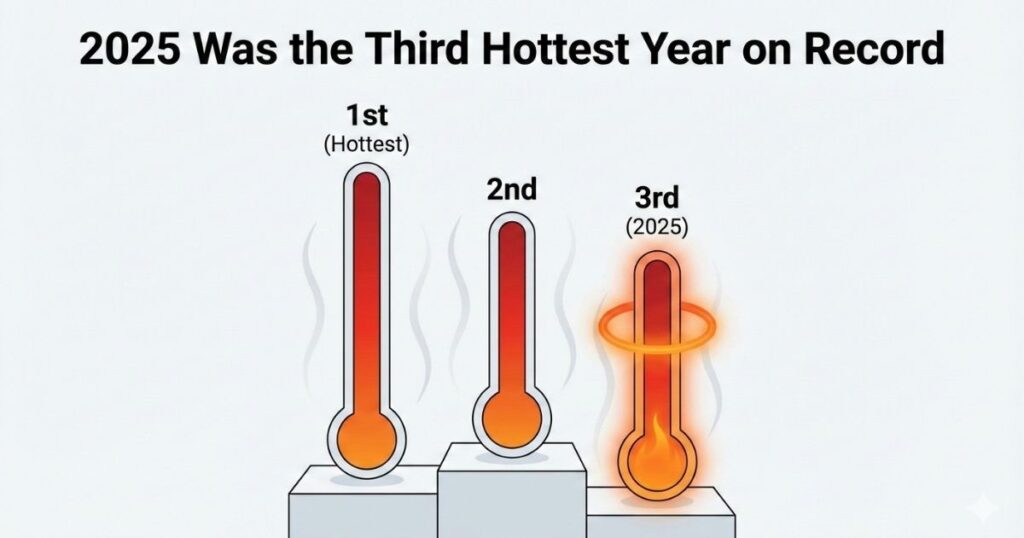
Kenya, January 14, 2026 – The year 2025 has been confirmed as the third hottest year on record worldwide, according to data from leading climate scientists and monitoring agencies, underscoring the persistence of the planet’s long term warming trend and the growing challenge of climate change for nations like Kenya and beyond.
The European Centre for Medium Range Weather Forecasts (ECMWF), which operates the Copernicus Climate Change Service (C3S), reported that global average surface temperatures in 2025 were around 1.47 °C above preindustrial levels (the baseline period of 1850–1900), only marginally (0.01 °C) below the levels recorded in 2023 and 0.13 °C below the 2024 record.
Copernicus data show that the 2023–2025 period averaged more than 1.5 °C above preindustrial temperatures, marking the first time a three year span has surpassed this critical climate benchmark established in the 2015 Paris Agreement. Scientists warn this is an unmistakable signal that global warming is accelerating faster than many projections anticipated.
ECMWF Director General Florian Pappenberger said the findings highlight how urgent climate action must be: “Every year and every degree counts,” adding that sound science is critical to guide adaptation and mitigation strategies as temperatures climb. Heat highs in 2025 were not limited to any one region. While average land temperatures were slightly lower than the historic 2024 peak, the Antarctic saw its warmest year on record, and the Arctic experienced its second warmest.
Many other regions, including parts of the Pacific and Atlantic, observed annual temperatures far above long term averages. The year also brought exceptional heat stress, with nearly half of the global land surface seeing more days of intense heat (“feels like” temperatures of 32 °C or higher), a key driver of heat related health risks and mortality.