
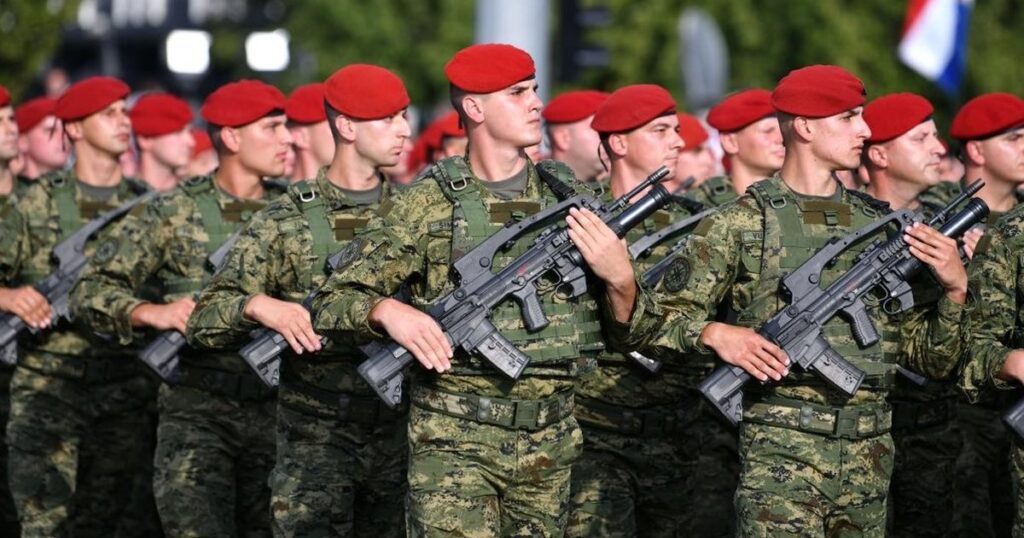
After a hiatus of almost two decades, young Croatians are once again being called up for military service. Why did Croatia reverse its decision to abolish military service? Will other Balkan countries follow suit?
The new year brings with it an old challenge in a new form for young people in Croatia. In the first days of 2026, around 1,200 of them received letters informing them that they had been called up for two months of military service.
They are the first generation to face compulsory military service since it was abolished in 2008, a year before Croatia joined NATO.
At the time, the idea was to professionalize the armed forces and abandon mandatory national service.
Now, with only Hungary separating Croatia from Ukraine, the prospect of armed conflict seems all too imminent.
A missing drone, possibly Ukrainian but never officially identified, crashed in the Croatian capital, Zagreb, in 2022. It didn’t cause much damage, but it definitely got people thinking.
Widespread support for the return of compulsory military service
The Croatian government realized that it could only rely on fewer than 15,000 active military personnel. Ahead of the 2024 parliamentary elections, it proposed reinstating compulsory military service for male school dropouts.
Defence Minister Ivan Anuši? said this would help young people change their “bad habits” and prepare them for “any major threat”.
Polls showed broad support for the idea, with seven out of ten Croats in favor. Voters re-elected the HDZ party, which has now implemented the policy. The necessary legislation was quickly passed in Parliament last October, with 84 MPs in favor and only 11 against.
Few protests
The Ministry of Defense wasted no time in contacting the first group of recruits, with little or no protest.
“I see no obstacle to compulsory military service,” says Gordan Akrap, acting rector of the Franjo Tudjman University of Defence and Security of Croatia.
“There will be more people who want to be part of this than can register, because at the moment the number is limited,” he adds.
“Some far-left populist groups say we should invest in gardens and things like that. But the truth is that someone has to protect the gardens, our European way of life and our democracy, and ultimately, that can be done by the military.”
A broader trend across the region
The reintroduction of compulsory military service in Croatia is part of a broader trend in countries that were part of Yugoslavia.
Some of them have been considering the return of a form of compulsory service as a return to the days of Josip Broz Tito’s socialist regime.
At the time, young men were required to serve a year in the People’s Army, which created a sizable fighting force. Just before the country began to disintegrate in the 1990s, two-thirds of the ground forces were conscripts, with another million trained reservists available.
After the Yugoslav wars
The independent countries that emerged from the Yugoslav wars of the 1990s gradually abolished compulsory military service.
Slovenia was the first to abolish compulsory military service in 2003; the last Serbian conscripts completed their service in 2010.
With the prospect — or, in the case of Slovenia and Croatia, the achievement — of EU membership, there seemed little need for the kind of military force that required the country’s youth to undergo months of training.
But even before Russia invaded Ukraine, the situation was beginning to change. Slovenia is discussing reinstating compulsory military service In 2020, the parties that formed Slovenia’s new right-wing nationalist government included the reinstatement of military service in their coalition agreement. Its prime minister, Janez Jansa, rose to fame as defense minister during Slovenia’s ten-day war of independence in 1991.
He declared that the country’s armed forces, with only 7,000 troops, could no longer defend the country from an attack and complained that young people did not know how to use weapons.
The current center-left government of Robert Golob has not embraced this idea, but parliamentary elections are scheduled for March and Jansa’s SDS party is leading in opinion polls.
Will Serbia follow suit?
In Serbia, the government has been discussing the possibility of introducing compulsory military service for several years. Several deadlines have passed without anyone being drafted, but that could change this year, as Defense Minister Bratislav Gasic says legislation will soon be presented to Parliament.
As countries in the region increase their military spending and work to increase personnel, the age-old question arises as to whether the rest of Europe should worry about the Balkans.
Toby Vogel of the think tank Council for Democratization Policy believes the possibility of a real conflict remains small.
“The military aspect of all this is mainly a matter of preparation, more than concrete planning, and certainly not offensive planning,” he told DW. “Serbia will not attack Croatia, and Croatia will not invade Serbia.”
“In a situation where the overall environment is unstable and unpredictable, I think governments are probably acting cautiously by taking preventive measures and putting in place the necessary elements to pursue a more strategic approach to international affairs,” he said. “But it is a throwback to the past.”/ DW