
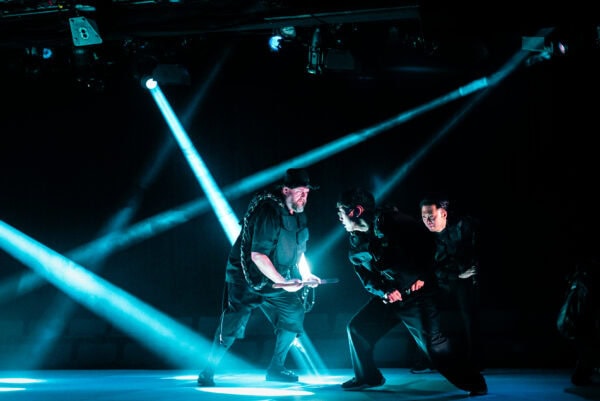
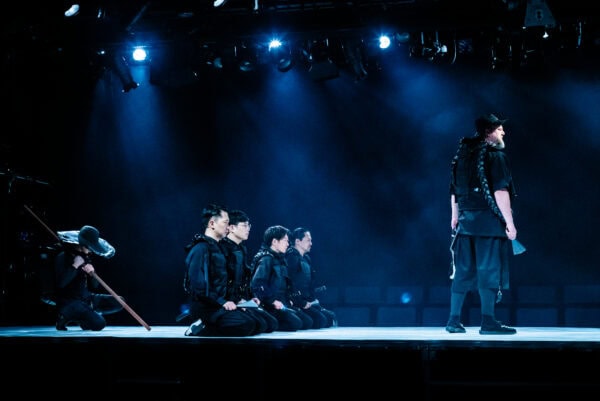
Kanjincho (Photo: Ayumi Sakamoto)
It’s that time of year again. The January Theater festivals kick off and with it bring unique works from around the world.
As part of Under the Radar and presented by fJapan Society, Kanjincho by Japanese theater company Kinoshita Kabuki is modern take on a kabuki classic involving injustice, borders, mercy, and sacrifice.
In a moment where much of the world is hellbent on stopping people from crossing borders, this show knows it is speaking to certain xenophobic attitudes in Japan and around the world. It is not always subtle. At some point, the company breaks into the Disney song, “It’s a Small World,” but the political import remains.
This production, directed and staged by Kunio Sugihara, combines the kabuki components of drama, music, and dance with humor and in a style that mixes traditional kabuki delivery with something more anarchic. That playful slyness gives the show a spark when the narrative itself might take some time to get used to. On the whole, it is more fascinating than completely enveloping but well worth a look.
General Yoshitsune (Noemi Takayama) has defeated his clan’s enemy but has been unfairly targeted by his jealous half-brother Yoritomo. Yoritomo has ordered Yoshitsune’s capture. Yoshitsune must escape his brother’s jurisdiction in disguise as his brother has already increased patrols of the border crossings.
Yoshitsune and his supporters are pretending to be mountain priests. But word has reached the border guards that that is the disguise he is in. Leader of the border patrol, Togashi (Ryotaro Sakaguchi) and his men (Yasuhiro Okano, Kazunori Kameshima, Hiroshi Shigeoka, Yuya Ogaki) are ready to pounce.
When Yoshitsune and his servant Benkei (Lee V) approach the border, Yoshitsune is dressed as a porter following behind Benkei and the others dressed as priests. Togashi tests Benkei to prove himself as a real priest and not one in disguise. He demands Benkei read from his kanjincho (which is a subscription list of those who have donated to their temple fundraising efforts). Essentially, he has to invent a big, long speech on the fly with a blank scroll in his hand.
This is a battle of wits and honor between Benkei, Togashi, and Yoshitune, interspersed with Red Bull, techno, and modern dress.
Adapted by the founder of the company, Yuichi Kinoshita, the piece is written in a contemporary vernacular. Though as a newbie to kabuki, it’s hard to say exactly where the company’s lines around modernization are.
Traditionally men perform women’s roles in kabuki (well, first it was a form for women to perform and then women were outlawed from performing it so all-male troupes became the norm). Here a nonbinary performer is playing the role of Yoshitune. A white American actor (who has long lived in Japan) and is fluent in Japanese is Benkei.
The casting of an American in this Japanese production certainly helps brings the idea of migration to the fore.
The company employs a more presentational style of acting, but it is not super jarring when they leap into song. For instance, there is a dance challenge moment that feels very Sharks and Jets. And bursting into a pop-rap song when two characters share a powerful moment seems natural in this context. There are also times where the cast, like a chorus, verbally make rhythmic sounds, close to percussive instruments or temple drums, and this ratchets up the tension.
It helped to read the synopsis of the story in advance to really understand the character dynamics and the meaning behind the gestures. Benkei takes liberties to protect Yoshitsune (he beats him to prove to the border guards that this porter is not the noble Yoshitsune) and that confrontation/conversation after is one of the more emotional moments in the play. But understanding why might take a beat.
This moment is clearly about Benkei feeling contrite for violating the hierarchy of feudal times (and possibly committing a crime by striking his master?), even if for a good cause. But Yoshitsune outstretches his hand to Benkei while a love song is performed (“I want to hold your hand, hold it as tight as I can”). The soldiers sing of distance and dedication to one another as Yoshitsune reaches for the bowing Benkei.
Rather than a love scene, it plays like one of respect and devotion because of what Benkei has done for Yoshitsune and the risks he has taken to protect Yoshitsune. Arguably there could be a queer reading here but it truly felt more rooted in honor and adoration than something romantic.
Did I love the highly overwrought red laser like lighting when Benkei beats Yoshitsune. No. But I did enjoy the ensemble of actors. Four actors double roles as the border guards and the fake mountain priests. They quickly shift between prayer beads in hand versus swords to make it clear which side they are on in the moment. But they also seemed to have the most personality as they are either eagerly waiting to capture Yoshitsune or panicked that they will be found out as fake priests.
They humanize this space where the feudal rules of engagement might be more opaque to us. But the emotions of fear, boredom, exhaustion, and impatience remain legible and familiar. And they are a lot of fun.