
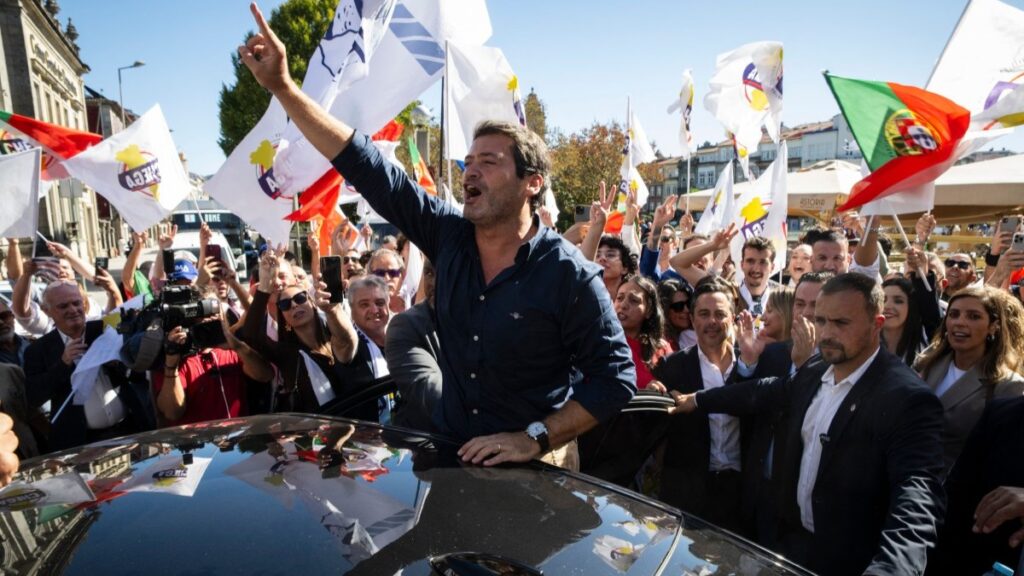
Portugal’s presidential election campaign is entering its decisive phase with a development that, until a few years ago, would have seemed unthinkable: sovereigntist Chega is leading the opinion polls.
The party led by André Ventura has consolidated its position as the strongest force in the first round, reflecting a profound shift in the Portuguese electorate and the gradual erosion of the political balance that has defined the country since the Carnation Revolution.
Portugal will hold presidential elections this Sunday to choose the successor to Marcelo Rebelo de Sousa, who is leaving the Belém Palace after ten years in office. According to the latest poll by the Centre for Opinion Studies and Surveys (CESOP) of the Portuguese Catholic University, Ventura would secure around 24% of the vote in the first round, followed closely by former socialist minister and party leader António José Seguro with 23%.
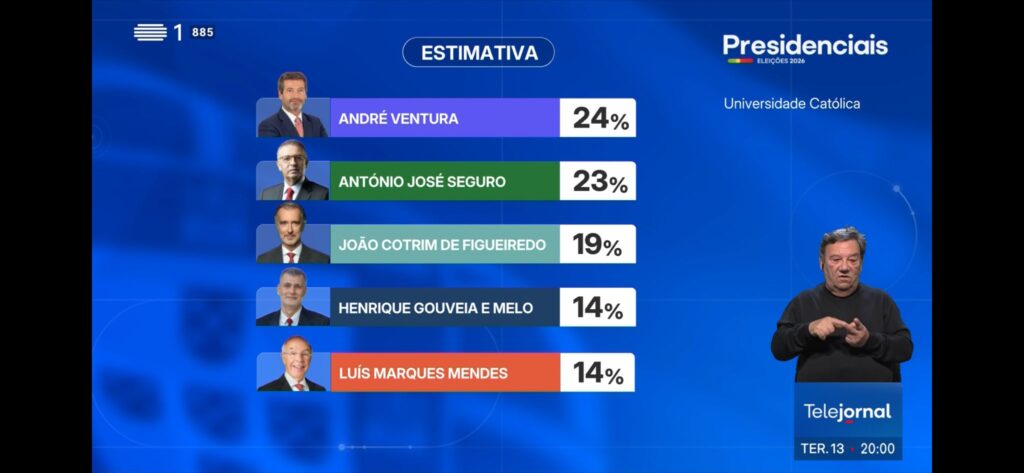 A chart showing the results of a polling by the Centre for Opinion Studies and Surveys (CESOP) Source: @PartidoCHEGA on X, January 13, 2026
Chega’s rise represents a break with one of Portugal’s longstanding political peculiarities in the European context. For decades, the country remained largely untouched by the surge of populist or identity-based movements that gained ground in other EU member states. After 1974, Portugal’s political system was structured around a relatively stable alternation between the Socialist Party (PS) and the Social Democratic Party (PSD), underpinned by an implicit consensus on the boundaries of political debate.
That consensus is now beginning to fracture. Chega’s emergence as the leading force in voting intentions reflects a loss of confidence in the traditional parties and a growing demand for clear answers on issues that for years were sidelined or addressed only superficially.
Immigration has become one of the central issues of the campaign. Portugal, historically a country of emigrants, has in recent years experienced a sustained increase in migration flows that is beginning to affect the labour market, housing and public services. Chega has placed this issue at the heart of the political debate with a firm, though more restrained, message than in previous phases, enabling it to broaden its electoral base.
The party has succeeded in attracting voters from both the traditional left and right: precarious workers, urban middle classes hit by rising housing costs, and younger voters who perceive a growing disconnect between political elites and everyday realities. This cross-cutting support largely explains the party’s steady growth.
Chega’s political normalization has been reinforced by its role in parliament. Recently, the Portuguese legislature approved a reform introducing migration restrictions promoted by the party and backed by the government of Prime Minister Luís Montenegro—an outcome that would have been unthinkable just one legislative term ago.
A fragmented race towards a second round
The CESOP poll places MEP João Cotrim Figueiredo, backed by the Liberal Initiative, in third position with 19%. He is followed by retired admiral Henrique Gouveia e Melo and former minister Luís Marques Mendes, both polling at 14%.
This fragmentation of the vote makes a second round on February 8th highly likely, with Ventura and Seguro emerging as the frontrunners. While several analysts argue that the Chega leader would face greater difficulties in a runoff, his first-round lead has already reshaped campaign strategies and intensified appeals for so-called “tactical voting.”
Chega’s advance does not occur in a vacuum. The party is part of the Patriots for Europe group in the European Parliament, aligning itself with other Eurosceptic forces that challenge Brussels’ centralizing drift. In this sense, Portugal is no longer an exception in southern Europe, but part of a broader trend of political realignment within the Union.
Within EU circles, there is growing unease at the prospect that Portugal’s next president could adopt a more critical stance toward certain European policies, particularly on migration and national sovereignty.
Even if André Ventura ultimately fails to prevail in a second round, the outcome of these presidential elections will mark a turning point. Chega will have consolidated its cultural dominance in key debates and forced both PS and PSD to reposition themselves. A victory, by contrast, would open a period of institutional tension with the government and the Constitutional Court, while also redefining Portugal’s role within the European framework.