
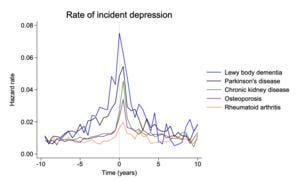
Depression occurs more often and earlier in seniors who go on to develop Parkinson’s disease or Lewy body dementia. Findings were especially striking for Lewy body dementia, where rates of depression were even higher than in Parkinson’s disease, both before and after diagnosis
https://www.eurekalert.org/news-releases/1112417
4 Comments
New research suggests that depression in later life may be more than an emotional response to illness—it could be an early sign of serious brain disease. A new nationwide study published in General Psychiatry provides the most detailed longitudinal evidence to date, demonstrating that depression frequently precedes the diagnosis of PD and LBD and remains elevated for several years thereafter.
Drawing on comprehensive Danish national health registers, the researchers conducted a retrospective case–control study including 17,711 individuals diagnosed with PD or LBD between 2007 and 2019. Researchers compared these patients with people of similar age and sex who were diagnosed with other long-term conditions, including rheumatoid arthritis, chronic kidney disease, and osteoporosis.
The results showed a clear pattern: depression occurred more often and earlier in people who went on to develop Parkinson’s disease or Lewy body dementia than in those with other chronic illnesses. In the years leading up to diagnosis, the risk of depression rose steadily, peaking in the three years before diagnosis. Even after diagnosis, patients with Parkinson’s disease or Lewy body dementia continued to experience higher rates of depression than the comparison groups.
Importantly, this pattern could not be fully explained by the emotional burden of living with a chronic illness. Other long-term diseases that also involve disability did not show the same strong increase in depression risk. This suggests that depression may be linked to early neurodegenerative changes in the brain, rather than being only a psychological reaction to declining health.
The findings were especially striking for Lewy body dementia, where rates of depression were even higher than in Parkinson’s disease, both before and after diagnosis. Researchers note that differences in disease progression and brain chemistry may help explain this trend.
https://gpsych.bmj.com/content/38/6/e102405
This really highlights how depression isn’t just a reaction to diagnosis, but can be an early warning sign of underlying neurodegenerative changes. Especially striking with Lewy body dementia it suggests mental health symptoms deserve way more attention in early screening
Lewey Body is what took Robin Williams from us.
Curious if anybody here read The Parkinson’s Plan: A New Path to Prevention and Treatment by Michael Okun and Ray Dorsey.
Within it is a groundbreaking discovery about proteins found systematically- Not just the brain.