
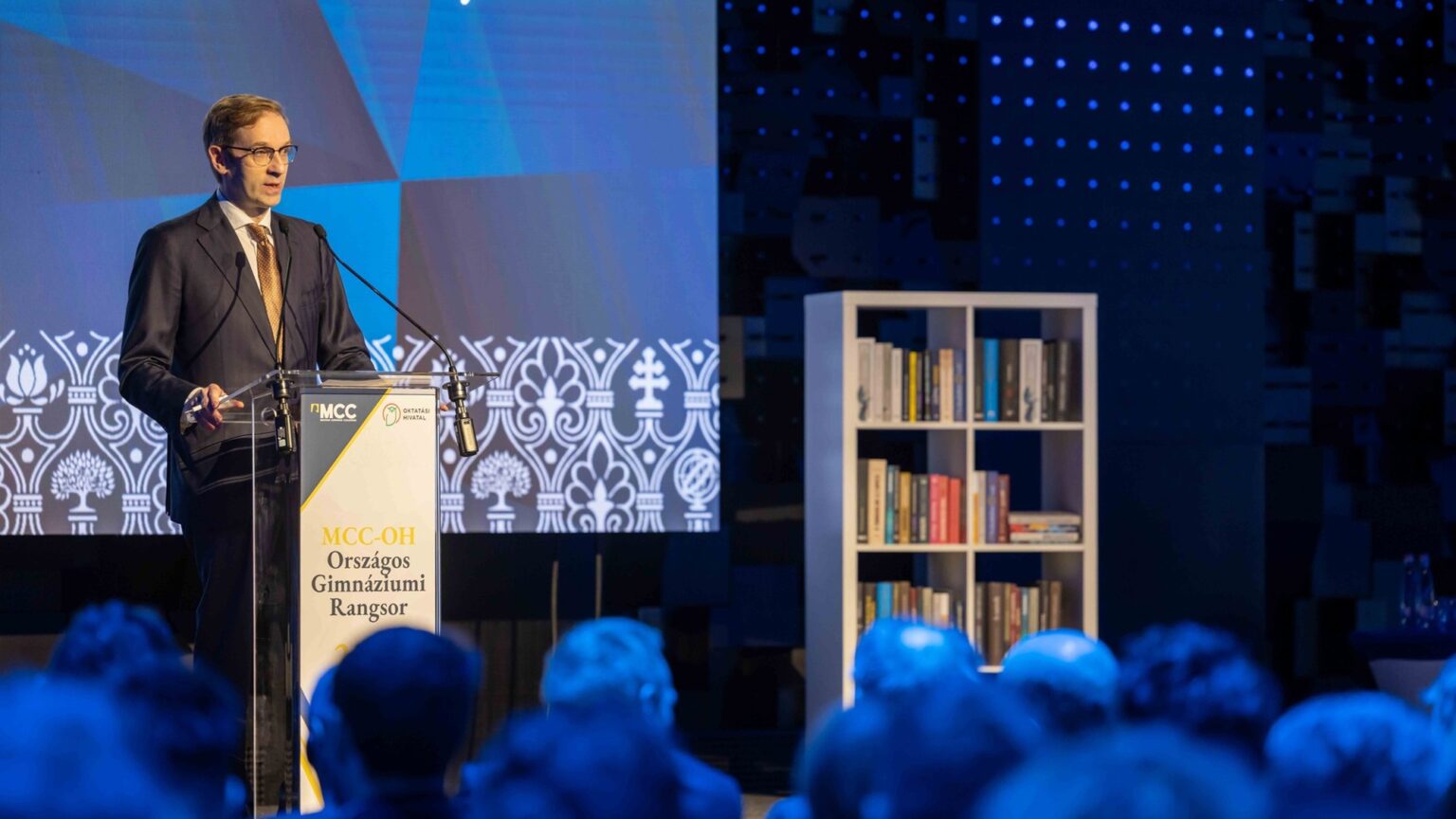
The annual list of the 100 best secondary schools in Hungary has been announced, originally published by the popular Hungarian political magazine and news site Mandiner in December. The list itself has been compiled in collaboration by the Mathias Corvinus Collegium (MCC) and the Education Authority (OH), a body within the Ministry of the Interior of Hungary.
The highest-ranked schools in each county, as well as the ten highest-ranked schools nationwide, were honoured at an illustrious event at the Castle Garden Bazaar in Budapest, Hungary on Thursday, 15 January.
Director General of MCC Dr Zoltán Szalai gave the first speech of the day. He asked the rhetorical question: ‘What is the point of this ranking?’ To answer his own inquiry, he first cited a quote by the late American planetary scientist Carl Sagan, who once said: ‘Science is more than a body of knowledge. It is a way of thinking.’ On that note, he stressed that while the schools were ranked based on objective data, he believes that plain data is like ‘a sheet music without actual music,’ thus emphasizing the in part objective nature of ranking public education institutions. The Director revealed that secondary schools in Hungary are judged from two aspects: ‘healthy performance orientation’—which he believes is very important in a society with high social mobility—and ‘community building’.
Director Szalai then spoke of the 20-stop educational tour MCC took along with 11 secondary school teachers from Hungary. He shared that while they were committed to finding ways to improve the Hungarian education system based on their experiences collected there, they were also actively seeking aspects in which the Hungarian system is better than the American. For example, the Director pointed out that Hungarian high school students tend to read more fine fiction literature than their American counterparts.
Speaking of the mission of his institution, MCC, he shared that he believes it is a great and rewarding task to make a high-performing college student, then a professional from a talented high school student. However, he stressed, it is just as great and rewarding of a task to guide an underprivileged student to a high school diploma. At the end of his speech, Director Szalai shared another quote, this time from Kuno von Klebelsberg, a highly influential Minister of Religion and Education of Hungary in the early 20th century, who once said: ‘It is not the sword, but culture that can make our Hungarian homeland great again.’
State Secretary Responsible for Public Education Zoltán Maruzsa spoke next. He told the packed house that creating the list was ‘a great responsibility’, as it can easily become a ‘self-fulfilling prophecy’ for the schools: the ones ranked high will get good publicity and thus increased levels of application; while the ones ranked low might experience the opposite impact. However, he pointed out that ‘the era of no rankings has long passed’ in an age when so much data is easily available. He then shared that this ranking is most useful to high-performing elementary students and their parents, in choosing which secondary school to continue their studies.
‘It is not the sword, but culture that can make our Hungarian homeland great again’ — Kuno von Klebelsberg
Mr Maruzsa added that we need to sort out the relevant data of all that is available, which still requires some subjective judgment. He also revealed that a new ‘health index’ has been introduced in the ranking of schools, which measures the physical well-being of the students. Then, he ended the speech by thanking the principals and teachers present, and telling them that ‘your success is the government’s success’.
Sándor Brassói of OH, the other institution behind the ranking besides MCC, followed. He began by describing secondary school as the stage in life when a young person’s intellectual curiosity and ambition first truly ignite. The speaker also explained that student performance is influenced by several interrelated factors, including individual expectations and internal motivation, family background, and the role of teachers. Mr Brassói stressed that educators must remain open to innovative teaching methods and commit themselves to continuous professional development in order to effectively support their students. Mr Brassói then went on to stress that this ranking of high schools is ‘not a closed process,’ and it only opens new opportunities for schools.
Zsolt Wittmann of MCC announced that applications are now open for secondary school teachers for another study trip in the United States. As for the annual rankings, he stated that ‘the more objective, measurable data the better’. He then likened the process of ranking high schools to debate by sports fans on whether Michael Jordan or LeBron James is the best basketball player of all time; or whether Cristiano Ronaldo or Lionel Messi is the best football player of all time: objective data is available in those debates as well, but there is still room for subjective opinions.
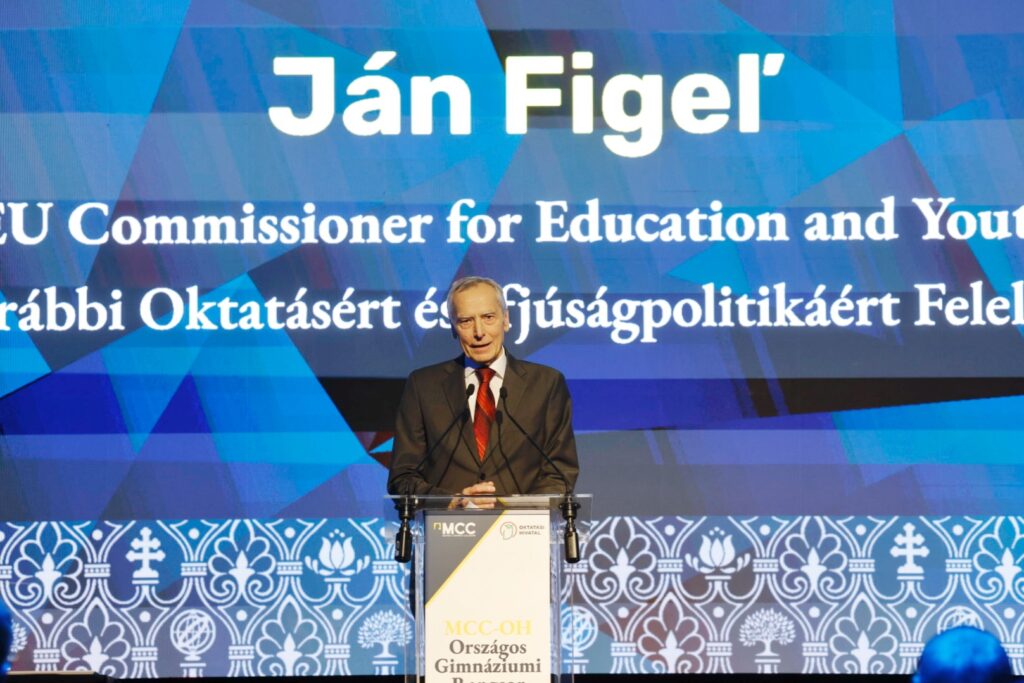 Former European Commissioner for Innovation, Research, Culture, Education and Youth Ján Figeľ PHOTO: Mathias Corvinus Collegium – MCC/Facebook
Ján Figeľ, Former European Commissioner for Innovation, Research, Culture, Education and Youth of Slovakia, closed the line-up of speakers. He told the audience that we should all live in a community, not just simply exist on our own, since ‘it is community that makes Europe Europe.’ In further words of advice, he encouraged all to be creative, as that is what makes us human, along with the ability to reason, conscience, and the capacity to love.
He also called on us to all to not just preserve, but improve our legacy, and ‘make the 21st century more humane than the 20th century’. On that note, he recalled the time when, growing up in socialist Czechoslovakia, he was offered a scholarship to study in the Soviet Union as a gifted high school student. However, he turned it down due to his ill feelings towards the Soviet oppression. This has caused him some trouble in his education. He pointed out, however, that he still had a better fate than his uncle, who was ‘killed by Stalin’s secret police’. He used this personal story to remind all that ‘freedom is not just given’ to us.
On the more topical issues, Mr Figeľ shared that he welcomes digitalization and modernization in public education, but he still thinks teacher quality is more important. He then described what he called ‘the three Ts’ as the pillars of modern education: talent, technology, and tolerance. The speaker also stressed that he believes in the era of easily available and plentiful data, wisdom is still more important than information and knowedge.
After the slate of impressive speakers concluded, the best secondary schools in Hungary were recognized.
Three schools in Budapest occupied the first three spots on the list. The Fazekas Mihály Primary and Secondary Grammar School was ranked #1, followed by ELTE Radnóti Miklós Primary and Secondary Grammar School in second and the Békásmegyeri Veres Péter Grammar School in third place. In the newly introduced category of Best Performing School in Sports, the Árpád Csanádi Sports School, Elementary School and Secondary School, also located in Budapest, was awarded.
There are around 800 secondary schools operating in Hungary, 400 of which were included in the data-based annual ranking by the MCC and the OH.
Read more: