
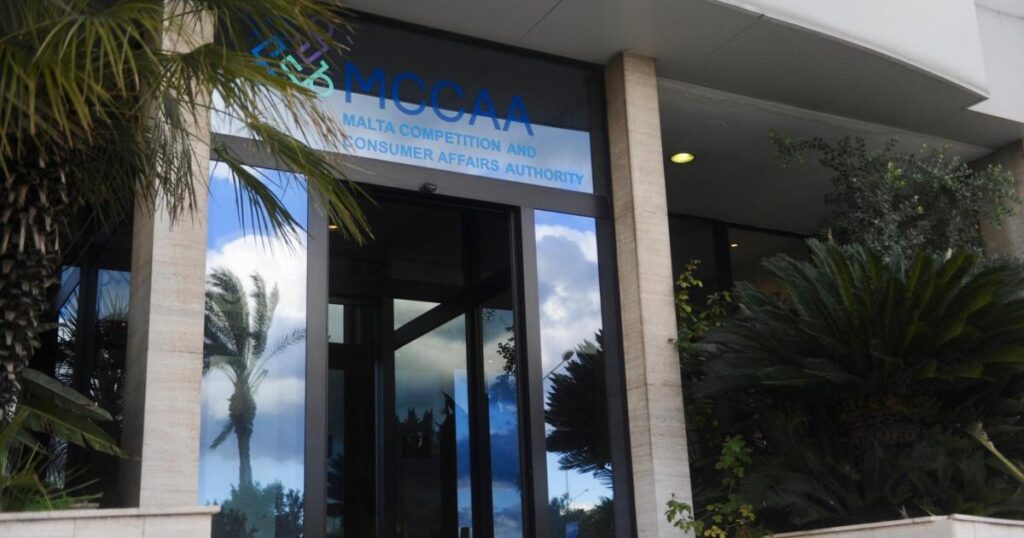
Malta’s merger laws are set for an overhaul under a new proposal released for public consultation on Thursday.
If implemented, the plan will change the way Malta’s competition regulator, the Malta Competition and Consumer Affairs Authority (MCCAA) investigates and approves mergers between companies.
The proposals mark the first major changes to Malta’s merger laws in almost two decades.
Threshold to rise to €4.5m
The new rules aim to raise the threshold under which the regulator needs to be informed of possible market concentrations, or the dominance of a particular sector by a single firm.
Under current rules, introduced in 2007, MCCAA must be notified of a potential market concentration if the companies merging have a combined turnover of over €2.3 million, with each of them registering a turnover of at least 10% of that figure locally.
This threshold would rise to €4.5 million, with a local turnover of at least €800,000 if the proposed rules are approved.
Raising the threshold will ensure that the regulator can focus on potentially problematic mergers, rather than those “unlikely to have any significant impact on the local market,” the proposal says. The higher threshold will also reduce the burden on smaller firms, it argues.
However, MCCAA will be bestowed with new “call-in” powers, allowing it to request information on planned mergers that fall below this threshold but may nonetheless distort competition in a sector.
According to the proposal, this call-in power will allow the regulator to investigate “killer acquisitions,” namely cases in which a firm acquires an up-and-coming company and kills its planned developments to avoid rising above the threshold.
Detailed investigation fees to rise to €35,000 cap
The proposal also calls for an overhaul of the fees paid to notify the regulator of a merger. Currently, firms pay just €163 for a merger notification.
Instead, firms will now have to pay €1,000 for the simplest form of notification and €6,000 for a Phase I notification, sparking the regulator to carry out a preliminary investigation into whether the merger could distort the market.
If the merger proceeds to a more detailed Phase II investigation, fees will rise to a figure between €20,000 and €35,000.
Higher fines
The proposal also introduces a raft of other procedural changes.
Fines for providing false or misleading information would rise to a maximum of €50,000, or 1% of the firm’s global turnover, while a firm can be fined up to 10% of its total turnover if it fails to notify the regulator of a concentration in the first place.
The competition regulator will also now have the ability to consult with other regulators as part of its investigation to determine whether a merger will cause distortion to a regulated sector.
Meanwhile, an investigation’s timeframe will be paused for up to 10 working days during the height of August and the Christmas period, to account for the unavailability of stakeholders during these periods.
The public consultation is set to run until January 30.
‘Welcome amendments’
Speaking to Times of Malta, Clement Mifsud-Bonnici, a lawyer and expert in competition law, described the proposed amendments as “welcome and long-awaited,” with the law having remained virtually untouched since 2007.
“The proposals aim to modernise and streamline Malta’s merger control regime in various respects,” Mifsud-Bonnici added, pointing to the increased thresholds and new call-in powers as the key changes.
Malta’s merger laws have come under the spotlight in recent years, particularly in the supermarket sector.
In 2024, the competition watchdog blocked Lidl’s planned purchase of a Scotts supermarket in Żabbar, warning that this would result in the German supermarket giant becoming too dominant in Malta’s southern area. However, the regulator opted against investigations into Lidl’s plans for new supermarkets in Żebbuġ and Qormi, saying they did not involve taking over an existing supermarket.
Meanwhile, the regulator went over 18 months without a director, following the retirement of previous director Godwin Mangion in 2023, prompting some industry insiders to question whether the regulator’s decisions were legally binding.
The situation was resolved last September, with the appointment of Melchior Vella as the regulator’s director for competition.