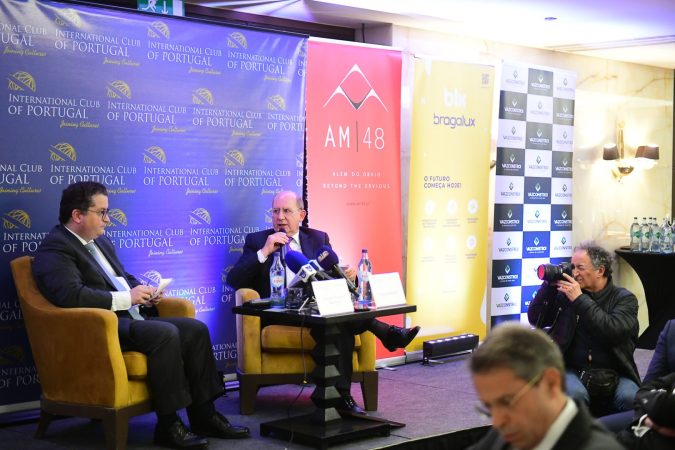
The trusted British economy current affairs magazine ‘The Economist’ voted Portugal as the economy of the year in 2025*, largely down to its financial discipline, prudent public spending, low inflation rate, higher than Euro Zone average growth rate and low unemployment rate. However, can it stay on track? Essential Business attended a lunch organised by the International Club of Portugal (ICPT) this week to hear what its Finances Minister, Joaquim Miranda Sarmento, had to say.
Text: Chris Graeme; Photos: Fernando Bento
Last year was a good year for Portugal’s finances and economy, particularly if the British current affairs magazine ‘The Economist’ is anything to go by after voting it the ‘Economy of the Year 2025’.
The Financial Times too highlighted Portugal’s success from a basket of tier 1 successful economic countries.
But according to Portugal’s Minister of Finances, Joaquim Miranda Sarmento, that doesn’t mean the current Portuguese centre-right Democratic Alliance coalition government led by Prime Minister Luís Montenegro can rest on its laurels.
On the contrary, the Portuguese ship of State and its finances must be as watertight as possible to withstand possible rough international seas in an ever-more uncertain and chaotic geopolitical ocean.
The minister alerted to the rising public debt of European Member States with Italy’s standing at 138% of GDP, France (115%) and Spain at 103% and the possible fallout from another sovereign debt crisis.
Portugal’s Achilles’ heel
Portugal’s main Achille’s heel, said the minister, continues to be (apart from low productivity) the country’s public debt.
Portugal had managed to reduce debt significantly in 2020 since the pandemic from 134% of GDP and by the end of 2025 it is expected to be on or near to 90% with a target to get that down to around 80% by the end of the current government’s term in office in 2028, and even below that by the end of the decade.
“This good performance with balanced public accounts couples with a very significant reduction in public debt of almost 45% in just four years which is absolutely extraordinary”, said the minister.
Miranda Sarmento pointed out that this had led to a significant improvement in the country’s ratings from the four main ratings agencies S&P, Moody’s, Fitch and DBRS.Fifteen years ago Portugal’s investment value had been deemed “trash” status by these agencies. Today, Portugal has an overall Grade ‘A’ investment status.
Reasonable financing costs
This renewed investor confidence has naturally been reflected in the borrowing costs for mortgages and family loans, as well as company borrowing.
And when measured against the German ‘bund’ benchmark, the costs of raising finance on the international financial markets through auctioning sovereign bond issues, Portugal performance for 10-year bonds is good at around 0.25 basis points above German bonds.
“That means we are 0.25% above Germany (2.8%) with financing costs that are very close to the Euro Zone benchmark. (Portugal 3.1% with yields of 3.097% and 3.088%).
And in terms of spreads and the direction of the budget “we ended 2024 with a surplus of 0.5% and this year we will end the year with a surplus slightly above 0.3% of GDP or €814 million. (Down from a revised 0.5% of GDP, or about €1.5Bn, in 2024. The surplus exceeded expectations in the first half of 2025, reaching 1%).
However, expenditure had risen considerably in 2024 (€93.1Bn or 42.8% of GDP) as a result of the decisions that had been taken in 2023 (€112.4Bn or 42.3% of GDP) and reflected in the State Budget in 2024*.
(*Portugal’s 2025 public expenditure is projected to see significant growth, with the government setting a spending cap at around €425.9Bn, a nearly 19.3% increase from 2024, aiming for a balanced budget with strong revenue growth, though projections vary slightly, pointing towards €100.2Bn for state budget expenditure and a near-zero deficit/surplus (0.0% of GDP) for general government, driven by economic activity, but also containing new spending measures).
Expenditure in 2025 was less than in 2024 while growth in the third quarter of 2025 was largely down to private consumption and an uptick in exports, except in the first half of the year in which order books were pummeled by tariff uncertainties.
“We continue to have a high public debt, albeit reduced, and that reduction makes us more protected. Nevertheless, it is still one of our weaknesses, particularly in the face of possible market turmoil,” Joaquim Miranda Sarmento warned.
And added: “I know we have experienced relatively calm years in the financial markets, particularly since the financial and sovereign debt crises (2008-2014), and even during the pandemic we didn’t have turmoil in the financial markets.”

Overspending and bankruptcy – a fine line
Miranda Sarmento was speaking at a packed lunch organised by the International Club of Portugal (ICPT) in a year in which it celebrates its 20th anniversary.
“I always recall a passage from Hemingway’s novel ‘The Sun also Rises’ in which two bankers are chatting and one asks: “How did you go bankrupt” and the other replied: “In two ways: gradually and then suddenly”.
“This is not Portugal’s problem, but it is the problem faced by some large European countries today that are heavily in debt, and so, at any time, could cause shock waves through the financial markets,” he said.
Miranda Sarmento argued that the more Portugal was protected through the competitiveness of its economy and the solidity of its public accounts and low debt of its economic agencies, families and companies, the more protected Portugal would be from possible future market shocks.
And Portugal’s solid performance could be contaminated by exposure from other countries in the EU.
Tracing Portugal’s recent economic performance the minister said that 2025 like 2024 had “exceeded expectations”.
“We have growth above the Euro Zone and EU, and we had a record low unemployment rate in the first half of 2025, a budget balance of +1% whereas the average for the Euro Zone is -3.1%”, he said.
Portugal also ended the year with a positive budget balance slightly above 0.3%. The public debt was the only indicator that had been above the Euro average, but that hard work could be undone in 2026.
Inflation too was at healthy 2%. “We have a monetary policy goal and this had led us to strengthen the country’s credibility”, he said.
Portugal’s long-term outlook
For 2206, Portugal’s Finances minister expects that both exports and FDI will pick up and continue to grow in the medium to long term; exports already representing 50% of Portugal’s economy.
And as for exports, these were not only goods, but also many exported services, and not just tourism but also technology services in the health area, among other exports.

A resilient labour market
Another strong aspect of Portugal’s economy is its resilient labour market (despite a string of unions-organised demonstrations over labour law reforms).
“Today, we have more than a million people working than we had in 2015 (when unemployment was at around 16%),” said Joaquim Miranda Sarmento.
“We have very significant levels of employment growth” he added while not mentioning that this was partly down to an immigration-driven population surge which doubled the immigrant population in five years to over 1.5 million and counting by the end of 2024, mostly driven by Brazilians, Ukrainians and Bangladeshis, but also a much smaller but significant number of highly-skilled professionals and HNW individuals from Europe, Canada, the US, and elsewhere)
To October 2025, employment was growing at 3.7% while combined company salaries were growing at close to 7% – a “very significant gain for employees”.
Portugal’s banks too had completely recovered from the banking crisis 15 years ago, with healthy results and tier 1 core capital ratios.
“This is all good news but we should not be complacent; on the contrary we should raise the bar on our ambitions and tackle the constraints we have in the Portuguese economy,” said the Finances minister.
Portugal’s main three constraints
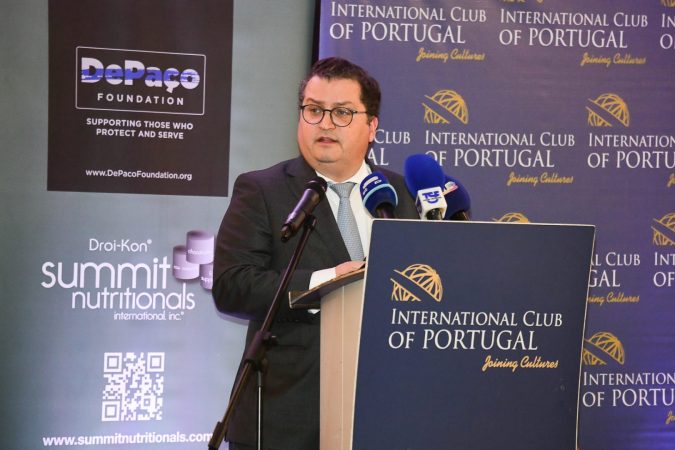
Portugal’s three main economic challenges, according to Joaquim Miranda Sarmento, are a lack of human capital (labour), particularly highly-qualified employees in all sectors.
The second is the cost of Portugal’s bureaucracy, and third, a rigid and dual employment market.
Other drawbacks highlighted in the minister’s speech were tax justice, innovation, quality and know-how.
“Many Portuguese companies are small, lack internationalization and, on top of it all, are indebted, although less than there were 15 years ago,” the minister conceded.
Overall, the problems were still high levels of public expenditure but with low efficiency, and low public and private investment to boot.
Over the past two decades, Portugal had not been capable of replenishing the depreciation of its stock of capital while its tax system was still complex with high levels of IRS and IRC as well as high rates of tax litigation – all of which created a hostile business environment.
And Portugal also needed to make a leap in terms of productivity in order to close the gap with her main peer competitors and this meant more larger companies which could only be achieved by scaling up.
These problems was actively being countered by reducing the tax burden – already reduced by 4 times – while the government has pledged to reduce IRC tax from 21% to 17% by 2028.
The government was also accelerating the Recovery and Resilience Plan (RRP) in order to apply all of the European loans and grants made available through it’s development bank Banco de Fomento, particularly in public investment projects.
Minister pledges technology shakeup in Finances
Portugal’s Minister of Finances, Joaquim Miranda Sarmento, also promised a shakeup to outdated government IT systems used to manage the State’s budget.
Joking that the system was like “Excel used by the Flintstones” the minister admitted the current system dates from the 1990s and pledged a technological revolution in which the entire system would be replaced.

Can Portugal stay on track?
Note: *Portugal was distinguished by the British magazine The Economist as the “Economy of the Year” in 2025, leading the annual ranking that evaluates the economic performance of the 36 richest countries in the world. The choice is the result of an analysis of five key indicators — inflation, inflation deviation, Gross Domestic Product (GDP), employment and stock market performance — where Portugal stood out by combining robust economic growth, low inflation and a rising stock market. According to the publication, “in 2025, Portugal managed to combine strong GDP growth, low inflation and a rising stock market.” Among the factors that boosted economic performance.
The Economist highlighted a dynamic tourism sector and Portugal’s growing attraction for foreign residents in a context of tax competitiveness. In the 2025 ranking Portugal succeeded Spain, the winner in 2024, which now drops to fourth place. Ireland and Israel occupy the second and third positions, respectively.
At the opposite end of the spectrum, the economies of Estonia, Finland and Slovakia are among the most penalised in the set of indicators evaluated. In a post on the X network, Portugal’s Prime Minister Luís Montenegro stressed that this distinction was “a fair acclamation of the merit and work of the Portuguese people” and reinforces “the Government’s motivation to follow the course that has brought us here in recent months.”
But then so much of a small country’s fortunes, which necessarily must be exposed to overseas markets, are influenced by and ultimately at the mercy of international economic and geopolitical events. All Portugal can do is be as prepared as possible with a comfortable cash cushion as a backup in case of a rainy day.