
Photo by Oksana Parafeniuk for The Washington Post via Getty Images
“Ukrainians are in love with bad news,” Andrey Kurkov told me, leaning over the table in Ognisko, a Polish restaurant in west London. “They are looking for traitors around them all the time.” The writer and novelist – Ukraine’s most famous – was speaking ironically but there’s a grain of truth in the statement. It’s perhaps an appropriate frame of mind for a nation that has received more than its share of betrayal since Donald Trump’s return to the White House.
When we met for lunch on a frigid winter day in London, it wasn’t long after Trump had unveiled his so-called 28-point peace plan to end Russia’s war in Ukraine. Many European critics remarked that the plan read as though it had been drafted by the Kremlin (stipulations mandated capping the size of Ukraine’s armed forces and ceding territory to Russia). Even so, there was some optimism outside of Ukraine that the US president’s investment in a ceasefire could lead to an end to the destruction. And even though the precise number of points to the plan continued to shift, weeks later Ukraine’s president Volodymyr Zelensky was telling the press that a deal was “90 per cent agreed”.
But the optimism was short-lived. By 14 January, Trump was telling reporters for Reuters that Zelensky was the one preventing a peace deal, not Vladimir Putin, who he claimed was prepared to wind down his nearly four-year-old assault on Ukraine. No matter that this was the same week that Russian drone and missile strikes had successfully attacked Kyiv’s heating and electrical infrastructure, plunging the capital into a deep freeze in the middle of winter.
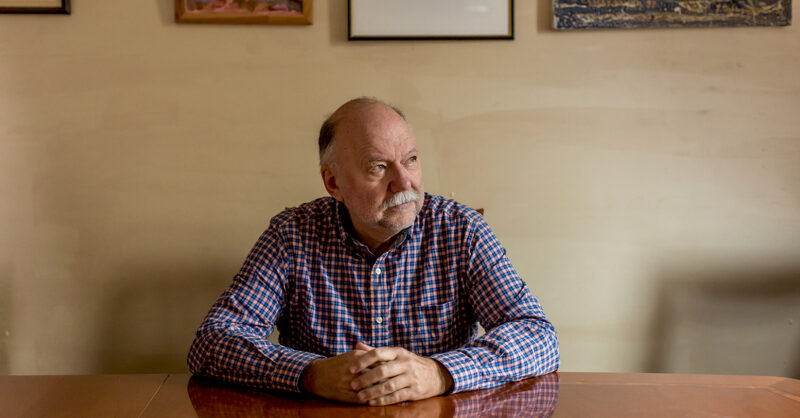
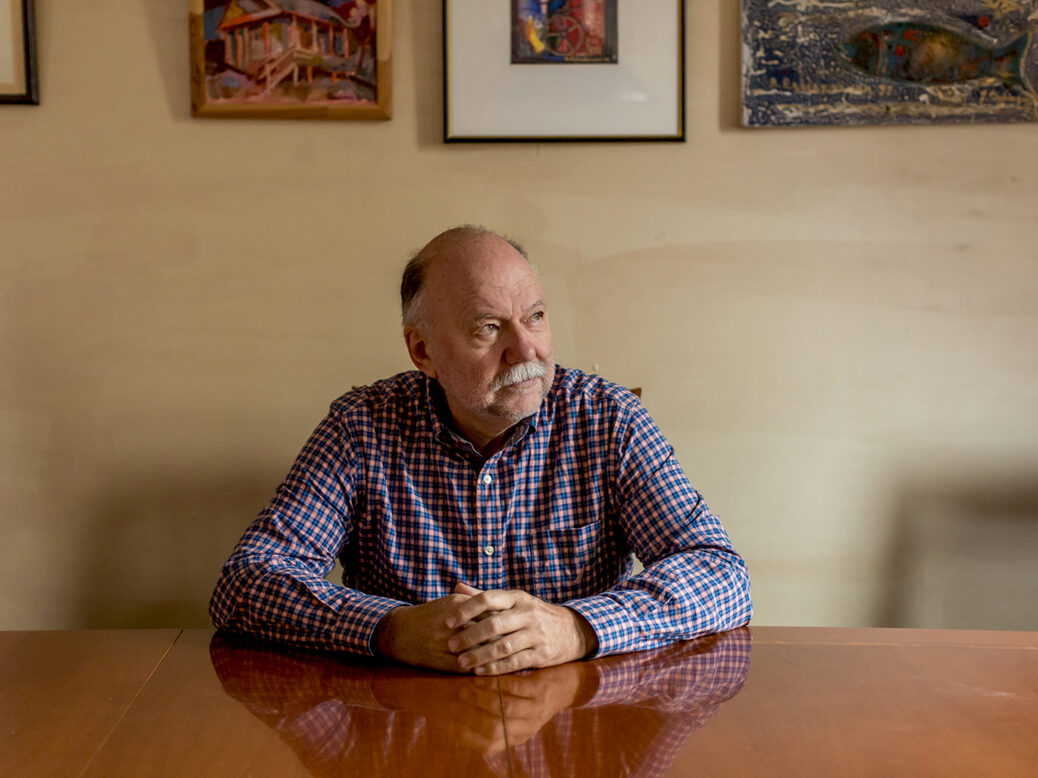
Kurkov was passing through London on a book tour for his latest book Three Years on Fire: The Destruction of Ukraine, the third installment in his series of war diaries. Since the start of Russia’s full-scale invasion of Ukraine almost four years ago, Kurkov has been documenting life under siege. At 64, Kurkov is short, but robustly built, bald with a greying moustache and a smattering of facial hair spread across his merry, open face. Even when discussing the grimness of war, Kurkov often peppers his accounts with the absurd, often grimly amusing details that have characterised his fiction for decades. In Three Years on Fire, for example, he writes of how Russia, for all its anti-West posturing, still craves Western prestige: “even before the war, the Russian State Duma forbade the use of the term ‘Champagne’ for any beverage except for Russian sparkling wine.”

New year, new read. Save 40% off an annual subscription this January.
He still lives in Kyiv with his English wife of many years, Elizabeth Sharp. Their grown children – a daughter and two sons – also live in Kyiv, working, studying and volunteering. (His children haven’t been drafted as they are, like their mother, British citizens.) Despite the war, Kurkov told me that Kyiv remains full of life. “It’s difficult to buy tickets for theaters, restaurants are full, museums are open,” he said, before starting his barszcz, a Polish soup made from beetroot. “There is no despair, no depression, but there is a lot of anger.” For years that anger has been directed toward Putin, but traitors can also be found closer to home.
In recent months, a scandal has engulfed Ukraine, with allegations that Zelensky’s closest associates have been involved in a plot to skim $100 million from Ukraine’s energy sector. While the scandal has already led to the resignations of some of his closest allies, it has not (yet) toppled the country’s president. Yet there is a feeling among many that Zelensky has been weakened by the scandal.
Kurkov certainly believes it has damaged the country’s chances of bringing a favourable end to the war – not that he imagines it will be over anytime soon. “It’s clear that it can drag on for another two or three years.” Does he have another diary in him? He still writes every day, he said, and dreams about a time when he doesn’t feel the need to document the everyday and can focus completely on fiction again. But he has no plans to publish another diary. On his book tours he’s noticed less and less enthusiasm from audiences abroad. The Brits, the French and Italians are still broadly supportive; Germans, less so. “I think actually people want to read less and less about the war.”
Andrey Kurkov was born in 1961, near Leningrad (not St Petersburg) where his father, a pilot in the Soviet Air Force, was stationed at the time. His mother was a doctor and the family spoke Russian at home. Within a few years the family had relocated to Kyiv, where Kurkov’s father had taken a job in an aviation factory. He started writing at an early age – he has vivid memories of writing poetry about Lenin in school – and developed an interest in languages. He picked up Polish and later studied Japanese at the Kyiv Institute of Foreign Languages. (His English is flawless and over the course of our two-hour lunch he apologetically took calls from friends, speaking in both German and French.) But right from the beginning, he wrote his fiction in Russian – a fact that would later infuriate Ukrainian nationalists.
After graduating, as part of his national service, Kurkov worked as a prison guard in Odesa. He wrote children’s books and finished a few manuscripts, which he would send to Soviet publishers. The rejections began to pile up, and he turned to self-publishing, making photocopies of his manuscripts, which travelled widely. He started to receive invitations to appear at underground readings, sometimes as far away as Moscow. By his own description, Kurkov’s work has always skewed towards the absurd; he has an idiosyncratic way of portraying the surreal, and Soviet and post-Soviet Kyiv offered plenty of inspiration. (In one of his earliest novels, The Bickford Fuse, the residents of one military town all work in the local straightjacket factory.) He struck mainstream international success with his novel Death and the Penguin, published in 1996 and translated into English in 2001. It follows a writer named Viktor, and his pet penguin Misha, whom he had rescued when Kyiv Zoo closed down.
Since then his profile outside Ukraine has only grown. Since the beginning of the war, Kurkov has been regularly writing for publications abroad (including the New Statesman). This has contributed, he thinks, to what he described as a diminished reputation at home: “I think because I’m the loudest voice from Ukraine, it irritates many Ukrainian intellectuals.” A few take issue with him being regularly described as Ukraine’s most famous writer, he told me; more have a problem with the fact that he writes in Russian.
Perhaps most damaging to his reputation at home, however, was what he glibly referred to as his “cancellation” in 2023 over a talk he did in Toronto with the Russian-American journalist Masha Gessen (a fierce critic of Putin). Critics saw it as a betrayal of Ukraine. “They stopped selling my books in Ukraine for many months, but they couldn’t do anything else.” What frustrated him most about that episode, he told me, was the hypocrisy. The most furious critics were “the publishers and intellectuals who escaped from the Ukraine, who were attacking me from abroad at the same time they didn’t want to be mobilised”.
Yet as scornful as Kurkov is towards contemporary Ukrainian intellectuals, he remains a champion of Ukrainian art and literature. He praises the recent work by the writer Artem Chapeye, whose own book on the war, Ordinary People Don’t Carry Machine Guns, was published in English last year. Even this support, however, can feel bitter at times; “260 poets and writers have been killed in this war,” he told me.
Kurkov spends about half the year travelling for work, attending literary festivals and giving talks. I asked him if he ever got annoyed by audience questions when abroad. “The question which was the most annoying for three years: ‘how and when the war will end?’” How would he even begin to answer? But he doesn’t get asked that anymore. “I think it stopped maybe eight, nine months ago.”
There is a monotony to war. For nearly four years, Ukraine has experienced an ebb and flow of support from its allies but the assault from Russia has been unrelenting. Yet as the spluttering peace negotiations stop and start, and the corruption police continue to investigate, many inside and outside the country are beginning to contemplate what a post-Zelensky Ukraine and what that could look like.
Kurkov, who was never a fan of Zelensky’s turn from professional comedian into a politician, told me the problem with Ukrainian politics is the lack of ideology. “Those who go into politics, they always want to create their own political party based on their reputation, their charisma – not on their ideas,” he said. “And then their ideas [become] flexible.”
Kurkov told me that if an election were held in Ukraine right now, Zelensky – who was for many years extraordinarily popular – would have a “50/50” shot of winning. The only other figure he could imagine winning at the moment is General Valerii Zaluzhnyi, Ukraine’s ambassador to the UK and the former commander-in-chief of the armed forces. But such a victory would also present a challenge: a general with no political previous experience “but the habit to give orders and to plan operations” would need to lean much more heavily on his team – “which will mean that actually he will be representing ideas that are not necessarily his own”.
Of course, debating the merits of potential candidates is a luxury for another day. Until the war ends, elections in the country are illegal. In the meantime, for Ukraine, the bad news continues. Temperatures continue to plunge. Allies are still wavering. Graveyards are running out of room. And Andrey Kurkov continues to document it all.
[Further reading: Rasmus Jarlov: If the US attempts a military takeover of Greenland, “then we are at war”]