

Published
17/01/2026 às 14:08
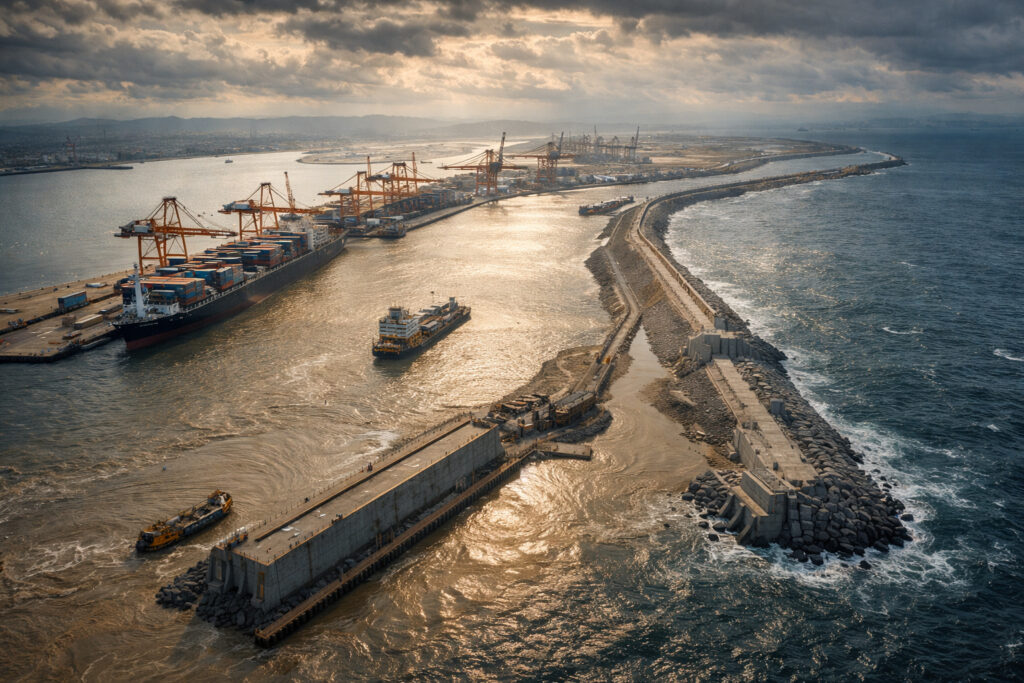
South Korea has transformed an exposed bay into a deep-water port, dragging 72 million cubic meters of sediment and erecting colossal maritime structures to compete in global trade.
According to official documents presented by the South Korean Ministry of Finance at APEC forums, the country dredged approximately 72 million cubic meters of sediment at the beginning of the development of Busan New Port, one of the largest maritime engineering projects in Asia. The goal was to create a deep-water port infrastructure capable of receiving the world’s largest container ships, expanding South Korea’s logistical capacity and repositioning the country in global maritime trade.
The area originally chosen was not a natural harbor. It was a region exposed to the open sea, with insufficient depth, risks of swells, and no coastal infrastructure. To make it viable, South Korea needed to excavate channels, deepen port berths, stabilize the seabed, and build… retaining walls, to shape artificial islands and then build an entire logistical ecosystem on this new maritime territory.
This process defines what engineers call “deep water port built”, unlike traditional ports that take advantage of natural inlets or bays.
See also other features
-
With 2,3 km suspended over the sea, pillars exposed to extreme salinity and winds that can exceed 140 km/h, an Indian railway has been operating for over 100 years to reach an isolated island in the middle of the Indian Ocean.

-
Brazil is changing the game in foreign trade with a billion-dollar international bridge in the Midwest that connects the country to the Pacific, shortens global routes, and promises to cut up to 15 days in the path of imports from China.
-
To build 42 km of tunnels beneath London, engineers traversed historic foundations, rerouted centuries-old pipelines, and operated TBMs just centimeters from active stations: the Elizabeth Line redesigned the subsoil of the English capital and became a global benchmark.
-
Praia Grande is accelerating two giant construction projects: Vilamar Shopping in Mirim, with 160 m², more than 300 stores and delivery scheduled for 2027, and a new pier in Aviação, 500 meters long, 35 meters wide, with a museum and 600 parking spaces.
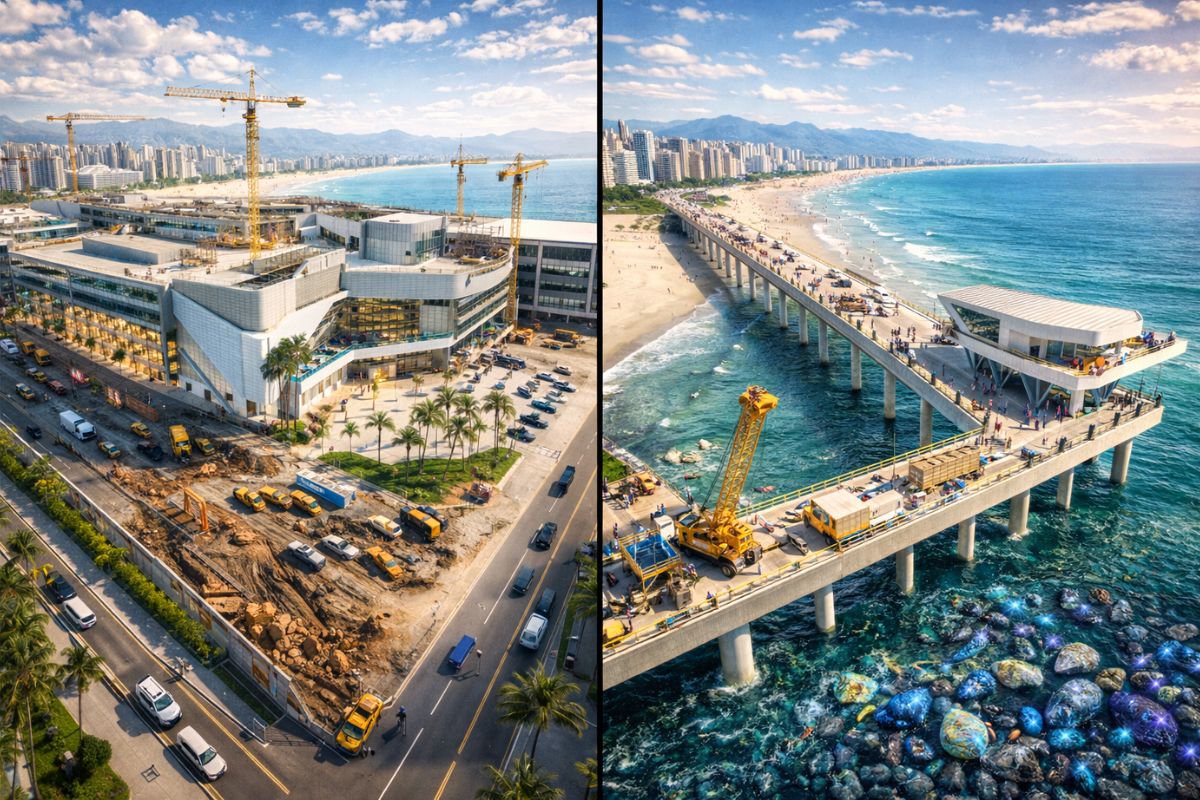
Industrial dredging on a continental scale
Dredging 72 million m³ That would already be an achievement in itself, but the impact goes beyond the sheer number. In practice, this means:
- Remove sediment to create deep drafts for post-Panamax and New-Panamax ships.
- Ensuring adequate depths even with rough seas and seasonal waves.
- Maintain the canal navigable throughout the year.
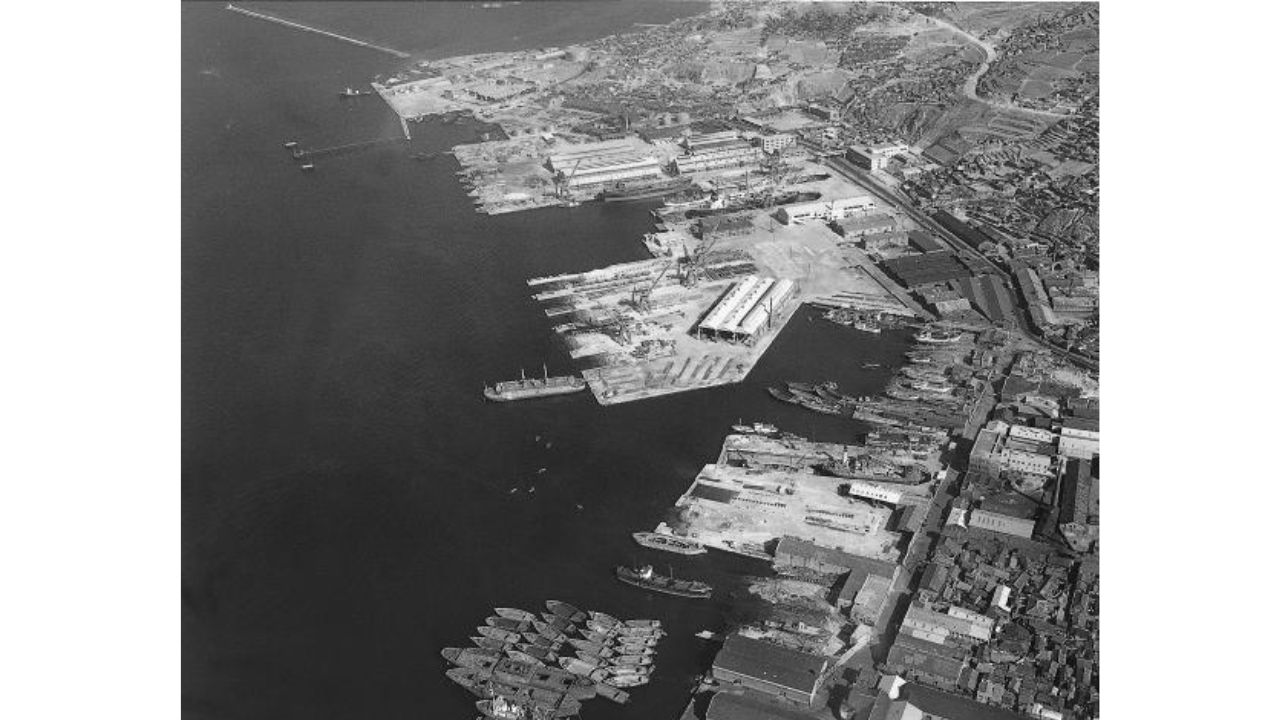 Port of Busan in 1965
For comparative purposes:
• 72 million m³ equivalent to filling approximately 28.800 Olympic-sized swimming pools
• It is greater than the volume of sediment removed in some European mega-river projects.
• It was conducted in an ocean environment, which multiplies the complexity.
All of this involves suction dredgers, offshore excavators, hydraulic transport systems, and rigorous environmental monitoring to ensure that none of this destroys sensitive biological areas near the port.
Construction of sea walls, dikes and platforms.
With the funds prepared, the structural phase began: building a port where there was no port. This meant:
• Build maritime retaining walls with cyclopean blocks and rockfill
• Create logistics islands and industrial platforms interconnected
• Stabilize docking areas with deep foundations
• Implement breakwaters which reduce waves and enable 24-hour operations
These projects are comparable to major Japanese offshore port projects, with one key difference: Busan’s objective was to compete with… Shanghai, Singapore and Yokohama, which are among the largest logistics hubs in the world.
A port designed for global trade.
The strategic choice was not accidental. There is a powerful economic reason: Approximately 90% of world trade is transported by sea. And logistical bottlenecks determine who profits, who loses, and who grows. The Busan New Port was created to:
- Receiving ships Ultra Large Container Vessels (ULCV) with more than 20.000 TEUs
- Being a transfer hub to the Pacific and to Indian Ocean routes
- Reduce dependence on foreign ports.
- To increase South Korea’s logistical autonomy.
Today, Busan is among the largest ports on the planet in terms of annual container traffic and acts as a multiplier effect on the Asian economy.
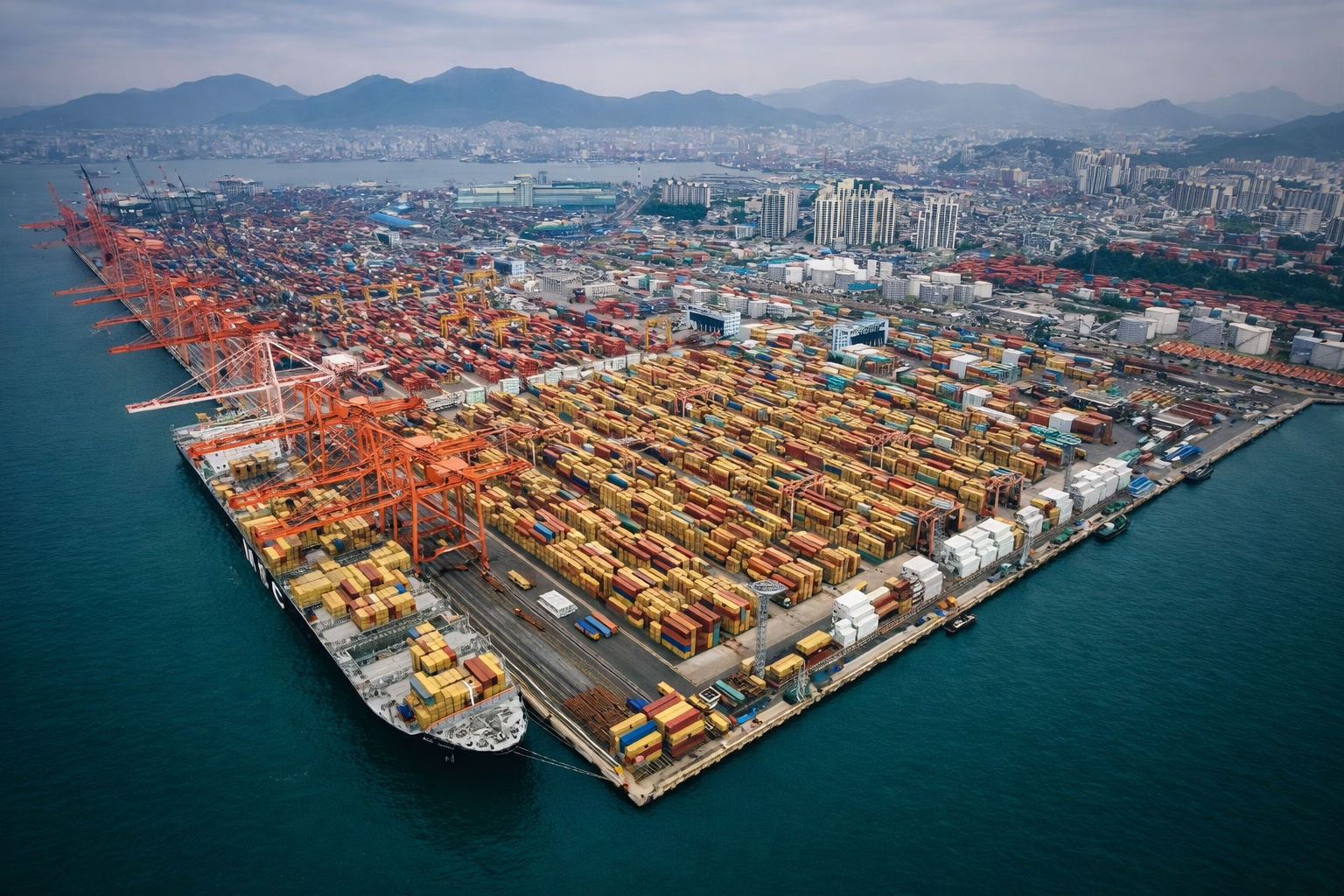 Recent images of the Busan New Port megaproject.
Maritime engineering as a geopolitical tool
Projects of this scale rarely deal solely with engineering. They shape trade relations, industrial chains, bilateral agreements, and even a country’s position on the international stage.
The Busan New Port:
- It attracted industrial clusters to the entire region.
- It accelerated logistics agreements with the United States, Europe, and Southeast Asia.
- It encouraged foreign investment in special economic zones.
All this because South Korea realized early on that Container ship doesn’t wait for a backward country.…and maritime logistics has become a form of economic sovereignty.