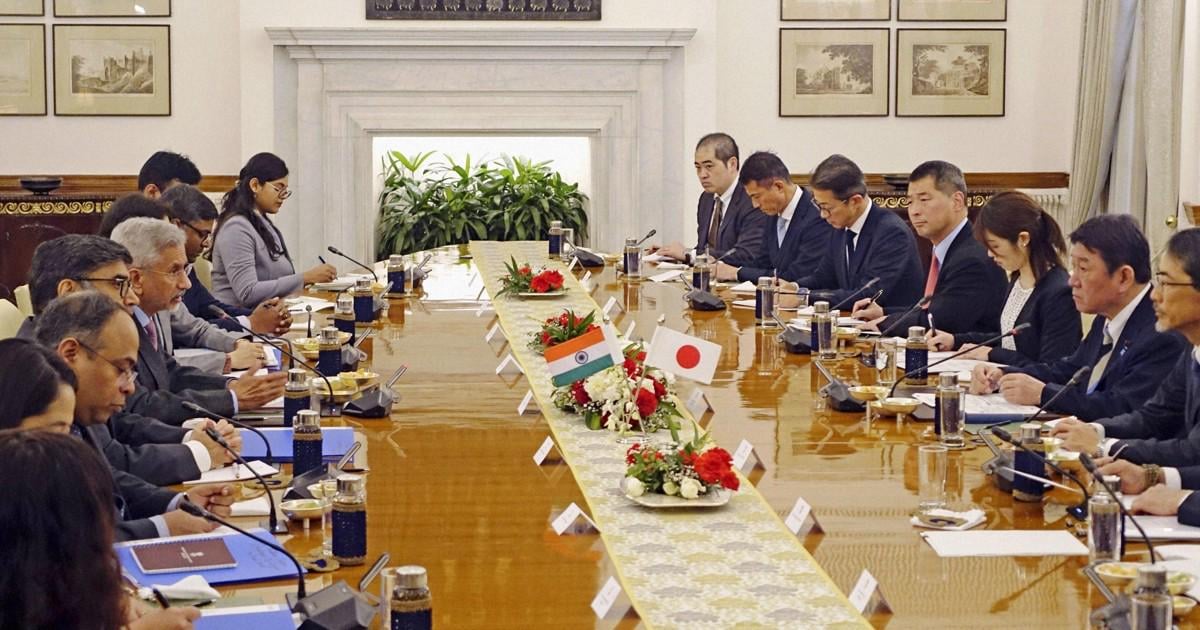
apan and India agreed on Friday to launch a private-sector economic security dialogue aimed at developing diverse supply chains for strategic items, such as semiconductors and rare earths, which currently depend heavily on China.
https://mainichi.jp/english/articles/20260117/p2g/00m/0bu/006000c

3 Comments
As an Indian living in Japan, I have been hearing these keywords of “cooperation” and “MoUs” for years lol. Nothing has come out of it, only India gains from it, Japan has little to gain from it.
I will honestly say it, everything that the Japanese government currently tries to do with India ends up either getting messed up, incomplete, or half-success, or probably lose interest in it long-term.
One thing to blame is the unequal relationship between the two nations.
India is a growing economic superpower and aims to rival China, while Japan is literally a stagnating (not declining yet) nation, and with their rising xenophobia, its going to get far more worse.
India’s top leaders see Japan as a close friend, and ally against China, and better than the US. Unlike with the 3 powers Russia, US and China, where Indian diplomats are walking on a tightrope to manage 3 of them at once without fucking up like Takaichi did, in the case of Japan, India is quite eager to attract foreign investments from Japan, not China.
Meanwhile Japanese leaders see India as an alternative to China, not a friend, but rather an alternative source. Their only friend is the US. If today, suddenly China reversed course and become friendly towards Japan (literally impossible at this point), Japan would turn its back on India and start negotiating with China.
Japan’s business predictions that “India will open up market for Japanese goods and made-in-Japan exports” is extremely unrealistic. The current ruling party, BJP has the core goal of “Make In India by 2050”, meaning even Japanese companies need to setup factories to sell products in India otherwise high tariffs.
For example, importing cars in India has a tax rate of 200%. So most Japanese automakers establish their local manufacturing plants in India. Maruti Suzuki (subsidiary of Suzuki) is a great success example of that.
Also, unlike China, India’s purchasing power although rising is very very low.
Only about 2% of India’s 1.3B population pays income taxes, the rest are below the threshold to be eligible for taxation.
Japan’s bullet train project in India which was supposed to start service by 2025, is still ongoing construction and even halted in some sections, with predictions of completion nearing 2032, and at worst cases 2035.
The main reason was due to Japanese govts inability to learn about how it works in India. Unlike Japan where land laws are quite flexible, in India, personal property laws are so strict that it often becomes a roadblock in major national projects.
Plus the issue of slums in between the Mumbai-Ahmedabad Line puts more pressure as removing slums forcefully is illegal in India, and most are living there illegally, but local politicians don’t want to remove them as they are a significant part of vote bank.
India’s economy is certainly growing, but not at a level that would outmatch the Chinese market.
Also India lacks technological capabilities to refine rare earth metals.
The only one important advantage that India has is DISREGARD for environment, meaning lax environmental laws, much more relaxed compared to even China.
And plenty of vacant abandoned land.
Location wise its pretty good, but unfortunately India lacks the expertise and the infrastructure needed for it.
Great, another **MAHSR**. Japan will continue to provide India with interest-free loans.
A whole lot of articles and news but nothing concrete. Just stfu and do it.