
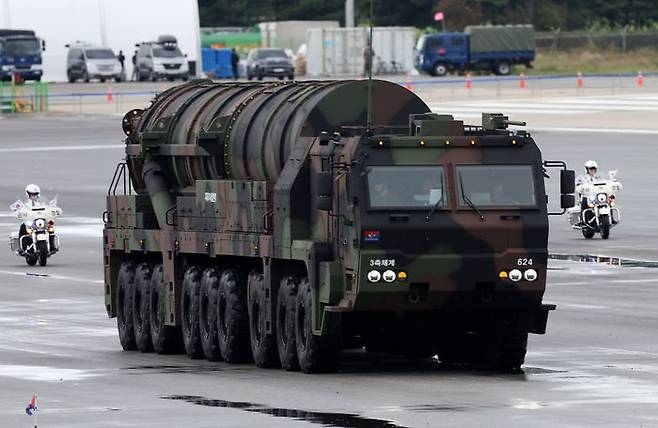
 A Hyunmoo-5 surface-to-surface ballistic missile is displayed during the 76th Armed Forces Day ceremony at Seoul Air Base in Seongnam, south of Seoul, in October 2024. (Newsis)
 South Korea has begun deploying the high-power Hyunmoo-5 surface-to-surface ballistic missile to frontline operational units, as Seoul steps up efforts to counter North Korean threats, military sources said Sunday.
Dubbed a “monster missile” because of its size and destructive power, the Hyunmoo-5 is a conventional weapon designed to destroy deeply buried bunkers, including hardened command facilities believed to be used by North Korean leader Kim Jong-un.
The missile is assessed to carry a warhead weighing up to 8 tons — giving it destructive power comparable to that of a tactical nuclear weapon.
A Defense Ministry official said Sunday that it was “pushing ahead with the integration of the Hyunmoo-5,” but did not disclose specific deployment plans.
According to military sources requesting anonymity, deployment of the Hyunmoo-5 began late last year, with full operational fielding expected to be completed during the administration of President Lee Jae Myung, whose term runs through June 2030.
The missile had previously been developed and procured under a classified program, with the military refraining from publicly using its official name. The designation “Hyunmoo-5” was first confirmed by Defense Minister Ahn Gyu-back in October last year in his interview with Yonhap New Agency.
“At this point, the Hyunmoo-5 has entered the process of full force integration, and we plan to mass-produce it,” Ahn said at the time.
South Korea has increasingly emphasized conventional strike capabilities as part of its deterrence posture, particularly as it remains bound by the Nuclear Non-Proliferation Treaty and cannot develop nuclear weapons. Ahn has argued that expanding the Hyunmoo-5 arsenal is essential to achieving what he described as a “balance of terror” against North Korea’s nuclear forces.
Although classified as a short-range ballistic missile, the Hyunmoo-5 is believed to have the potential to achieve intermediate-range performance — which would put its range above 3,000 kilometers — if its payload weight is reduced, according to military assessments.
However, military experts caution against equating the Hyunmoo-5’s capabilities with those of nuclear weapons. While praising its effectiveness against underground targets, they note that even the most powerful conventional warheads cannot match the destructive force of tactical nuclear arms.
They assessed that the Hyunmoo-5 would be highly effective in destroying North Korean underground facilities used to store key military assets. However, the expert noted that facilities located at depths of 80 to 100 meters would likely survive a direct strike, observers noted at the same time.
The missile forms a key component of South Korea’s “three-axis” deterrence system, specifically the Korea Massive Punishment and Retaliation doctrine, which envisions overwhelming conventional strikes against North Korean leadership and strategic facilities in the event of a nuclear attack. The three-axis framework also includes the Kill Chain preemptive strike concept and the Korea Air and Missile Defense system.
The Hyunmoo-5 was first publicly unveiled during Armed Forces Day celebrations in 2024, though most of its technical specifications remain classified due to its strategic sensitivity.
Military authorities are also developing next-generation missile systems to follow the Hyunmoo-5. Combined with upgraded variants, South Korea is expected to deploy several hundred high-power missiles as part of its broader effort to strengthen deterrence against North Korea.
mkjung@heraldcorp.com