
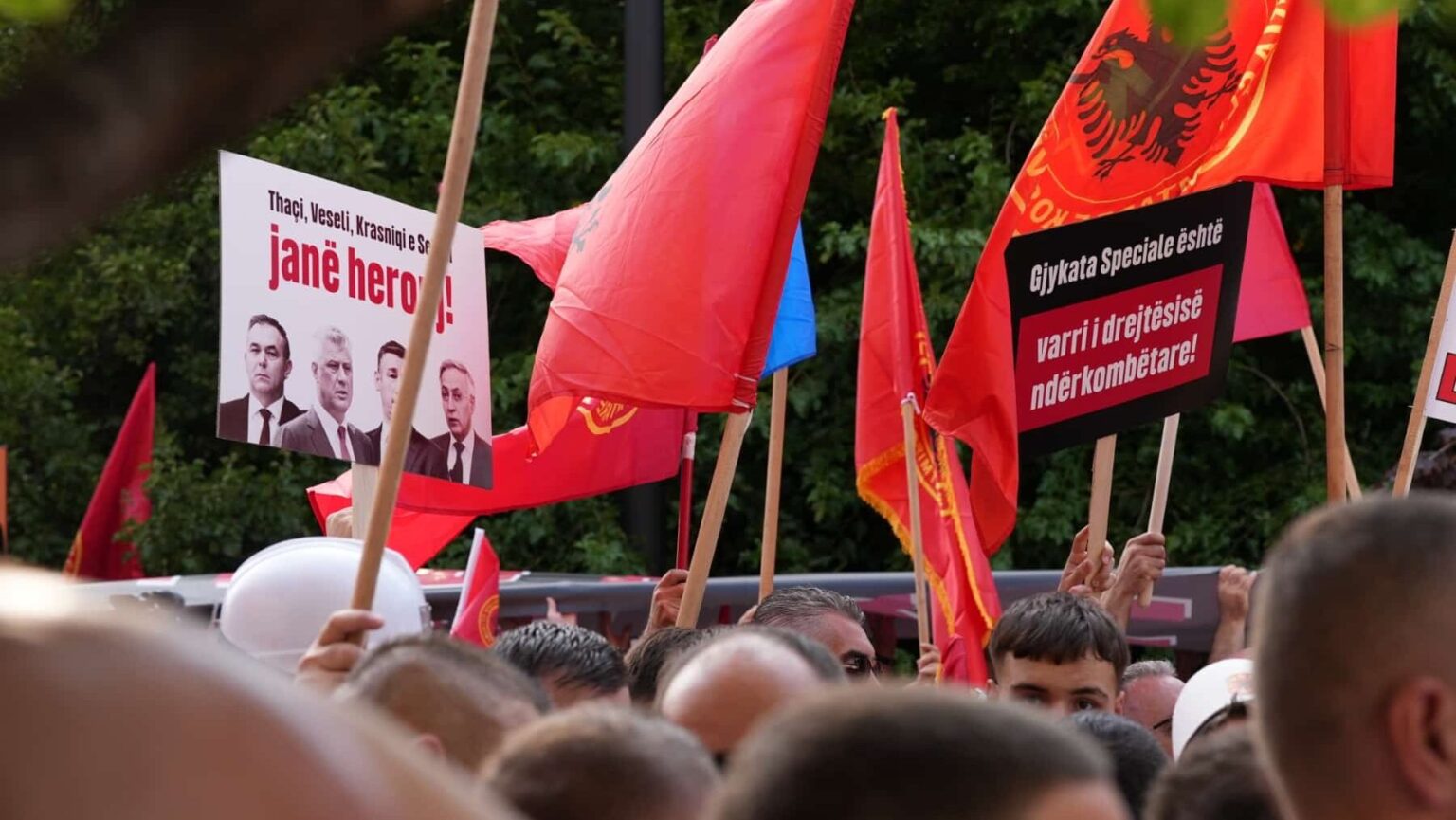
In late 2017, dozens of Kosovo legislators tried in vain to overturn the law that established the court, to the fury of the international community which threatened severe ramifications.
The court survived this challenge and finally issued its indictments against these four defendants in November 2020, creating more opposition.
They were all high-ranking and popular KLA veterans: Hashim Thaci, Kadri Veseli, Jakub Krasniqi, and Rexhep Selimi. Indeed, Thaci at the time was president of the country.
These defendants have been in detention for almost five years, and the court has repeatedly denied their motions for release. This was another issue highlighted by the protesters on August 7.
Relations with the war veterans and their supporters soured further when two senior members of the War Veterans’ Association, Hysni Gucati and Nasim Haradinaj, were convicted of obstruction of justice in 2022 and jailed by the court after they shared with the media confidential documents leaked from the court and sent to them anonymously.
The people who stole and delivered the documents have never been identified.
The trial in the Thaci et al case began in April 2023, after two-and-a-half years of pre-trial detention, and the prosecution rested its case two long years later. The prosecution’s theory of the case is that these individuals committed heinous crimes while engaged in a so-called joint criminal enterprise. The case for the defendants will commence on September 15, followed by likely appellate proceedings. The end is nowhere in sight.
Aware of its low standing in Kosovo, the leadership of the Chambers has pursued a vigorous outreach programme to persuade the public that the court is just and fair, and that it is prosecuting only individuals and not the KLA itself, a subtlety lost on many of the court’s critics who believe the court is trying to rewrite the glorious history of the KLA’s fight for liberation.
The actual impact of the 185 public-awareness events that the programme has held since 2018 is questionable.
Indeed, court president Ekaterina Trendafilova has personally attended outreach events in Kosovo on three occasions between 2022 and 2025, and each time she has had to adjust or even cancel her schedule because of protests and safety concerns.
It is beyond mere conjecture, of course, that Thaci and his co-accused will be found guilty of at least some of the charges against them. And if not, the outcome will be perceived by the international community as a total waste of time and money.
Ironically, however, acquittals stand more chance than convictions of actually fostering reconciliation, as was demonstrated in 2012 when Ramush Haradinaj returned home a war hero from the ICTY.
If indeed there are convictions, this will play directly into the hands of Serbian officials who would like nothing more than to claim that Kosovo’s war of liberation was nothing more than a joint criminal enterprise rather than a fight for freedom, further inflaming local passions.
All things considered, reconciliation has been proven to be nothing more than a naive pipe dream among those international officials who insisted on the creation of the court; its demise is virtually certain.
However, it is not my intention to denigrate the court or its employees, all of whom I’m sure are acting professionally in exceedingly difficult circumstances. The fact remains, however, that there are persuasive reasons why reconciliation, one of the court’s major goals, will not be achieved.
Judge Dean B. Pineles is a graduate of Brown University, Boston University Law School and the Kennedy School of Government at Harvard University. He served as an international judge with EULEX from 2011-13. In addition to Kosovo, he has extensive rule-of-law experience in other countries. His book, ‘A Judicial Odyssey, From Vermont to Russia, Kazakhstan and Georgia, then on to War Crimes and Organ Trafficking in Kosovo’, was published by Rootstock Publishers, Montpelier, Vermont (2022).
The opinions expressed are those of the author only and do not necessarily reflect the views of BIRN.