
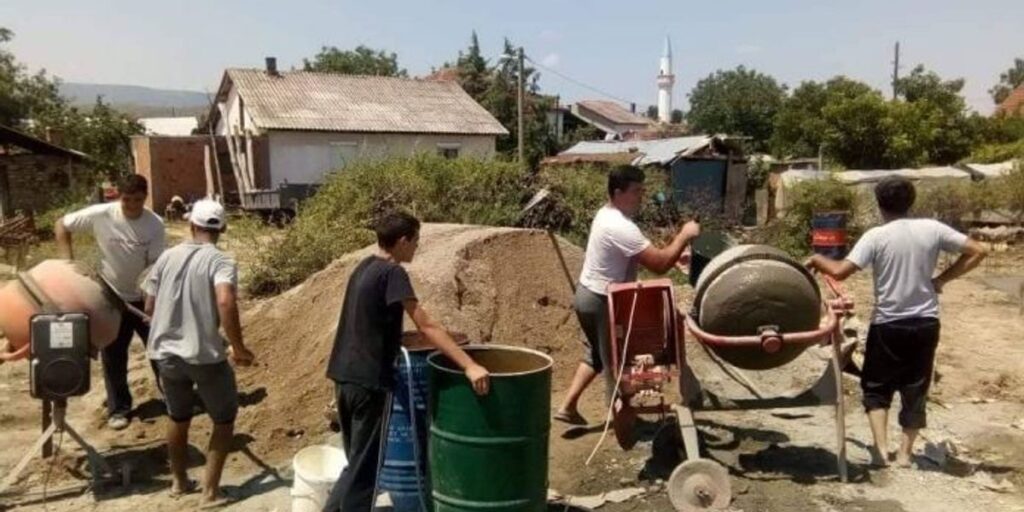
A total of 6.128 foreign workers received temporary residence permits in North Macedonia in 2025. That’s three times more than five years ago, when 1.704 workers had received permits due to work in the country, according to data provided by the Balkan Service of Radio Free Europe (RFE/RL) from the Ministry of Internal Affairs (MIA).
Construction, manufacturing, accommodation and services, as well as wholesale and retail trade, are the sectors where there has been the greatest interest in hiring foreigners, according to the Employment Agency as of 2020.
Workers from Turkey predominate, but now more and more workers from Nepal, Bangladesh, and India are arriving in North Macedonia.
Bangladesh, Nepal, India, Turkey, China and the Philippines are among the countries whose citizens the Ministry of Interior has issued residence permits for work.
The data that REL received from the Employment Agency also shows which foreign citizens are in greatest demand.
According to them, a total of 8.509 positive opinions for work permits were issued in 2025. This number also includes 798 personal work permits issued to administrators, managers, etc. This opinion is necessary among the documents that the MIA collects when deciding whether or not to approve the residence permit.
These data also show the growing trend of foreigners seeking work in the country. In 2020, for example, the Agency issued 3.227 positive opinions, which is half the number in 2025.
For years, workers from Turkey have topped this list, while in 2024 and 2025, the top five countries whose citizens have received positive opinions also include Nepal, Bangladesh, and India.
Last year, out of a total of 8.509 opinions, the Employment Agency gave 2.815 opinions to Turkish citizens alone. They were followed by Bangladeshi citizens with 1.567, Nepalese with 1.089 and Indians with 1.079.
In fifth place are citizens of Kosovo with 406.
Previously, when the number of quotas and permits for foreigners was significantly smaller, these places were occupied by countries in the region, such as Serbia, Albania, and Kosovo.
The trend of increasing the number of foreign workers is also visible in everyday life, especially in the capital of North Macedonia, where they are often seen on construction sites, but also in hotels, restaurants, bars, etc.
This process, emphasizes Krste Blazhevski from the voluntary and non-profit association of hotel and gastronomic businesses – HOTAM, is natural considering that local workers are migrating to other European countries.
The majority of permits are requested for Skopje, while a few dozen per year are issued for Bitola, Tetovo, Ohrid, Kumanovo, etc.
“These are workers from poorer countries, who would earn a living here, survive and send something to their families, because even today there are places where they receive salaries of $100 a month. Here they receive $600–800,” Blazhevski tells REL.
But how do they come to North Macedonia? The most common practice, when it comes to workers from distant countries like Nepal and Bangladesh, is through intermediary agencies.
Unlike in the past, today – Blazhevski emphasizes – there are many such agencies that offer workers every day. According to him, there are dozens of them. They send videos, CVs of the candidates’ work experience, etc.
One such agency, which has been bringing foreign workers to North Macedonia for four years, is “Balkan – Human Resources.” It cooperates with an agency from Bangladesh.
“At first it was difficult to find the first workers, to convince people that there was work for them here too. However, with the arrival of the first people here, trust was created and now it is easier to find people to come here,” a representative of the agency tells REL.
According to him, the interest of local employers is great.
“At first I was skeptical that Macedonia would really need so much labor, but my assessment was wrong. I see more and more requests every day,” he adds.
He first mentions gastronomy, then manufacturing and construction as the sectors that require the most workers.
Blazhevski from HOTAM says that recently the workers coming in are not “just general workers.”
“There are also many experienced workers who can quickly understand what they need to work on here,” he emphasizes.
In the hotel and catering industry, foreigners are most often engaged in “behind-the-scenes work” – cleaning, working in the kitchen, etc. But, according to Blazhevski, they learn the language quickly. From experience, in six months they master the basics, and they often even understand English.
“You know, no country in the world has failed to date because of its workforce, it has not fallen behind. It only moves forward. If there is no one to fill the job positions, then we will be in big trouble, facilities will have to be closed and there will be no income,” says Blazhevski.
However, years of experience with workers from distant countries, such as India, Nepal and Bangladesh, have shown that even the jobs they occupy are vacated as they flee to other European countries. This problem is not denied by either business sector representatives or intermediary agencies.
The representative of “Balkan – Human Resources” says that it currently cooperates only with one agency from Bangladesh, because some of them “misuse our companies to flee to other European countries.”
According to him, only four percent of those his agency has brought into the country have left.
The trend of foreign workers leaving, according to Blazhevski, has decreased.
“The regulations were not properly regulated and a certain number of migrant workers took advantage of this. But last year, those who came stayed. If some left, it is a very minimal number,” he claims.
In 2025, when 6.128 foreign citizens received permits, the Ministry of Internal Affairs identified 166 foreigners who left North Macedonia while they were in the country with the status of “temporary stay due to employment”.
According to data that REL received from the Ministry of Interior, 129 of them were citizens of Bangladesh, 34 of Nepal, and three of India.
According to legal provisions in North Macedonia, the quota for the employment of foreigners must not exceed 5% of the total working population in the country. According to data from the State Statistical Office, the number of employed people in the third quarter of 2025 was around 705.000, while the unemployed were around 92.000.
As for the quota for work permits for foreigners, for 2025 the Government has set it at 10.000 workers. This too, in parallel with the increase in the number of foreign workers employed, has increased in recent years. At the end of 2023, the previous government increased it from five to seven thousand. Previously, it was 3.250.
Last year, the Government proposed, and the Parliament approved, amendments to the Law on Foreigners, which foresee that, outside of this quota, temporary residence for work purposes will also be approved for a foreigner working on strategic projects defined by a special law.
This means that workers engaged in strategic projects are additional workforce, outside the quota of 10.000.
One such strategic project is, for example, the construction of corridors 8 and 10D by the American-Turkish consortium “Bechtel & Enka”./REL/
In October, 446 construction permits were issued in Macedonia, 22.9% more than in the same period last year.
 In October, 446 construction permits were issued in Macedonia, 22.9% more than in the same period last year.Albania with the contribution of the construction sector to the economy the highest in Europe, Kosovo second