
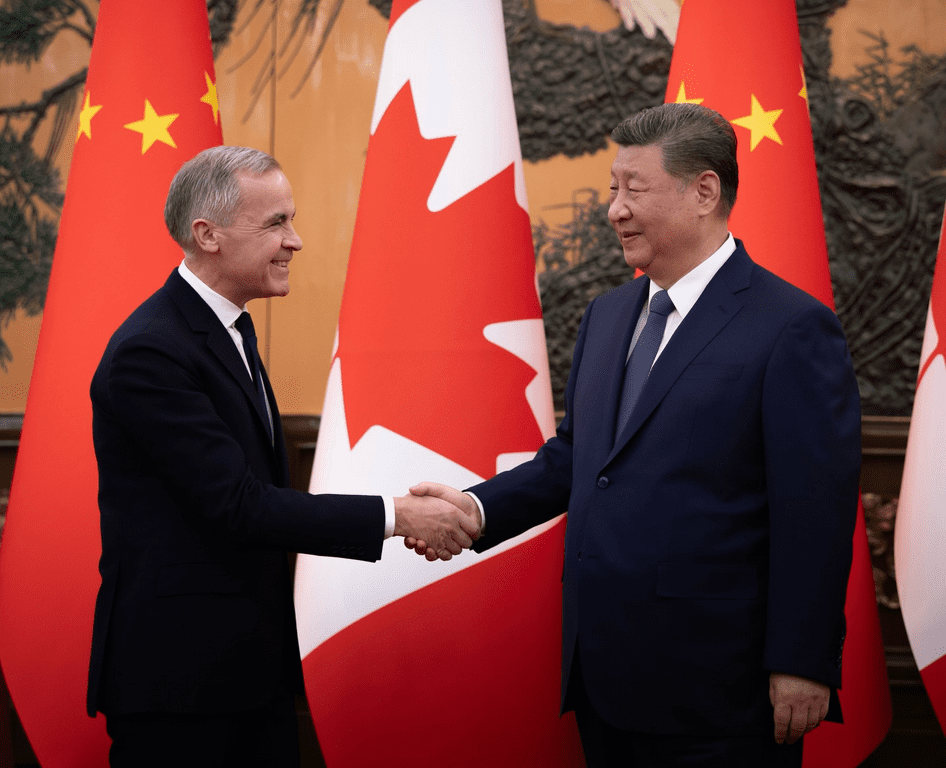
Relations between Canada and China have improved since the recent meeting in China between Canadian Prime Minister Mark Carney and China’s President Xi Jinping. Photo: Mark Carney
AUSTRALIA looks set to face increased competition on canola following an improvement in trade relations between China and Canada.
On Friday, the Canola Council of Canada and Canadian Canola Growers Association issued a statement welcoming the announcement made that day in Beijing.
Under the bilateral Canada-China agreement, China is expected to reduce its tariffs on Canadian canola seed from 84 percent currently to 15pc from March 1; the current 100pc tariff on canola meal is expected to be removed until at least the end of 2026.
In a trade-off, Canada will allow in up to 49,000 Chinese electric vehicles with a 6.1pc tariff, down from the 100pc tariff imposed under former Canadian Prime Minister Justin Trudeau.
The news follows a visit by Canadian Prime Minister Mark Carney to China.
“The agreement reached on canola seed and meal is an important milestone in Canada’s trading relationship with China,” CCC president and chief executive officer Chris Davison said.
“The Canadian canola industry has been clear since the outset that these tariffs are a political issue requiring a political solution.
“We are pleased to see significant progress in restoring market access for seed and meal and will continue to build on this development by working to achieve permanent and complete tariff relief, including for canola oil, moving forward.”
“With most of the 2025 canola crop stored on farm, and planting of the 2026 crop only months away, canola farmers are looking for predictability and confidence in the ability to market their canola,” CCGA president and CEO Rick White said.
“We are pleased to see this significant progress and will be looking for resumption of canola movement in the future.”
Because of the tariffs, Canadian 2025 exports of canola and canola products to China are expected to be less than half those of 2024 in value terms.
China was traditionally Canada’s largest market for canola seed and, prior to the imposition of tariffs by the US’ Trump Administration, its second largest for canola meal.
“With the impacts of this trade disruption being felt across the entire Canadian canola value chain, we welcome meaningful progress to restore smoother, more predictable trade,” Mr Davison and Mr White jointly said in the statement.
“We greatly appreciate the efforts of Prime Minister Carney and the Government of Canada, including Agriculture and Agri-Food Minister Heath MacDonald, to re-establish bilateral trade with our second-largest export market.”
The Canadian canola industry has recognised the establishment of a Canada-China Economic and Trade Cooperation Roadmap, and the revitalised Canada-China Joint Agriculture Committee.
“These avenues for collaboration build on the work of the Canada-China Joint Economic and Trade Commission and will be important mechanisms for advancing remaining canola tariff issues,” the joint statement said.
The CCC is a full value-chain organisation representing canola growers, processors, life science companies, and exporters.
Its mission is to facilitate market access and strategic development and enable industry innovation to grow the value and profitability of Canadian canola.
CCGA represents canola farmers on national and international issues, policies, and programs that impact farm profitability.
Impact for Australia
ABARES and others estimate Australia’s canola harvest, now almost over, to have yielded its second-biggest crop ever, seen by ABARES in early December at 7.23 million tonnes (Mt), below only the 8.44Mt crop in 2022-23.
Australia crushes around 1Mt of canola annually, and exports the balance.
Australian export data shows Australia shipped its first cargo of canola to China since 2020 in November, with the business ostensibly reopening in response to the China-Canada trade stoush.
In the Lachstock Supply and Demand Report – Canola released today, Lachstock Consulting said Canada had harvested another very large canola crop, with record yields and a heavy carry-in keeping supply ample.
“Domestic crush remains the key absorber, running near capacity and underpinning margins near US$150/t on firmer vegetable-oil prices and a weaker Canadian dollar.
“Export demand has been the constraint, but the outlook has shifted with China resetting tariffs.”
Assuming Australia continues to face a standard import tariff of around 9pc, equating to roughly US$30/t at current values, Lachstock said Canadian seed looked to remain around 6pc worse off than Australia once its seed tariff into China drops.
“Canola meal tariffs will revert to the standard 5pc, restoring Canadian access and increasing competition for Australian meal exports.
While weekly Canadian exports have lifted modestly…crop-year-to-date shipments of 2.8Mt remain well behind last year’s 4.7Mt, reinforcing the supply overhang unless trade flows materially improve.
“Prime Minister Carney’s engagement with China is a key watchpoint, with meal and oil access improving, though seed access remains only partially restored and still less competitive than Australia.”
Europe is traditionally the major market for Australia’s non-GM canola, and Lachstock said its big domestic crop dampened nearby demand for Australian seed.
“Import demand has been subdued as local availability competes strongly with offshore origins, though Australian canola has seen improved flows into December as new-crop became available,” Lachstock said of the European market.
“Ukraine remains the largest supplier, with Australia holding second position.
“Rapeseed oil prices have softened despite firmer futures, as higher meal values lift crush margins and pressure oil.”
Lachstock said EU biodiesel policy remained the key structural support for vegetable-oil demand, but near-term import appetite was capped by supply.
Grain Central: Get our free news straight to your inbox – Click here