Company Logo
Opportunities include enhanced risk-based procurement, supplier diversification, robust packaging, and regional inventory strategies in response to evolving compliance and supply chain complexities
Triflyl Chloride Market
Triflyl Chloride Market · GlobeNewswire Inc.
Dublin, Jan. 19, 2026 (GLOBE NEWSWIRE) — The “Triflyl Chloride Market – Global Forecast 2026-2032” has been added to ResearchAndMarkets.com’s offering.
The triflyl chloride market is undergoing significant transformation as industry leaders adapt to evolving synthesis technologies, complex compliance landscapes, and increased scrutiny on supply chain operations. Senior decision-makers require clear, actionable insights to align procurement, sourcing, and regulatory strategies in a sector shaped by reagent precision and operational reliability.
Market Snapshot: Triflyl Chloride Market Size and Demand Trends
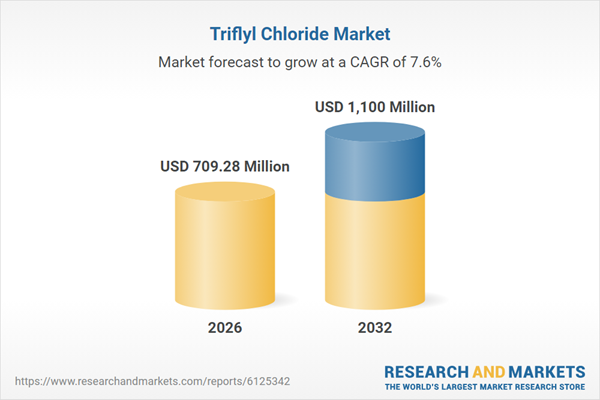
Triflyl chloride’s market value rose from USD 660.86 million in 2025 to USD 709.28 million in 2026, with sustained momentum forecasted at a CAGR of 7.62%, and estimates reaching USD 1.10 billion by 2032. This accelerated growth is supported by the compound’s central role in advanced chemical synthesis, enabling new pharmaceutical routes, optimizing agrochemical production, and facilitating the development of specialty materials. Market participants are responding by tightening supply chain controls, increasing investment in quality management systems, and implementing robust risk mitigation processes to address challenges inherent to this highly reactive, moisture-sensitive reagent.
Scope & Segmentation of the Triflyl Chloride Market
-
End-User Industries: Pharmaceuticals, agrochemicals, specialty materials, and fine chemical intermediates are primary sectors benefitting from triflyl chloride’s advanced route-enabling and activation properties. Their requirements drive specifications for reagent performance and supplier reliability.
-
Application Segments: The compound is critical for triflate formation, selective coupling reactions, process streamlining, and multi-step synthesis applications where efficiency and yield improvement are crucial.
-
Product Grades: Research and development phases prioritize rapid delivery and adaptability in specifications, while full-scale commercial operators require triflyl chloride with low impurity profiles, validated documentation, and maintained change-control protocols.
-
Packaging & Logistics: Emphasis is placed on moisture-protective containers, rigorous dangerous goods compliance, and secure storage that preserves chemical integrity through distribution and handling.
-
Regional Coverage: In the Americas, supply resilience and robust warehousing are focal points; EMEA concentrates on aligning with regulatory and sustainability standards; Asia-Pacific leverages manufacturing depth and expansive, integrated supply chains.
-
Procurement Channels: Direct sourcing is prevalent where qualification rigor and transparency are critical, while distributor-based approaches support flexibility for smaller buyers and agile R&D teams, shaped by stringent hazardous material handling protocols.
By understanding these market dynamics, decision-makers can enhance their strategic planning and secure a competitive advantage by efficiently aligning procurement and compliance strategies.
Key Takeaways from This Report
-
Risk-based procurement is increasingly prioritized over routine sourcing, with quality control and logistical reliability at the forefront of strategic planning.
-
Supplier qualification incorporates impurity management, extensive documentation, and digital quality monitoring systems consistent with stringent regulatory environments.
-
Diversifying supplier networks and expanding inventory management buffers are fundamental strategies for minimizing supply disruptions from logistics or policy shifts.
-
Competitive differentiation depends more on value-added aspects such as robust packaging, technical consultancy, and order fulfillment reliability than on reagent price alone.
-
Procurement choices align closely with an organization’s infrastructure: advanced hazardous materials capability supports bulk procurement and stable agreements, while contract research and agile operations opt for small pack sizes and fast delivery.
-
Regional variations shape compliance rigor and logistics; however, global buyers aim to harmonize product requirements where feasible to streamline operational complexity.
This report provides vital insights for decision-makers by identifying opportunities and mitigating risks through strategic investment and procurement optimization in the triflyl chloride market.
Key Attributes
|
Report Attribute
|
Details
|
|
No. of Pages
|
192
|
|
Forecast Period
|
2026-2032
|
|
Estimated Market Value (USD) in 2026
|
$709.28 Million
|
|
Forecasted Market Value (USD) by 2032
|
$1100 Million
|
|
Compound Annual Growth Rate
|
7.6%
|
|
Regions Covered
|
Global
|
Key Topics Covered
1. Preface
2. Research Methodology
3. Executive Summary
3.1. Introduction
3.2. CXO Perspective
3.3. Market Size & Growth Trends
3.4. Market Share Analysis, 2025
3.5. FPNV Positioning Matrix, 2025
3.6. New Revenue Opportunities
3.7. Next-Generation Business Models
3.8. Industry Roadmap
4. Market Overview
4.1. Introduction
4.2. Industry Ecosystem & Value Chain Analysis
4.2.1. Supply-Side Analysis
4.2.2. Demand-Side Analysis
4.2.3. Stakeholder Analysis
4.3. Porter’s Five Forces Analysis
4.4. PESTLE Analysis
4.5. Market Outlook
4.5.1. Near-Term Market Outlook (0-2 Years)
4.5.2. Medium-Term Market Outlook (3-5 Years)
4.5.3. Long-Term Market Outlook (5-10 Years)
4.6. Go-to-Market Strategy
5. Market Insights
5.1. Consumer Insights & End-User Perspective
5.2. Consumer Experience Benchmarking
5.3. Opportunity Mapping
5.4. Distribution Channel Analysis
5.5. Pricing Trend Analysis
5.6. Regulatory Compliance & Standards Framework
5.7. ESG & Sustainability Analysis
5.8. Disruption & Risk Scenarios
5.9. Return on Investment & Cost-Benefit Analysis
6. Cumulative Impact of United States Tariffs 2025
7. Cumulative Impact of Artificial Intelligence 2025
8. Triflyl Chloride Market, by Application
8.1. Agrochemicals
8.1.1. Fungicides
8.1.2. Herbicides
8.1.3. Insecticides
8.2. Pharmaceuticals
8.2.1. Catalyst
8.2.2. Drug Synthesis
8.2.3. Intermediates
8.3. Polymers & Materials
8.3.1. Polymer Modification
8.3.2. Surface Treatment
8.4. Specialty Chemicals
8.4.1. Dye Intermediates
8.4.2. Flame Retardants
8.4.3. Surfactants
9. Triflyl Chloride Market, by Production Process
9.1. Batch
9.1.1. Large Scale Batch
9.1.2. Small Scale Batch
9.2. Continuous
9.2.1. Fully Continuous
9.2.2. Semi Continuous
10. Triflyl Chloride Market, by Purity Grade
10.1. Industrial Grade
10.2. Laboratory Grade
10.3. Technical Grade
11. Triflyl Chloride Market, by Distribution Channel
11.1. Online Sales
11.1.1. Company Website
11.1.2. E-Commerce Platforms
11.2. Offline Sales
12. Triflyl Chloride Market, by Region
12.1. Americas
12.1.1. North America
12.1.2. Latin America
12.2. Europe, Middle East & Africa
12.2.1. Europe
12.2.2. Middle East
12.2.3. Africa
12.3. Asia-Pacific
13. Triflyl Chloride Market, by Group
13.1. ASEAN
13.2. GCC
13.3. European Union
13.4. BRICS
13.5. G7
13.6. NATO
14. Triflyl Chloride Market, by Country
14.1. United States
14.2. Canada
14.3. Mexico
14.4. Brazil
14.5. United Kingdom
14.6. Germany
14.7. France
14.8. Russia
14.9. Italy
14.10. Spain
14.11. China
14.12. India
14.13. Japan
14.14. Australia
14.15. South Korea
15. United States Triflyl Chloride Market
16. China Triflyl Chloride Market
17. Competitive Landscape
17.1. Market Concentration Analysis, 2025
17.1.1. Concentration Ratio (CR)
17.1.2. Herfindahl Hirschman Index (HHI)
17.2. Recent Developments & Impact Analysis, 2025
17.3. Product Portfolio Analysis, 2025
17.4. Benchmarking Analysis, 2025
17.5. Ambeed, Inc.
17.6. Apollo Scientific Ltd.
17.7. BLD Pharmatech Ltd.
17.8. Capot Chemical Co., Ltd.
17.9. Central Glass Co., Ltd.
17.10. Changzhou Weijia Chemical Co., Ltd.
17.11. Combi-Blocks Inc.
17.12. Hangzhou FandaChem Co., Ltd.
17.13. Hangzhou MolCore BioPharmatech Co., Ltd.
17.14. Huzhou Liheng Chemical Co., Ltd.
17.15. Jiangsu Yongtai Chemical Co., Ltd.
17.16. Matrix Scientific
17.17. Merck KGaA
17.18. Oakwood Products, Inc.
17.19. Santa Cruz Biotechnology, Inc.
17.20. Shanghai Canbi Pharma Ltd.
17.21. Shanghai Yayu Biological Technology Co., Ltd.
17.22. Sigma-Aldrich Co. LLC
17.23. Solvay S.A.
17.24. SynQuest Laboratories, Inc.
17.25. Tokyo Chemical Industry Co., Ltd.
17.26. Zhejiang Hailan Chemical Group Co., Ltd.
17.27. Zhejiang Weihua Chemical Co., Ltd.
For more information about this report visit https://www.researchandmarkets.com/r/g1y1mp
About ResearchAndMarkets.com
ResearchAndMarkets.com is the world’s leading source for international market research reports and market data. We provide you with the latest data on international and regional markets, key industries, the top companies, new products and the latest trends.
Attachment
CONTACT: CONTACT: ResearchAndMarkets.com Laura Wood,Senior Press Manager press@researchandmarkets.com For E.S.T Office Hours Call 1-917-300-0470 For U.S./ CAN Toll Free Call 1-800-526-8630 For GMT Office Hours Call +353-1-416-8900