
Paul Meyer is a fellow in international security and adjunct professor of international studies at Simon Fraser University, and a director of the Canadian Pugwash Group.
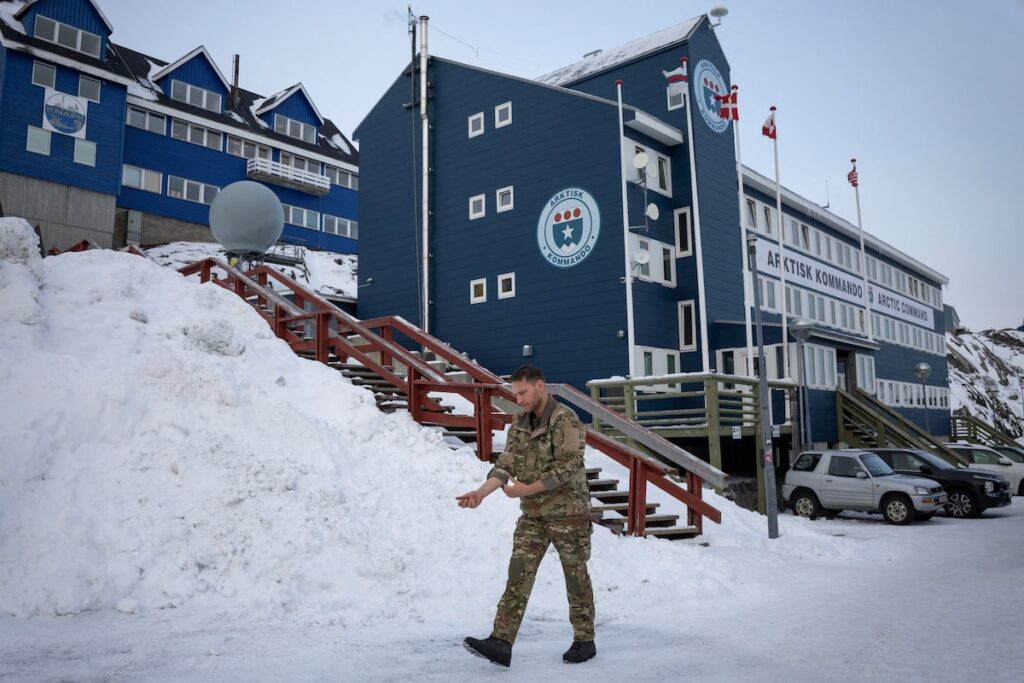
A Danish soldier walks in front of Joint Arctic Command in Nuuk, Greenland on Friday.Marko Djurica/Reuters
In the current geopolitical environment, and particularly in the wake of Russia’s aggression against Ukraine, we have seen frequent references to NATO’s Article 5: the “one for all and all for one” obligation of allies to assist one another in the face of attack.
Less attention is paid to the article of the North Atlantic Treaty that immediately precedes it. Article 4 stipulates that “The Parties will consult together whenever, in the opinion of any of them, the territorial integrity, political independence or security of any of the Parties is threatened.” Once Article 4 is invoked, it would prompt a meeting of the North Atlantic Council (NATO’s permanent ambassador-level body) to consider and respond to this threat. This provision for collective consultations has rarely been invoked, but last September, both Poland and Estonia on separate occasions triggered an Article 4 meeting in light of hostile Russian actions.
Unfortunately, alliance members are currently facing threats to their sovereignty from an unexpected source: the hitherto-undisputed leader of NATO, the United States. We are by now all painfully aware of the bellicose language coming out of Donald Trump’s White House that has been directed at NATO members. From bald assertions that the U.S. needs to “own” Greenland, the semi-autonomous territory of Denmark, to sustained pressure for Canada to become “the 51st state,” the alliance is being confronted for the first time in its history with a fellow member threatening the political independence and territorial integrity of another ally. These actions are incompatible with NATO’s foundational treaty, not to mention the UN Charter.
Trump’s annexation threats raise thorny questions for Greenland and Denmark
Given the importance of the broader bilateral relationship with the United States that most NATO members have, there has been a tendency for concerned governments to ignore or downplay this aggressive rhetoric. The situation has produced convoluted statements such as that of Prime Minister Mark Carney earlier this month: “We stand with Denmark. We stand with Greenland. Our closest partnership is with the United States, and we’ll work with everybody to make sure that we move forward together,” he said.
The Danes have also tried to keep a low profile regarding the escalating American claims to annex Greenland. But Mr. Trump’s recent provocations and disinformation (his false claims that Chinese and Russian warships are patrolling Greenland’s shores) have reached the point that the Danish Prime Minister felt obliged to retort that if the U.S. made a military grab on Greenland, that would be the end of NATO. Denmark also showed its support for Greenland’s defence by announcing the addition of aircraft, ships and soldiers in and around the area.
Last week, Denmark and Greenland’s Foreign Ministers met in Washington with U.S. Vice-President JD Vance and Secretary of State Marco Rubio, but after the meeting, the Danish side indicated that “a fundamental disagreement” remained. In a scramble to show support for Denmark, some European allies will be sending military representatives to Greenland, although this looks to be an essentially symbolic move; Britain and the Netherlands are contributing a single officer, Norway will send two, and Germany is sending the largest contingent, at 13. Canada might consider having our Governor-General and Foreign Minister arrive onboard a Canadian warship when they travel to Nuuk in February.
Denmark’s foreign minister says a ‘fundamental disagreement’ over Greenland remains with U.S. President Donald Trump after talks in Washington with Vice President JD Vance and Secretary of State Marco Rubio, though both sides agreed to form a working group to find a ‘common way forward.’
The Associated Press
One would have assumed NATO Secretary-General Mark Rutte would have been quick to defend the crucial principle of respect for allied sovereignty, especially given that he had previously served as the prime minister of the Netherlands. But Mr. Rutte has failed to uphold the core tenet of the alliance. He has engaged in cringe-worthy sycophancy in his fawning reference to Mr. Trump as “Daddy” and has reportedly kept silent in White House meetings while his host indulges in verbal assaults on the sovereign independence of NATO members.
Trump’s Greenland aggression poses unforeseen threat to NATO alliance
It may be time for Canada and Denmark, separately or together, to seek an institutional response to Mr. Trump’s undermining of allied solidarity. Invoking Article 4 would force a meeting of the North Atlantic Council to consider the threat being posed to Canada’s and Denmark’s political independence and territorial integrity. The actual proceedings would be confidential, but the fact that a meeting was convened would be public knowledge, which would constitute a public rebuke of the Trump administration’s irresponsible rhetoric. It would also provide an occasion for reprimanding Mr. Rutte for his failure to stand up for the inviolability of the sovereignty of NATO members in the face of solidarity-eroding American hostility. Even if the only public outcome is a blandly worded statement reaffirming NATO’s core principles and mutual respect for the sovereign independence of all allies, it would still be a worthwhile endeavour.