
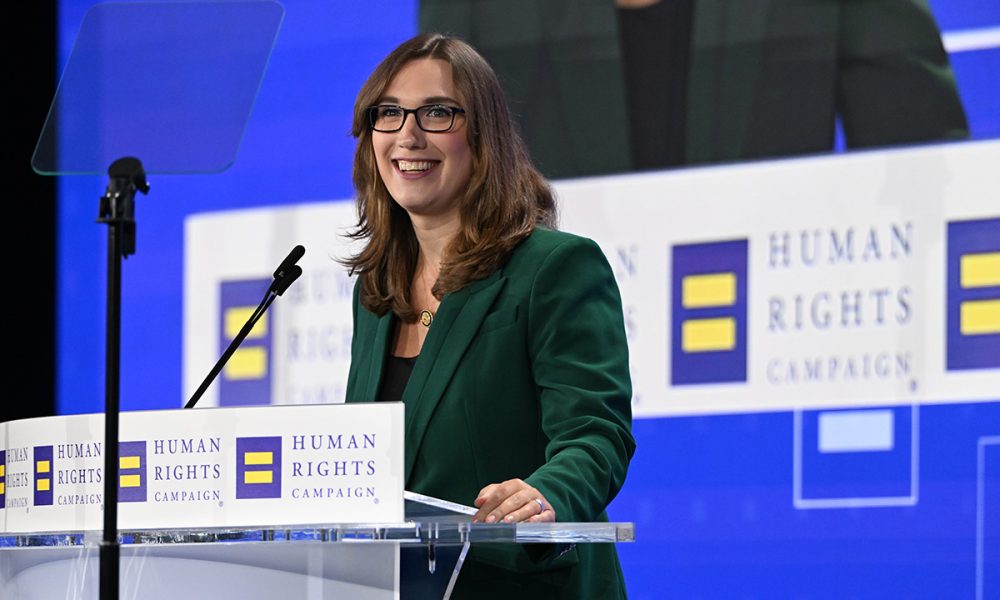
It has been just over two years since George Santos — the disgraced politician who once represented New York’s Third District — was expelled from Congress. Now, Santos is breaking his silence about his expulsion, imprisonment, subsequent pardon, what he believes he did wrong, and allegations regarding immigration fraud.
In 2022, Santos was elected to represent the Long Island communities of North Hempstead, Glen Cove, and Oyster Bay, one of the wealthiest congressional districts in the United States. This week, he sat in the lobby of the Hyatt Capitol Hill, just blocks from his former office in the Cannon House Office Building, to speak with the Washington Blade about how he became the center of one of the most outrageous political scandals in modern U.S. history. Despite the media scrutiny surrounding his lies, criminal convictions, and eventual pardon by President Donald Trump, Santos appeared relaxed during the interview, speaking freely about his experiences, admissions, and grievances.
Scope of Santos’s misconduct
Many journalists have struggled to verify George Santos’s personal history and professional resume. Numerous claims he made during his campaigns have been debunked or walked back, particularly regarding his personal and professional history since 2020.
Santos gained media attention for claiming Jewish heritage despite being raised Catholic and identifying as Catholic. He said his maternal grandfather grew up Jewish, converted to Catholicism before the Holocaust, and raised his children Catholic. Investigations, however, show his maternal grandparents were born in Brazil, not Ukraine or Belgium. Santos described himself variously as “Jew-ish,” “half Jewish,” a non-observant Jew, a “proud American Jew,” and a “Latino Jew.”
He also misrepresented his mother’s professional history, claiming she was “the first female executive at a major financial institution.” Records, including her 2003 visa application, show she had not been in the U.S. since 1999 and listed her occupation as a domestic worker.
Santos further fabricated his educational history, claiming a bachelor’s degree in finance and economics from Baruch College, where he said he graduated near the top of his class. Investigations revealed he never graduated. He also falsely claimed an MBA from New York University on official campaign documents — a misrepresentation that later became grounds for his expulsion. Santos later blamed the lies on a local Republican Party staffer.
His professional claims were also fraudulent. Santos called himself a “seasoned Wall Street financier and investor” and claimed to have worked for Citigroup and Goldman Sachs. Both companies reported no record of his employment. When pressed, Santos admitted he had used a “poor choice of words,” eventually describing his experience as “limited partnerships.” He also falsely claimed to have lost four employees in the 2016 Pulse nightclub shooting in Orlando; no victims had any connection to companies listed in his biography.
Santos misrepresented his residences during his 2020 campaign. He listed an Elmhurst, Queens, address outside the district he sought to represent, later moving with his partner to a Whitestone rowhouse. He was registered to vote at the Whitestone address but did not live there.
When asked about his lies, Santos told the Blade he wishes he did everything differently.
“Everything, everything, everything,” Santos told the Blade. “I made so many poor choices that I think it would be redundant to not say everything.”
He did not fully take responsibility, describing the scandals as a mix of personal ambition and what he called a “sensational political assassination.”
“Ambition is a toxic trait, and unfortunately, I was consumed by that. I forewent everyone else’s [considerations]… I had no consideration for anything around me other than myself, and that’s awful,” he added.
In addition to personal history fabrications, Santos made numerous false claims the Department of Justice later treated as campaign finance fraud. He solicited donations through a fake political entity, diverted funds into an LLC he controlled, and disguised personal expenditures as legitimate political expenses, using donations for luxury purchases.
Santos denied wrongdoing, stating, “I didn’t steal people’s credit cards… I didn’t go shopping at Hermes and Onlyfans. It’s not true either.”
He defended some purchases as campaign-related, singling out House Ethics Committee Chairman Michael Guest.
“The only two luxury brands that you’ll see of purchases in my campaign were Ferragamo and Tiffany. [I got] Ferragamo for the [male members of the] Republican steering committee when I was lobbying for my seat committee and three Tiffany pens for the females … That’s where those are legal expenses. They’re very legal.”
The House Ethics Committee found “substantial evidence” of lawbreaking, stating Santos “fraudulently exploited every aspect of his House candidacy,” using campaign funds for luxury shopping, cosmetic procedures, travel, and rent.
“I had a choice to not straw donate to my campaign, and I chose to, yeah, that was a poor choice,” Santos admitted. “Of course, I’m guilty for that. Was I forthcoming in the GOP with the party? No, I was not. I was very dishonest with the GOP, and for that I regret, and I also regret that the GOP in New York created an environment that made somebody like me feel it was needed to do that. But I regret not being forthcoming and honest about it.”
Santos also collected pandemic unemployment payments of approximately $24,000 while employed.
He was charged with multiple federal offenses, including conspiracy to commit offenses against the United States, wire fraud, making materially false statements to the FEC, falsifying records, aggravated identity theft, access device fraud, money laundering, and theft of public funds. Santos pleaded guilty to wire fraud and aggravated identity theft and was sentenced to 87 months in prison in April 2025, ordered to pay hundreds of thousands in restitution and forfeiture. He was released from the Federal Correctional Institution in Fairton, N. J., following Trump’s pardon in October.
Immigration fraud allegations
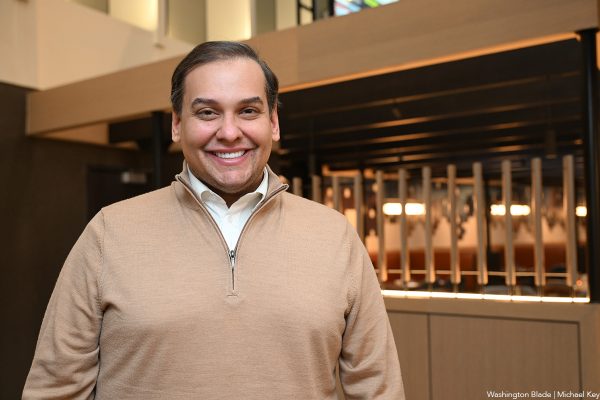 George Santos (Washington Blade photo by Michael Key)
In addition to the professional and personal claims Santos has made that have been proven false, he also addressed allegations of immigration fraud raised by the Washington Blade. A source familiar with Santos’s history with U.S. immigration proceedings described several alarming allegations, most notably a reportedly fraudulent marriage to his former wife, Uadla Viera, to help her obtain U.S. immigration status. Santos has adamantly denied wrongdoing.
According to the source, who spoke to the Blade on condition of anonymity, Santos married Viera in a civil ceremony in Manhattan in 2012, despite neither living in the city. There are no known photos, announcements, or records of a wedding celebration, engagement, bridal party, shower, or honeymoon. This unusual lack of documentation stands out for Santos, whose life and actions are typically geared toward media attention.
While the source questioned the motive behind the marriage, Santos insisted it was legal and not done for any nefarious purpose.
“I married a person who was legally in this country, and all in all, what I did was kind of skip the line for her. And we were married, and there was no financial benefit [for me]. We were married. We had bills together. There’s no proof or evidence of a financial benefit other than jaded people again, anonymously, lying saying ‘He got paid. He offered me money.’ First of all, I don’t even have the wherewithal for that. Second of all, we went through a very rigorous — fucking rigorous — immigration litmus test, house interviews, multiple layers of interviews, a consummate marriage that was very obvious for anybody who was around us, and then I ended up cheating for now, obvious reasons.”
In 2013, the source said Santos dated Leandro Bis, a Brazilian tourist, while still married to Vieira. Santos denies this, framing the period as tumultuous and asserting that he was merely helping someone in need who now falsely alleges more. Bis told ABC News in a 2023 interview that Santos had “promised the world” to him while they dated.
“I’ve never dated a Leandro,” Santos told the Blade. “I can’t believe that six months of my life are common stories in the New York Times. This lunatic is going on TV and putting himself out there…I look so much better than him, and I’m much older than him. I mean life does numbers on people, because hate is a virus.”
The source further recounted Santos’s interactions with Greg Morey-Parker, a former roommate of Santos’s who told CNN that he was suspicious of Santos’s academic resume and stories of family wealth.
“Greg Morey-Parker is not a boyfriend– nowhere near a boyfriend,” Santos told the Blade. “He was actually a homeless Starbucks barista that I felt bad for. Let him crash in my living room. … He accused me of stealing his Burberry scarf. You’re homeless and you have a Burberry scarf? Bro, make up your fucking mind.”
In 2014, Santos met Pedro Vilarva, 18, on Tinder and dated him for a year while still married to Viera. According to the source, the trio socialized frequently: Santos and Vilarva with other gay men, Viera with heterosexuals. That same year, Santos filed a family-based immigration petition for Viera, who was granted conditional permanent residency. Santos publicly celebrated his engagement to Vilarva in a Facebook post at La Bonne Soupe, a Manhattan restaurant, though the relationship eventually ended. That Facebook post has since been deleted.
Santos maintains he was honest with both immigration authorities and his spouse.
“I was honest with immigration authorities, 100% above board. I was honest with my spouse, as far as my relationship with him and with my ex-wife, so much I’m the one who told her, I’m sorry we can’t do this anymore. I’m seeing Pedro. And she knew Pedro, it was a shit show. Okay? I’m gonna leave it at that, out of respect to both her and Pedro … I cheated on my first wife, and that was a whole story on its own.”
Later in 2014, Santos met Morey-Parker, who told the Daily Beast that Santos advised him to marry an immigrant woman from Brazil to make money. Santos denied that claim to the Blade.
“That is Gregory again making more shit up and there’s no proof or evidence or anything that you can point to,” Santos said.
Viera became a permanent resident in 2017, according to previous media reports, and in 2018 gave birth to a daughter. Santos did not claim paternity or seek custody. Santos and Viera were granted an uncontested divorce in 2019. Viera became a U.S. citizen in 2022 and purchased a $750,000 home in New Jersey, according to the Blade’s source and to the official deed of the property.
Santos did not mention that he had been married or divorced during his congressional campaigns until an internal vulnerability study commissioned by the campaign identified it as a potential issue for voters.
Santos downplayed all of this, saying it was a running joke among his staff. “I would be a joke. I would allude to it [and say] ‘Ladies, look, I love you guys, but there’s a reason that I don’t date women anymore, and I’m divorced from my first wife.’ It was like a running joke, making light of it and self-deprecating humor, which is my favorite kind of humor.”
He claimed that the New York Times story was the reason he became more sensitive with posts related to his ex-wife.
“The reason it’s not [visible] today is because I pulled it all off because of privacy issues. It was all archived for my Instagram, but if you had access to my Instagram prior to the New York Times story, you would see I never deleted my pictures with her…They were all over my Instagram, going to the beach, like everything. It’s like our entire life was documented together.”
On Trump, politics, and public office
Santos was tight lipped when the Blade questioned him about his conversations with President Trump.
“You never, ever share a lick of a word you exchange with the sitting president of the United States, no matter who that person is… I’ve seen it backfire for people who did it with Biden, with Trump, with Obama. I’m not about to make that mistake. Yeah, my conversations with the president are private.”
He did say that he was humbled by Trump’s pardon but regrets ever entering politics.
“I had such a good life, and to have to be at the place I am today is indicative of, you know, politics is really for the elites…I’m so uninterested in politics these days…I want to get involved in policy change, but not politicking.”
He said he is not interested in a position in the Trump administration.
“I would respectfully decline [any government job], I would say thank you from the bottom of my heart, and say ‘I’m probably not best suited for a job in government.’ I want nothing to do with the government or public office.”
Trans and LGBTQ issues
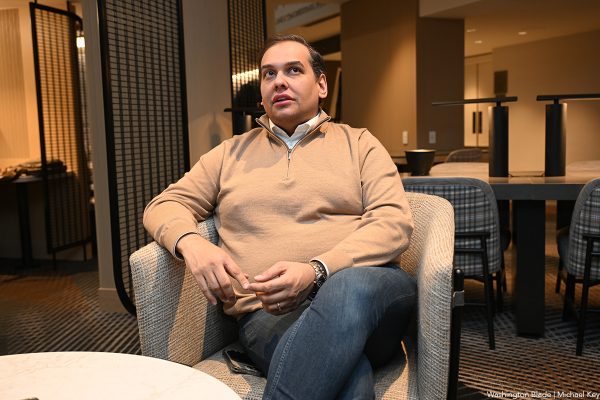 George Santos (Washington Blade photo by Michael Key)
Santos also spoke on his experience as both a member of the LGBTQ community and a Republican legislator. Most notably, he doesn’t think there is any barrier for gay people to join the Republican Party, citing his ascent into Republican leadership as an example.
He defended his record as a gay Republican, noting the continued election and reelection of LGBTQ members of Congress and emphasizing that he disproved stereotypes about Republicans.
“There’s no bigotry in the Republican Party. It’s a matter of how you present yourself…I’m not saying there’s no anti-gay sentiment, I’m pretty sure there is, but I never experienced it.”
He continued, explaining how far-right figures gaining prominence within Republican circles sets off some tension.
“I know it exists… I mean Nick Fuentes exists, right? His followers go on my social media, and either call me a Jew or a homo all day long. But I’m proud of it. I’m proud that I was the first who didn’t conceal the fact that he’s gay, and still got elected by a constituency of Republicans in a landslide victory.”
It is important to note that Santos is the first openly LGBTQ non-incumbent Republican to be elected to Congress, not the first openly LGBTQ Republican to win an office. Santos won his seat with 53% of his district’s vote while his opponent, Robert Zimmerman, got 46%.
Santos spoke on his experience as a gay man, echoing other LGB Republicans who have distanced themselves from transgender rights.
“This is very controversial for me, but I don’t loop my issues in with the trans community issues. I’m a gay man. I’m gender conforming. I’m he/him/sir.”
He continued, saying all he can speak on is his experience as a gay man, which doesn’t inherently lend him to being a champion for transgender rights, unlike many other LGB elected officials have done.
“I’ve never walked in the shoes of a trans person, so I can’t speak for them.” Santos framed his stance on gender-affirming care carefully: “I believe those people deserve the right to treatment, and that’s fair. I don’t believe in a mass agenda of pushing children towards that. I think we need to have a sensible conversation of, let’s allow kids to get to a certain age, right? Let’s allow adults to make those decisions, not children…for permanent decisions like hormone blockers and puberty blockers…that should be with adults.”
This is despite general medical consensus that views gender-affirming care as medically necessary, appropriate, and potentially life-saving for trans youth. The American Medical Association, the largest medical association in the country, opposes state laws that interfere with or ban gender-affirming care, calling such actions harmful and contrary to medical evidence.
Prison experience
Santos also spoke explicitly about what he says are dehumanizing conditions at FCI Fairton, something that has given him a new passion following his release from the facility.
“It’s punitive and dehumanizing,” he said when describing the situation he was in.
“Black mold bubbling all over the ceiling. Rat infestations… Listeria and ringworm outbreaks. Expired food… Underwear with skid marks… either wear that or don’t wear underwear.”
He continued, emphasizing the dehumanizing treatment he says he received, and hoping it will lead to prison reform.
“Solitary confinement for 41 days. Three showers a week. One 15-minute phone call every 30 days. [The warden] an absolute vicious human being. … We need to rehabilitate people. Just make it humane.”
Santos hinted at a future in media and activism, particularly related to prison reform, signaling that while he has stepped away from public office, he may still seek to influence policy and public discourse.
Despite his dramatic fall from political grace, Santos remains unapologetically in the public eye. From allegations of fraud to his prison experience and ongoing controversies, he presents a portrait of a man both shaped by — and defiant of — the consequences of his actions. Whether the public views him as a cautionary tale, a redeemed figure, or something in between, Santos’s story continues to provoke debate about accountability, ambition, and the limits of political power in America.