
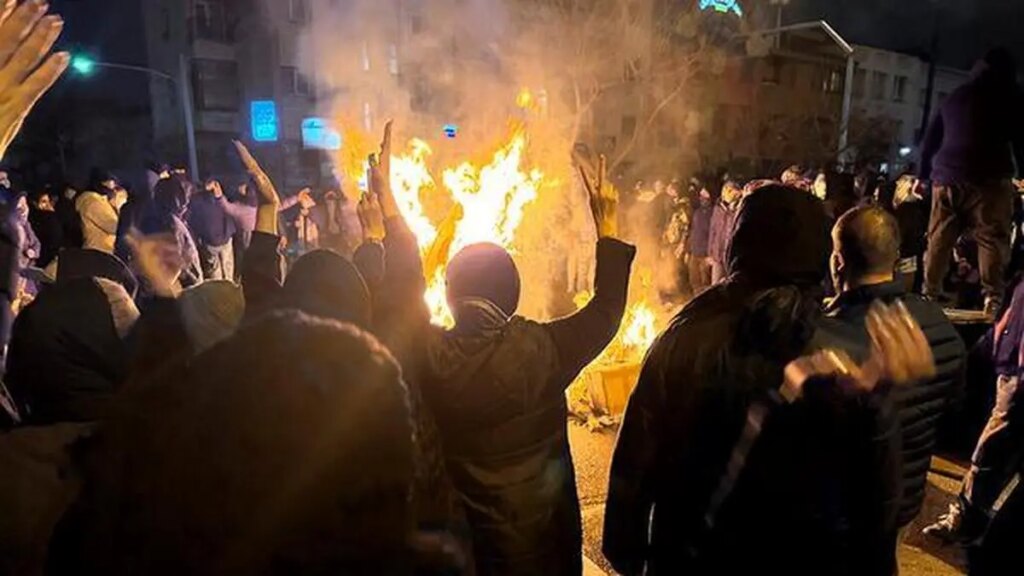
The global response of the Left (including in India) to the Iranian protests, which began as 2025 was coming to an end, against the repressive Islamic regime has been muted at worst and guarded at best. The reasons, as I gather from various sources close to home (including friends) and abroad, primarily include concerns regarding the US’ intervention as well as Israel’s connection in the matter. It is feared that a US-Israel intervention will spell disaster amidst the already fragile geopolitics of the region. This idea needs some unpacking.
The world witnessed Hollywood-style US blitzkrieg in Venezuela in the beginning of the new year. The US does not follow the codes of international law because it has the power to dictate that law. The consequences of its supremacy were evident back in the cold war of the last century when both the US and the erstwhile Soviet Union flouted international codes.
National interests merged with their desire for world supremacy. Ideological camps either rallied against or overlooked what happened in Czechoslovakia, Hungary, Poland, Vietnam, Cuba, Nicaragua, and Afghanistan, among other countries, depending on who the aggressor was. Acts of war and occupation were never completely about humanism, but political ideology. The rhetoric of siding with the “people” was always conditioned by which side one was on. This rational hypocrisy of the world’s powers has extended its career into the 21st century.
Iranians fighting the Ali Khamenei regime and dying in the thousands desperately require the world’s attention and solidarity. But their expectations must endure the calculations of ideological politics. Palestinians in Gaza resisting Israel’s unending brutality have found spontaneous support from the people who stand firmly against Israeli occupation and the Zionist project. Non-Muslims and secular Muslims who support the cause of Palestine are driven by a humanist sensibility. For Muslim believers, the suffering in Palestine represents oppression against the Umma. But drawing a distinction between these two positions can be crucial when it comes to opposing oppressive Islamic regimes.
Secular critics of Israel see the problem of Zionism not as a Jewish phenomenon alone but in the context of a global phenomenon of territorialising power in the name of a religious community abstracted from history. For instance, Faisal Devji argued in Muslim Zion: Pakistan as a Political Idea (2013) that Pakistan is a Zionist idea based on a solely religious nationalist identity.
The larger political point that can be made when history is seen through a secular lens is that the problem of political evil cannot be determined by ideological or religious camps that are fixed on a particular idea of the enemy. Evil can be identified in all repressive regimes around the world irrespective of their political and religious character. In the 20th century, rulers like Adolf Hitler, Joseph Stalin, Mao Zedong, Francisco Franco, Pol Pot, Kim II-sung, Ruhollah Khomeini, and Idi Amin brutally repressed their own people. US Presidents Harry S. Truman, Lyndon B. Johnson, Richard Nixon, George W. Bush, and now Donald Trump have repressed people belonging to other nations. The undeniable historical lesson here is that all political regimes—from fascist, communist, theocracies, to liberal democracies—are capable of being evil.
Lack of efforts for a consensus
I borrow the idea of political evil from the Marxist thinker Alain Badiou. In an interview in the winter 2001-2002 issue of Cabinet, Badiou says: “Who indeed today would defend the Stalinist terror, the African genocides, the Latin American torturers? Nobody. It’s there that the consensus concerning evil is decisive.” Contrary to Badiou’s optimism, there does not seem to be a consensus in the case of Iran. The irony is that the Left has abandoned efforts for a consensus. The philosophical definition of evil that Badiou offers in the interview is: “There is no natural definition of evil; evil is always that which, in a particular situation, tends to weaken or destroy a subject.” This aligns with my understanding of political evil.
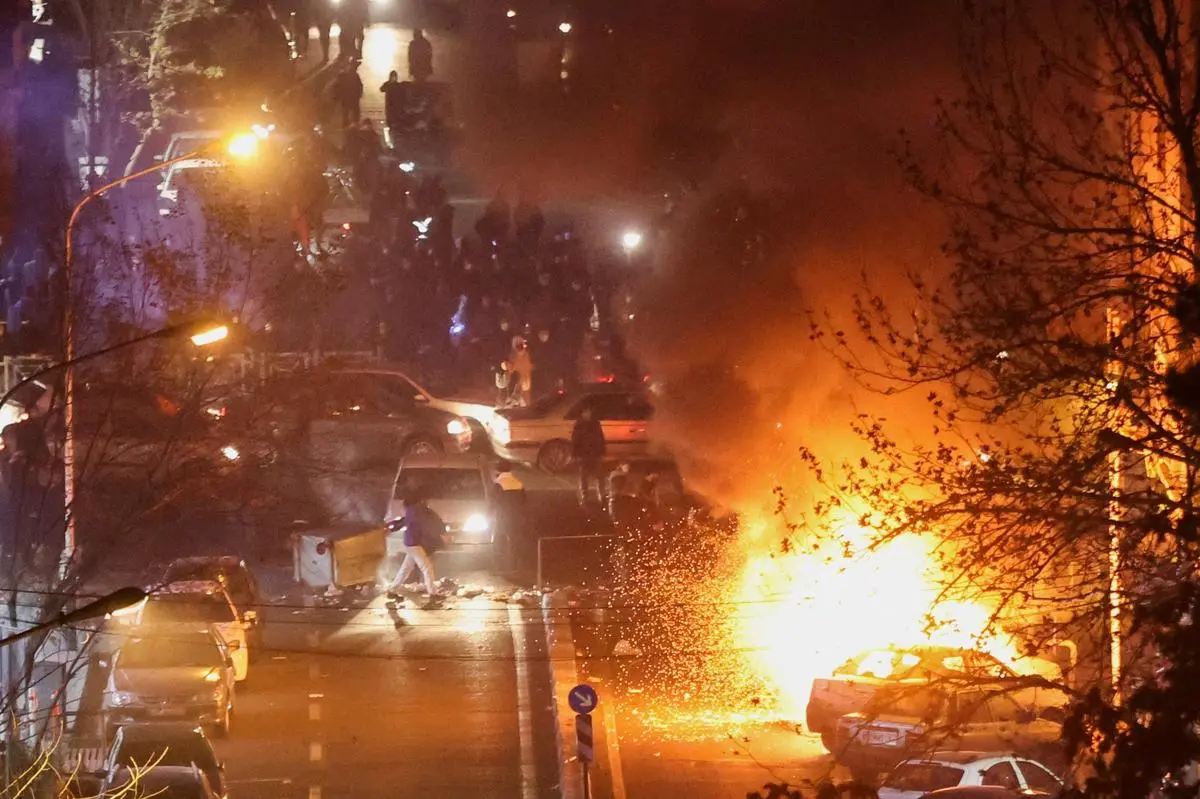
At one of the anti-government protests that have erupted across Iran, sparked by record-high inflation and currency depreciation, in Tehran on January 8, 2026.
| Photo Credit:
West Asia News Agency via Reuters
The Iranian regime has barbarically controlled and repressed lives within the Republic. The Iranian poet, Forugh Farrokhzad, wrote in the poem “Panjareh” (Window) in 1962, “When my trust was suspended from the fragile thread of justice / and in the whole city / they were chopping off my heart’s lanterns / when they would blindfold me / with the dark handkerchief of Law… I discovered / I must / must / must love, / insanely.” Farrokhzad’s frank rebellion in the lyric form embarrassed the Islamic regime that banned her work until 1979.
Iran’s brilliant filmmakers have often mutedly, and sometimes openly, addressed the problem of political coercion. In Abbas Kiarostami’s Taste of Cherry (1997), the central character Badi’s search for a man to carry out his burial after his planned suicide is kept ambiguous. There have been theological and existential readings of Badi’s crisis, but there is a clear lack of piety in his attempt at suicide that suggests an underlying secular concern with something that deeply bothers him. This can be read as the muted politics of the film.
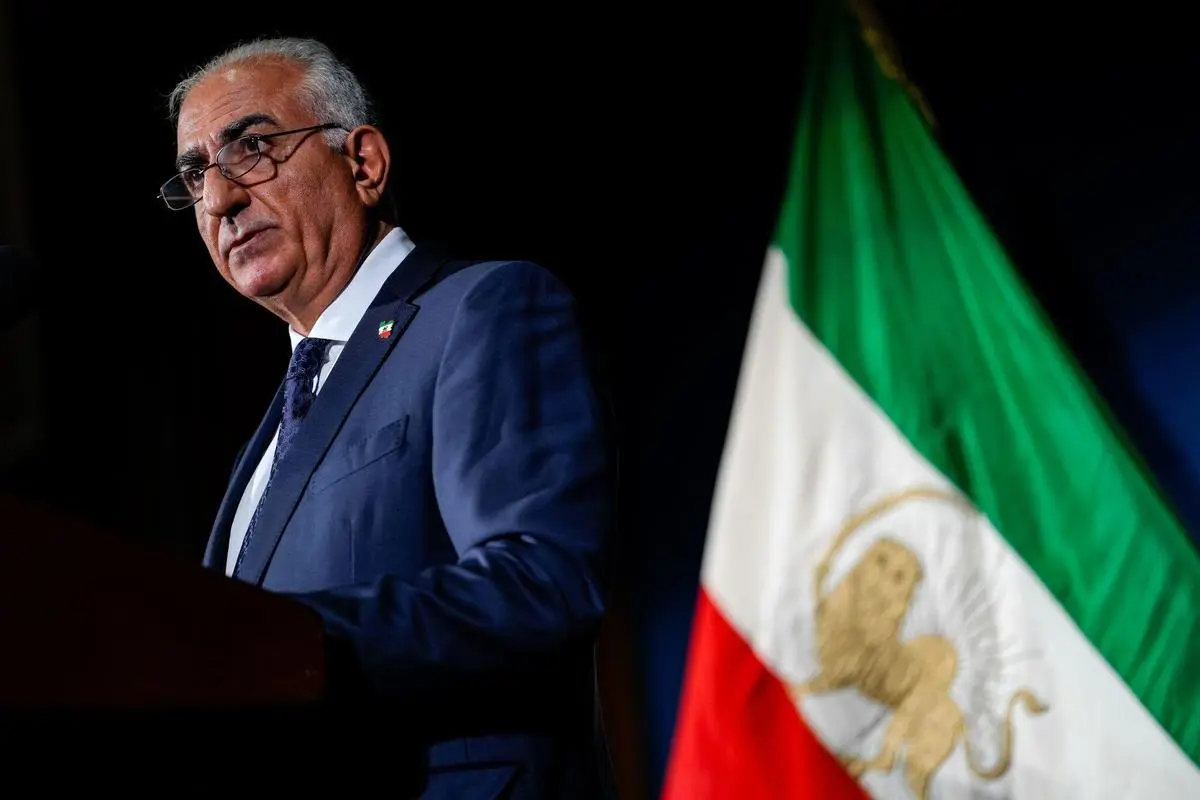
Reza Pahlavi, a prominent voice against the Iranian regime, at a news conference in Washington, DC, on January 16, 2026.
| Photo Credit:
Kent Nishimura/Bloomberg
Jafar Panahi took on the regime’s suppression of women boldly (and sometimes poetically, like other Iranian filmmakers whose sensibilities are rooted in the tradition of Persian poetry). In Ayneh (Mirror) in 1997 and Offside (2006) Panahi addresses the repressed culture of seclusion and the lack of women’s rights in public spaces, respectively. In Panahi’s short documentary film Hidden (2020), the last few haunting minutes features a Kurdish girl forbidden to perform, singing behind a cloth-screen.
In Reading Lolita in Tehran (2003), Azar Nafisi recounts her experience of being fired from her teaching position at Tehran University when she refused to wear the veil, and her final decision to emigrate. There are enough writings on the extrajudicial torture of political dissidents and staggering lists of cases of capital offenses in Iran. Badiou’s definition of evil applies to the Iranian regime that has weakened and destroyed lives in the last four-and-a-half decades.
More broadly in the Middle East, the Iranian regime has played a dubious role, particularly in arming, funding, and training non-state militias. It has of course stood for the Palestinian cause against the colonising projects of Israel, but this is in keeping with a narrow sentiment of religious fraternity and not a fundamental concern for human life. The point is that religious sentiments circumscribe even the seemingly genuine international concerns of the Iranian regime. These very sentiments make the regime disallow its own people the dignity of freedom.
Meanwhile, the global Left has been on Palestine’s side along with everyone else who have defended Palestinian resistance to Israel’s evil deeds. The Left in no time also responded to Trump’s violation of Venezuela’s sovereignty. Tariq Ali, a member of New Left Review’s editorial committee, unequivocally tweeted in solidarity with “Bolivarian Venezuela” (the socialist project initiated by Hugo Chávez) on January 3. Despite allegations by the UN and the Human Rights Watch of serious human rights violations by the Venezuelan President Nicolás Maduro, the US’ action was rightly seen as imperialistic.
Ali was, however, extremely tentative in his first reactions to the uprising in Iran. On January 14, he tweeted his concerns about the regime. Ali alleged that Mossad (Israel’s Institute for Intelligence and Special Operations) and Reza Pahlavi, one of the principal Iranian political voices opposing the regime, were together involved in creating unrest in Iran, and dreaded a “US/Israel takeover” as disaster for the region and a repeat of what US intervention did to Iraq, Syria, and Libya.
Ali, however, did not spare a single line of thought for the people of Iran, despite the concern he has relentlessly shown for the people of Palestine and recently for Venezuela. The news media Aljazeera that brought us daring and heartbreaking reports from Gaza preferred to quote Iran’s Foreign Minister on the images of state killings that appeared on social media and focussed on the threats of the US and the negotiations between the US and Iran.
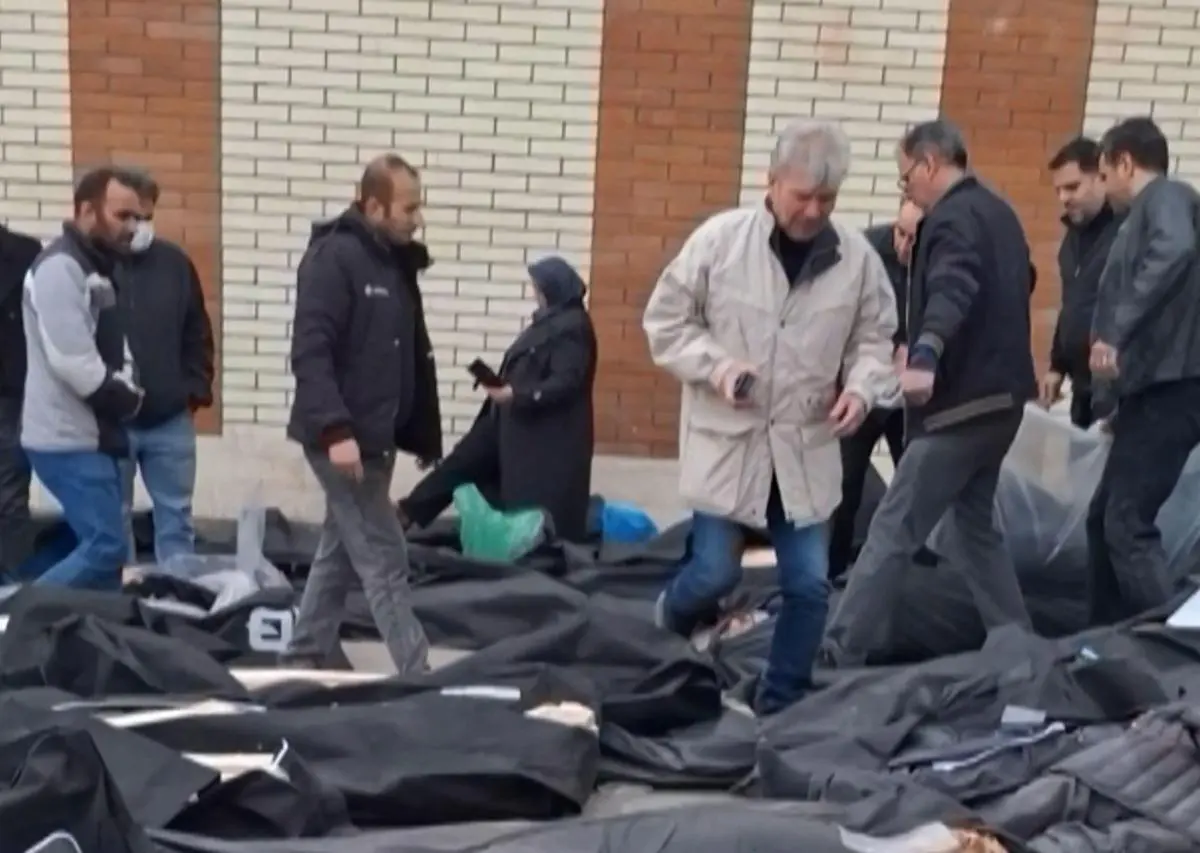
A screengrab from a video posted on social media on January 13, 2026, showing dozens of bodies on the ground as grieving people search for their loved ones, at the Forensic Diagnostic and Laboratory Centre of Tehran Province in Kahrizak.
| Photo Credit:
Anonymous source/AFP
Thus, there is a deliberate, calculated silence on Iran among people across the world, particularly those who have been vocal about Gaza. It appears that geopolitical concerns are more valuable to some than human lives. Iranians on social media have conveyed their shock on the indifference of the global Left. Suddenly, the gaze of the world has shifted from the Iranian regime to US conspiracy.
Progressives are circulating these conspiracy theories. It is a consequence of the ideological game of evil that arguments claiming to be objective steer away from the ethical principle of situating evil where harm to human lives is most entrenched. In this post Hannah Arendt world, we seem to be faced with a more complex reality than what Arendt’s warnings captured. It is no longer the moral hesitation to choose between good and evil that enables evil to persist as Arendt said, but the pitting of a supposedly greater evil against a supposedly lesser one. It is not the US that is killing Iranians today, but Iran’s own regime.
The pro-regime sentiments
Writing about Iran in his penetrating essays on world politics in One Earth, Four or Five Worlds (1985), Octavio Paz strikes at the heart of the ideological game: “Tyrannies and despotism need a threat of an outside enemy to justify their rule… the enemy is the devil. Not just any devil, but a figure, half real and half mythical… it is alien, and we must all rally round the revolutionary chief to defend ourselves. In the case of Iran, the devil [Jimmy] Carter was the agent of revolutionary unity. It was imperative for Khomeini to achieve this unity. Without the devil, without the foreign enemy, it would not have been easy for him to justify the fight against ethnic and religious minorities—Turks, Kurds, Baluchi, Sunnites—and against nonconformists and dissidents.”
Replace Carter with Trump and you get the present pro-regime sentiments and arguments. Paz does not discount the US’ “dubious” role that earned it the image of the devil. But, he shows that it is no excuse to go weak-kneed before the militant theocracy of the tyrannical clergy that rules Iran.
The German television correspondent of Iranian descent Golineh Atai reminded readers of the importance of this ideological indifference on X on January 16: “In 2019, when Iranians rose up against the regime, much of Western media became the witting and unwitting arm of the regime’s propaganda. Instead of investigating, media helped the perpetrators to cover up their crimes.” She added a moral warning: “In a dictatorship, when you doubt the eyewitness [who is] one of countless other witnesses telling the same story, you choose to believe the lie. Or you choose to not believe anything anymore. You choose to not make up your mind.”
Atai returns us to Hannah Arendt’s point about the undecidability of evil during the Eichmann trials in 1961 to sharpen the argument against the current display of ideological hypocrisy: if you disbelieve the accounts of vulnerable witnesses, you are one with the lie of the regime. The logic of fear of US intervention neither addresses nor justifies this moral breakdown of opinion. It is a false and dubious argument to say that a nation’s future can be protected by allowing its repressive past to thrive. It is the people who must freely decide their political fate.
Manash Firaq Bhattacharjee is the author of Gandhi: The End of Non-violence.
Also Read | The lesson of Bangladesh and Iran for the next global uprising
Also Read | Will Iran’s protests bring down the Islamist state?