
Lulzim Hoti, the executive director of 7arte, an arts organisation based in Albanian-majority South Mitrovica, agrees: “Cross-ethnic cooperation is central to our work at 7Arte and it is absolutely worthwhile but it is also complex and requires long-term commitment.”
Krama, who also covers art and culture programmes for the NGO CASA, says many people don’t want to be part of any “box-ticking” scheme. People see it as the organisers getting money for them to show up.
Hoti has some ideas about improving the situation. “What I would change is the depth and balance. This means involving cross-ethnic collaborators earlier in concept development, not only in implementation, and ensuring they are visible on main stages, in leadership roles, and in public narratives, not just symbolic inclusion,” he says
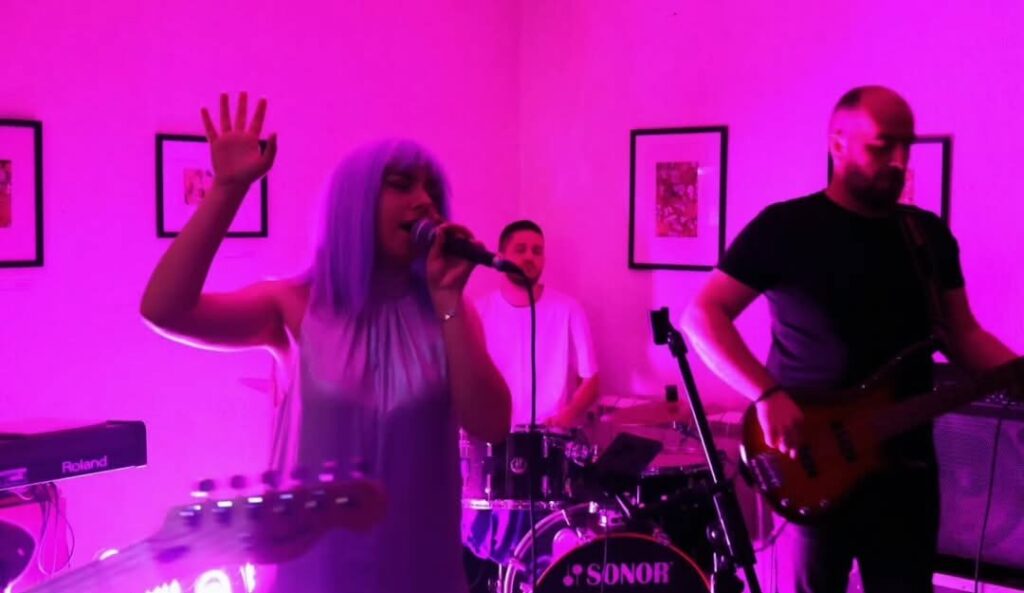
Pirit Festival, a music event completely conceived and developed in North Mitrovica, gets no international or NGO support but still attracts bands from the region, from North Macedonia as well as Serbia. Co-founded by one of the members of Something Went Wrong, it relies solely on its own ability to sell tickets and with help from small businesses.
Krama says that Pirit reflects a broader issue: “Despite its longevity, artistic consistency and importance for the local alternative scene, the festival often lacks institutional support precisely because it does not foreground identity narratives in the way that is expected.”
Meanwhile, in South Mitrovica, festivals like the Green Festival and Mitrovica Jazz Festival have been criticised for rarely platforming ethnic minority groups. Hoti, whose organisation produces Green Festival, says he understands why people feel this way but insists: “Green Festival has always aimed to be inclusive, but the local cultural ecosystem is small, and at times political tensions also affect artists’ willingness or ability to participate in visible cross-community collaborations.
“We acknowledge that this visibility is not always enough, especially on the main stages [but it is] due to the fact that we are not supported properly,” he adds.
In August 2025, a widely seen confrontation happened in the middle of North Mitrovica when the Mitrovica Jazz Festival erected a stage in the middle of the promenade at the same time and place as another community-organised event was taking place.
The bars around the promenade drowned out the music and the crowds turned their backs to the musicians. It descended into an incident where police dragged away two young Serb men and the crowd turned on the police who later released them without charge.
Krama said this is what happens when you try to force integration and inclusion without including the communities.
There is still no word on when the culture centre in the north will re-open, but in the meantime arts continue. Akvarius held its annual Christmas market and Something Went Wrong will release their latest single, Let Me Shush, this month. All their music is available on Spotify and on sale at their concerts.
The marginalisation of pop culture in North Kosovo is connected to the fact that politics dominates life here. This is a problem, Krama says: “When cultural value is measured primarily through political or ethnic framing, initiatives that focus on music, artistic continuity and community building are frequently sidelined, even when they play a crucial role in sustaining the city’s cultural life.”
Hoti believes more investment in youth activities is needed to keep young people engaged from all communities. “To make it better, we need more stable spaces, longer-term funding, stronger links with education, and more regional and international exchange,” he says.
“The impact on the city is real, even if it cannot always be measured economically, it is most visible in its social and community impact.”