
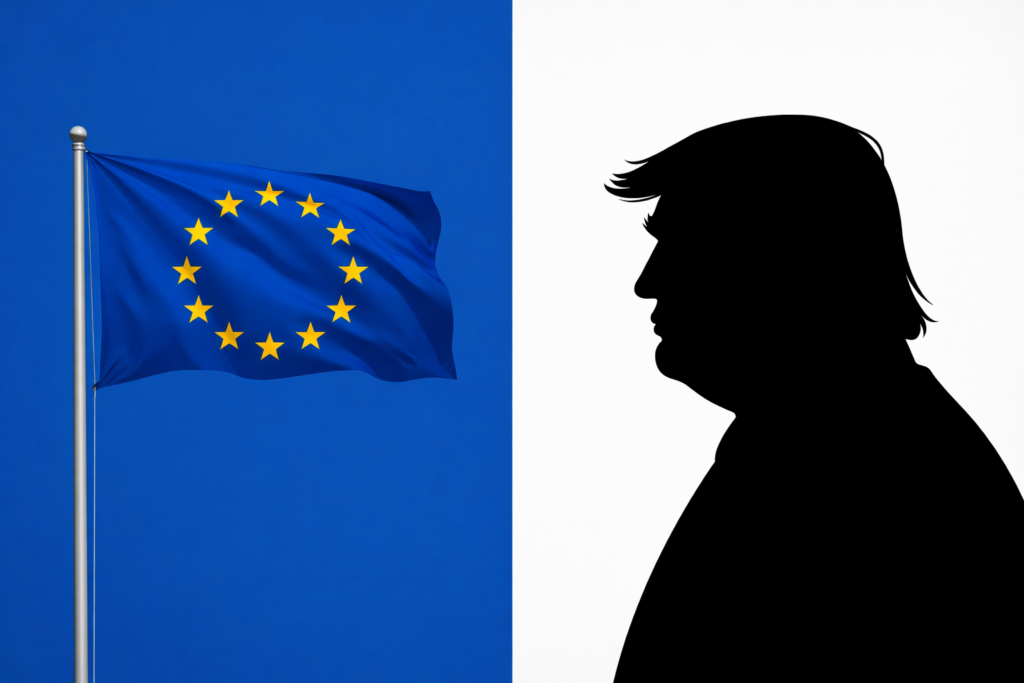
Europe has the arguments. It has the market size. It has the legal tools.
And yet it looks uneasy — because this isn’t really a trade dispute.
This is a sovereignty test under coercion. And Trump doesn’t operate inside Europe’s institutional mindset. He operates in a primal one.
The European instinct is to treat the clash as tariffs, schedules, technical fixes. That misses the point. Trump isn’t using tariffs as economics. He is using them as pressure — to force compliance, to fracture unity, and to make resistance feel too costly.
Put bluntly: Europe thinks it’s negotiating. Trump thinks he’s breaking a rival.
That sounds harsh. It is harsh. But it fits the behavior better than Brussels’ favorite language.
Europe negotiates through institutions: rules, committees, communiqués, consensus. In normal times, that’s strength. Under coercion, it becomes a weakness — because it slows everything down and spreads responsibility until nobody can bite.
Trump doesn’t respect institutions as such. He respects only what looks like force with consequences attached.
If the channel in front of him cannot strike back quickly, he treats it as harmless. Not because he has studied policy papers, but because it lacks aura. It doesn’t feel dangerous.
That’s the mismatch. Europe believes legitimacy generates power. Trump believes power generates legitimacy.
Most people misunderstand the battlefield. They think it’s America versus Europe.
I’m not sure it is.
The real battlefield is inside Europe.
Europe’s biggest vulnerability is not American pressure. It is European leakage. Trump’s best strategy is not to confront the EU as one rival — but to turn it into a market of competing egos. That’s why parallel channels are toxic. The moment national leaders start calling Washington individually, the EU stops being a political actor and becomes a decorative logo.
And Europe always produces the same type of operator in these moments — the Schleimspuren people. Smooth survivors. Trained for decades in appeasement, bilateral deals, constant maneuvering. They believe they can “manage” Trump personally.
They can’t.
Not because they’re stupid. Because they’re trying to manage the wrong thing. Trump doesn’t merely negotiate with them. He uses them. He rewards them publicly. He flatters them. He signals they are “the sensible ones”.
Then he waits. Others copy. Unity erodes. The bloc becomes a set of anxious competitors.
It’s crude. And it works.
Here is what this looks like in practice — the part Europe hates seeing.
Brussels spends weeks assembling a response package: legal wording, internal coordination, careful sequencing. The centre tries to build pressure slowly. Then one member state makes a private call to Washington.
A few days later a headline appears. A photo leaks. A quote gets planted:
“We had a very good conversation. They’re smart.”
And suddenly the internal message across Europe shifts: maybe it’s safer to go solo. Maybe unity is for fools. Maybe the EU will not cover you when things get ugly.
That is the fracture. That is the infection.
In theory, Europe could respond with an intelligent ladder: show readiness, hit selectively, escalate step by step, keep control of tempo.
That’s the textbook. The textbook assumes cohesion.
In the real EU, gradual escalation fails because the system leaks. While the centre tries to build pressure, internal actors undermine the line by opening side talks, signaling weakness, and offering Trump what he wants most: proof that Europe is not one adversary, but many.
Trump reads that instantly. Once he smells it, he pushes harder.
The result is ugly: paralysis — either soft appeasement or chaotic overreaction. Neither one scares him.
Europe does not merely need a strategy against Trump. It needs a strategy against itself.
One channel negotiates. Everyone else stops freelancing.
And yes, any parallel channel must pay a cost. Not as moral theatre — as survival engineering. The leash has to be automatic. If someone tries to cut a bilateral deal, fine. But then they do not get to enjoy the bloc’s protection as a free insurance policy. They lose priority. They lose compensation. They lose shelter. They stand alone.
Without internal discipline, Europe will always lose. Trump will always find the weak link and turn it into a trophy.
The darkest outcome is not losing a tariff battle. It is “solving” the crisis by surrendering what should never be surrendered — humiliating arrangements around Greenland, for example, just to buy temporary calm.
That would not be compromise. It would be a civilizational collapse.
It would set a precedent visible to everyone: if you pressure Europe’s periphery hard enough, Europe abandons its own. From that moment, the EU stops being a sovereign pole and becomes a managed market inside someone else’s imperial architecture.
And it still wouldn’t buy stability. It would only teach that coercion works.
Europe can send a tough political figure to the table — someone who can take confrontation, dominate language, resist humiliation. Macron, for instance, can carry the theatre.
But theatre alone is nothing without muscle.
Trump cannot be checked by refined institutional language. He can only be checked by consequences — and those consequences must be ready, not imaginary: targeted counter-tariffs designed for political pain, procurement restrictions, market-access limits, anti-coercion tools ready to fire, escalation triggers that don’t require a fresh round of emotional consensus every time.
Trump dominates people. He struggles against systems that strike back predictably.
Trump dominates tables. Europe must dominate structures.
Dr. Yosef B. Moran is a writer and philosopher based in Antwerp, Belgium. He explores transcendence, human dignity, and the balance between inner growth, action, and the hidden structures of power. He is the author of Weekly Parashah, a series bringing Torah to life through existential and ethical reflection.