
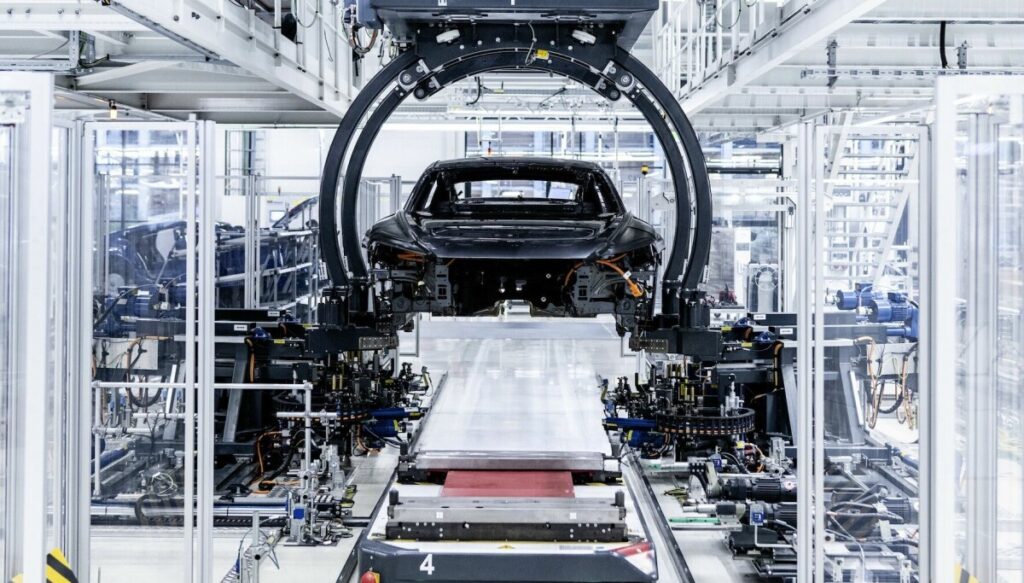
Assembly of the Audi e-tron GT at Böllinger Höfe.
AUDI AG
As 2026 begins the automotive industry faces intensifying pressures from geopolitics, tariffs and cost constraints with investment priorities are being reset and flexibility becoming critical
2025 was a challenging year for the auto industry; 2026 is
unlikely to be any different with many of last year’s challenges intensifying.
The geopolitical situation across the world makes long term planning increasingly
difficult. Car companies and suppliers alike will need to display agility and flexibility
to a far greater extent than in the past. And they will need to do this while financial
pressures on some suppliers are such that investment is being squeezed, or
cancelled, and some analysts suggest many suppliers will fail without significant
support from their customers, the vehicle companies.
There are so many critical issues facing the sector that deciding
on the most important and ranking them is all but impossible. This comment
column looks at those which – as of early January 2026 – appear to be the most
pressing. The brooding presence of China is clear. A second column will look at
other key issues which have, arguably, a longer horizon in view.
Geopolitics and the auto industry are clearly linked through China. Two issues stand out: first, the supply chain disruption caused by disputes over the ownership and control of chip maker Nexperia and second, the future of Taiwan
Geopolitical pressure intensifies
So much is going at present, and while it may be difficult
to directly link issues like the continuing Ukraine conflict, the US’ interest
in taking over Greenland and the US’ regime change policy for Venezuela to the
auto sector, they will impact the broader investment climate, and indeed consumer
confidence. The US’ control over Venezuelan oil supplies may well lead to falls
in the oil price and indirectly at least give a continued boost to the ICE and
hybrid vehicle sectors; if operating costs for ICE or hybrid vehicles fall further
compared to EVs, the case for consumers to switch to EVs will become ever weaker.
Why Chinese carmakers are rethinking Russia and turning to Central Asia for growth
As sanctions, investor pressure, and rising import fees reshape the Russian market, Chinese OEMs are pulling back and redirecting investment to Kazakhstan and Uzbekistan.
Geopolitics and the auto industry are clearly linked through
China. Two issues stand out: first, the supply chain disruption caused
by disputes over the ownership and control of chip maker Nexperia (Honda is
just one of the main companies whose production has been disrupted by this);
and second, the future of Taiwan. The Chinese government has had its eye
on taking control of Taiwan for far longer than President Trump has had his
eyes on Greenland. The Chinese, moreover, tend to play the long game and the
more they see the US focusing on issues within “its hemisphere”, the freer they
will feel to choose when to try to take control of Taiwan. And when they do,
the impact on chip supplies for the auto industry, and other sectors, will once
again be front page news. To some extent, the US and European have tried to
prevent this becoming an issue in future by building chip factories in the US
and Europe. However, these developments also involve the likes of TMSC – Taiwan’s
leading chip maker – making investments outside Taiwan and how far these would
be impacted by any potential Chinese takeover of Taiwan is not yet clear.
The slowdown in EV take-up outside Europe, especially in the US and Japan, has continued to influence the decisions taken in Europe; but at the same time, the Chinese are pressing ahead with the EV transition
The EV shift
The switch to EVs, especially in Europe, had been assumed to
be inevitable and unstoppable. Not now. The EU’s plan had been to ban ICE vehicle
sales from 2035, with even hybrids expected to have been reduced to a minor
role by that date; in December 2025, however, under immense pressure from the
vehicle companies and some national governments, the 2035 plans were watered
down and hybrid sales beyond 2035 will now be allowed in greater numbers than
before and various exemptions will also allow the likes of Porsche and other
low volume brands to continue to sell ICE vehicles beyond 2035. The precise details of how the new regime
will work in practice have not been fully worked through. However, vehicle companies’
investment plans, which had been predicated on a complete switch to EVs by the
early 2030s, will certainly be rethought.
The slowdown in EV take-up outside Europe, especially in the
US and Japan, has continued to influence the decisions taken in Europe; but at the same
time, the Chinese are pressing ahead with the EV transition – and keeping hybrids
on offer for Europe and other markets where the switch to full EVs is slowing.
Japanese carmakers look to increase imports of US built vehicles back to Japan
Japanese OEMs are increasingly sourcing vehicles from overseas plants for sale at home, reflecting shifting trade rules, cost pressures and manufacturing strategies. From India and Thailand to potential US imports, the trend highlights changing global production logic.
Changing investment priorities
Volvo had planned to be fully electric by 2030, but the
return of Hakan Samuelson as CEO has led to a pragmatic change of plan; Volvo
will continue with hybrids, especially PHEVs and a new range of EREVs well into
the 2030s. Ford is continuing with EV programmes – in Europe this is in
association with Renault on top of its earlier partnership with Volkswagen, while
in the US its new Universal EV platform will provide the basis for various
entry models for the US market. However, the Universal EV platform will not
come to Europe for some years and in Europe, Ford’s Valencia factory will launch
production of a new Bronco Sport model, with a PHEV powertrain; this will be
made alongside the existing Kuga ICE model for a number of years. the Bronco
programme was originally due to use a multi-energy platform but for now at
least there will not be a BEV version produced in Spain. In the US, Ford has
also cancelled investment in large electric SUVs and Pick-ups and will boost
ICE production of these models instead.
Mercedes meanwhile has decided to continue with the A-class;
this was due to be dropped but the continued popularity of an ICE-powered
vehicle in this entry segment has proved too attractive to ignore; with profits
being undermined elsewhere, the continued popularity of A-class renders the
vehicle a potential cash-cow. To maximise its cash generating potential, production
will shift from high-cost Germany to (relatively) low-cost Hungary. Similar
moves can be seen at Stellantis in Europe and North America and many other vehicle
companies as well.
In Europe, where the EU has imposed penal tariffs on Chinese EVs, Chinese companies have responded by raising imports of PHEVs and accelerating European EV production plans
Tariffs and the European local content issue
Register now: Digitalisation – Smarter automation
This livestream will provide a reality check on smart factory tech – what’s truly delivering on the shopfloor and where automation is finally paying off.
The final issue covered here concerns the impact of tariffs
and European local content policy. The traditional trading system in vehicles
was turned into turmoil early in 2025 by President Trump raising tariffs dramatically
on US vehicle imports. Japanese, Korean and European companies were forced into
a mix of short-term production switches, raising US production to avoid tariffs,
and longer-term strategic change. How this will work out in the long run remains
to be seen, but for now most countries face a 15% tariff on vehicle imports
into the US. Mercedes and Volvo have responded by switching some production
from Europe to the US, while Honda, Nissan, Toyota and Hyundai are increasing production
volumes in the US.
Meanwhile in Europe, where the EU has imposed penal tariffs
on Chinese EVs, Chinese companies have responded by raising imports of PHEVs and
accelerating European EV production plans. The situation in Europe will become
more complex again when the EU launches its “Made in Europe” policy; the details
of this plan remain to be confirmed, but in essence they are likely to mean
that vehicles sold in the EU will need a certain level of EU content to avoid
being subject to tariffs. Depending on the level at which this local content is
set, and how it is measured, there may be cases of some European-made vehicles
with high levels of Asian content, falling foul of this rule. This is certainly
an issue to watch with interest.