
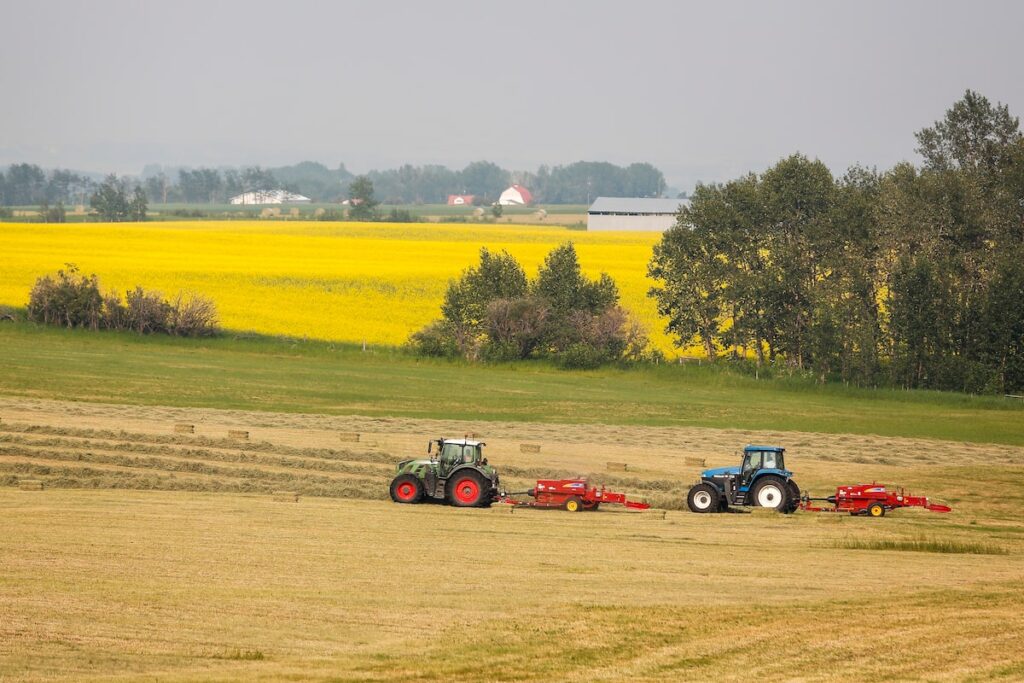
Farmers bale a hay crop with a canola field in the background as a haze of wildfire smoke hangs in the air near Cremona, Alta., in July, 2021.Jeff McIntosh/The Canadian Press
The agreement on canola tariffs the federal government struck with China is a “good deal for Canada,” Saskatchewan Premier Scott Moe said Tuesday after Ontario Premier Doug Ford had criticized the arrangement, saying it would hurt his province’s auto industry.
The deal – announced Friday as part of Prime Minister Mark Carney’s trade mission to Beijing – slashed China’s tariffs on canola from a combined 84 per cent to 15 per cent. Tariffs on canola meal, peas and some seafood products were also eliminated until at least the end of the year.
In exchange, Canada will allow nearly 50,000 Chinese-made electric vehicles into Canada at a low tariff rate.
Beijing’s tariffs on agricultural goods, which took effect in March of last year, were a retaliation for Ottawa’s 100-per-cent levies on Chinese-made electric vehicles.
Mr. Ford has since criticized the deal, saying an influx of cheap Chinese vehicles will undermine Ontario’s auto industry. Mr. Ford also claims the Prime Minister did not give him sufficient warning.
“So much for the partnership,” Mr. Ford said during a speech at the Rural Ontario Municipal Association conference in Toronto.
What to know about the Canada-China trade deal on EVs and canola
But the deal with China is not a matter of federal favouritism, Mr. Moe, who joined the Prime Minister on his trade mission last week, said in an interview with The Globe and Mail.
While the deal immediately benefits Saskatchewan’s $6.7-billion canola industry, Mr. Moe said Beijing and Ottawa’s truce will benefit the entire country in the long-term.
“This is a deal that we’re able to build on,” Mr. Moe said.
Instead of pitting agriculture against auto manufacturing, the deal sets the stage for many more agreements that will diversify trade from an increasingly unreliable southern neighbour, Mr. Moe said.
“Doug Ford’s words are not lost on me, nor should they be lost on anyone … But I think it’s important for us – when we’re talking about coming together as premiers – to approach the threats that are coming from international leaders.”
Mr. Carney, the first prime minister to visit Beijing in more than eight years, flew to Beijing in hopes of resetting what had become an increasingly fraught relationship under Justin Trudeau’s tenure. Mr. Carney was also courting China in hopes of reducing Canada’s reliance on the United States for trade. The Prime Minister has since pledged to expand exports to China by 50 per cent.
Andrew Coyne: In seeking to deepen trade with China, Canada is hedging its bets
The canola deal was the first outcome of a strategic partnership with China that will accomplish this goal, said Mr. Moe, who returned from Beijing at 3:30 a.m. Tuesday and held a press conference a few hours later in Saskatoon with provincial agricultural ministers and representatives from industry stakeholder groups to discuss the details of the deal.
Resecuring access to the Chinese market for agricultural products will help farmers across the country, he said. Canola is also a major crop for Manitoba. Seafood products such as lobster and crab are essential to the Atlantic provinces, and in 2023 China accounted for $1.4-billion in trade of fish and seafood (second only to the U.S.). On Tuesday, China also lifted its years-long tariffs on Canadian beef. Beef is a $7-billion industry in Alberta.
However, the long-term value of the trade mission is rebuilding the structural foundations of China and Canada’s trade, Mr. Moe said, pointing to the memorandums of understanding Ottawa signed with Beijing on energy and food safety.
In a joint announcement published by the Chinese and Canadian governments on Jan. 15, the two countries said they would encourage Chinese investment in areas including energy, agriculture and consumer products as part of a joint “economic and trade co-operation road map.”
The Canadian Food Inspection Agency also signed an MOU last Thursday with the Chinese customs agency that said it would “enhance long-term co-operation and co-ordination on food-safety and animal and plant health matters.” The MOU marked a significant pivot for two countries whose political battles often manifest in agricultural trade disputes.
Canada’s food-safety agency signs agreement with China
Armed with these MOUs, the Saskatchewan Premier sees potential for more Canadian exports to China in conventional energy products, such as oil and gas, alongside Chinese investment in liquefied natural gas plants and the Alberta oil sands. Chinese investment in Canada’s value-added food manufacturing also shows promise, he said.
The Prime Minister has also said the deal on electric vehicles will set a framework for Canada and China’s auto trade, and increase jobs in the sector. A new policy to be released in February will reserve preferential access to the Canadian domestic auto market for foreign manufacturers who build vehicles in this country. The same tactic was used to attract Japanese manufacturers to Ontario in the 1980s.
Mr. Ford doubts the deal with China will yield any long-term benefits for his province and questioned the likelihood of China investing further in the Canadian economy.
“Folks, you hear there’s jobs coming. There’s no jobs coming,” Mr. Ford said during his speech Monday.
Mr. Moe acknowledged the toll global trade tensions have taken on Ontario’s auto manufacturing sector, however, he said Canadian leaders need to stay focused on the real threat facing the national economy.
“Threats and challenges have morphed and now they’re really coming from that international sphere,” Mr. Moe said. “Tariffs and market access challenges are threatening our Canadian economy as a whole. We won’t agree on every point, in this deal or any other deal, I suspect. However it’s important for us to respect that and keep moving forward.”