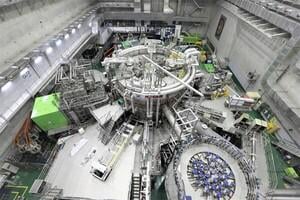
South Korea Launches Nuclear Fusion Demonstration Reactor Development, Doubles Fusion R&D Budget
https://www.businesskorea.co.kr/news/articleView.html?idxno=261403

South Korea Launches Nuclear Fusion Demonstration Reactor Development, Doubles Fusion R&D Budget
https://www.businesskorea.co.kr/news/articleView.html?idxno=261403
1 Comment
Submission statement:
South Korea has launched an aggressive “2026 Nuclear Fusion R&D Implementation Plan” that dramatically accelerates its timeline for clean energy, targeting the demonstration of a Korean-style innovative fusion reactor by 2035. To bridge the gap from experimental physics to industrial power production, the Ministry of Science and ICT is doubling its budget to 112.4 billion won and integrating artificial intelligence to optimize plasma control and research efficiency. This mission-oriented strategy moves beyond traditional Tokamak research to fund diverse next-generation concepts like stellarators and spherical tori, while simultaneously investing 1.5 trillion won into a national infrastructure of superconducting test facilities and a dedicated “Nuclear Fusion Innovation Alliance” between industry and academia. By shifting the commercialization target forward from the 2050s to the mid-2030s, Korea is positioning itself as a global leader in the race to provide a virtually limitless, carbon-free energy source through a fully integrated AI-fusion ecosystem.