
Editorial & Advertiser disclosure
Global Banking and Finance Review is an online platform offering news, analysis, and opinion on the latest trends, developments, and innovations in the banking and finance industry worldwide. The platform covers a diverse range of topics, including banking, insurance, investment, wealth management, fintech, and regulatory issues. The website publishes news, press releases, opinion and advertorials on various financial organizations, products and services which are commissioned from various Companies, Organizations, PR agencies, Bloggers etc. These commissioned articles are commercial in nature. This is not to be considered as financial advice and should be considered only for information purposes. It does not reflect the views or opinion of our website and is not to be considered an endorsement or a recommendation. We cannot guarantee the accuracy or applicability of any information provided with respect to your individual or personal circumstances. Please seek Professional advice from a qualified professional before making any financial decisions. We link to various third-party websites, affiliate sales networks, and to our advertising partners websites. When you view or click on certain links available on our articles, our partners may compensate us for displaying the content to you or make a purchase or fill a form. This will not incur any additional charges to you. To make things simpler for you to identity or distinguish advertised or sponsored articles or links, you may consider all articles or links hosted on our site as a commercial article placement. We will not be responsible for any loss you may suffer as a result of any omission or inaccuracy on the website.
Trump says he agreed to lower tariffs on Swiss imports, but they could rise again
Published by Global Banking and Finance Review
Posted on January 21, 2026
2 min read
Last updated: January 21, 2026
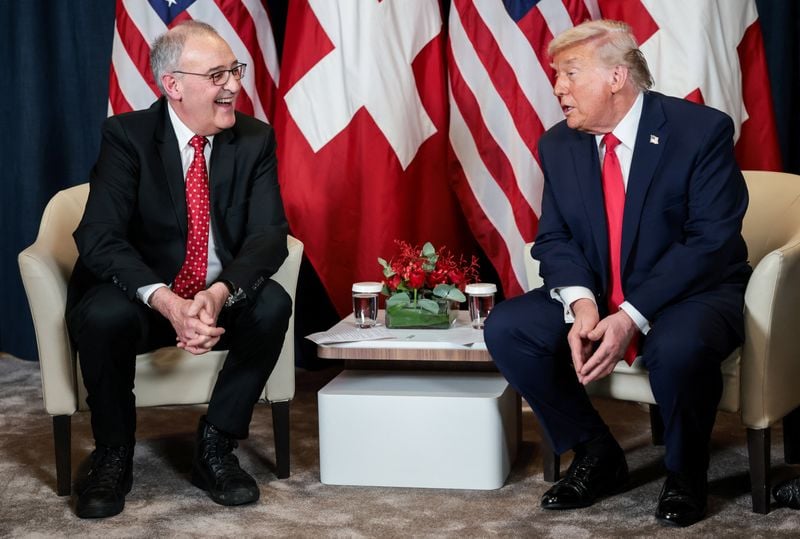
U.S. and Swiss Tariff Negotiations
By Steve Holland
Background of Tariff Increases
DAVOS, Switzerland, Jan 21 (Reuters) – U.S. President Donald Trump said on Wednesday he had agreed to lower the 39% U.S. tariff rate on imports from Switzerland to 15% amid pressure from Swiss companies, including Rolex, but the rate could rise again.
Details of the Agreement
“I reduced it because I don’t want to hurt people. I don’t want to hurt them. And we brought it down to a lower level; doesn’t mean it’s not going up,” Trump told a gathering of world leaders and business executives in Davos, Switzerland.
Future Implications
Trump defended his decision to impose higher tariffs on nearly every country, saying that many countries – including Switzerland – had taken advantage of low or zero tariff rates.
He said he initially planned a tariff rate of 30% on Swiss imports but raised it to 39% after a meeting last year with then-Swiss President Karin Keller-Sutter, saying she “just rubbed me the wrong way, I’ll be honest with you.”
Trump said Keller-Sutter, whose one-year term ended in December, had kept repeating that Switzerland was a small country and that Trump should not impose such a high tariff. He gave no details on any future increase.
Keller-Sutter drew domestic criticism for her handling of the call, and Trump later publicly complained she “didn’t want to listen” to his concerns about the U.S. deficit.
U.S. and Swiss negotiators reached a preliminary agreement in November on a deal to lower the tariff rate to 15%, with Swiss industry committing to making investments of $200 billion in the U.S. by the end of 2028.
Swiss companies have welcomed the tariff reduction, which puts them on a level playing field with EU competitors.
The two countries must still finalize their agreement in negotiations they hope to conclude by the first quarter of 2026.
(Reporting by Steve Holland and Andrea ShalalEditing by Rod Nickel)