
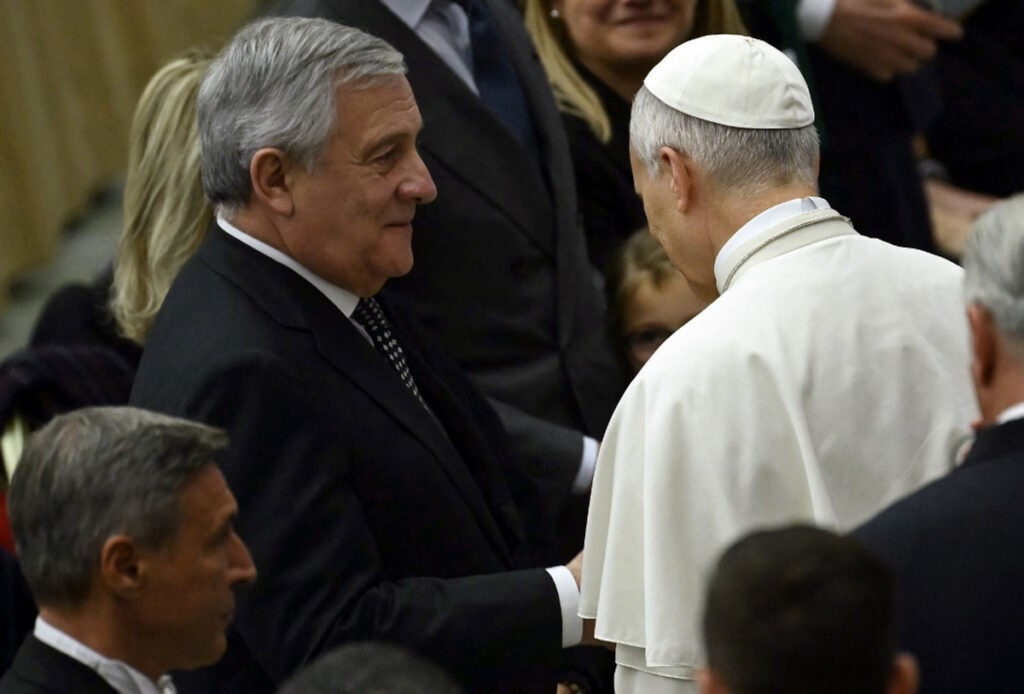
After UK and French leaders made a pledge this month to send their troops to Ukraine should the situation there require it, Italy’s Foreign Minister on Wednesday reiterated that Italy would continue to help financially and otherwise, but would not be sending any soldiers if there is a chance they would engage with Russian forces.
“We have always said that we would not contribute troops on the ground, but that we would continue to help Ukraine, as we have always done, through military, financial and political means,” Foreign Affairs Minister Antopnio Tajani told conservative daily Il Foglio.
Follow our coverage of the war on the @Kyivpost_official.
“We are not at war with Russia and we do not believe it is right to send Italian troops there,” he continued.
Italy’s Prime Minister Giorgia Meloni was in South Korea this week, signing an agreement with leadership that Seoul and Rome would collaborate on defense projects, artificial intelligence and aviation, some of which would help Ukraine’s cause, even if both countries are hampered by their respective contributions from direct military aid.
Not only has Italy, since it ratified a new Constitution at the end of World War II, been restricted from sending soldiers to resolve international conflicts, it historically has been sandwiched between larger geopolitical powers, lying just west of the erstwhile Iron Curtain and meanwhile hosting Europe’s largest Communist Party, but also, without any native energy assets of its own, retained unusually good relations with Islamic states in the Middle East while remaining a staunchly Western nation.
Other Topics of Interest
Greenland Dominates Davos: Leaders Warn Ukraine Must Remain Top Security Priority
Trump’s Greenland rhetoric shook Davos, but NATO leaders warn the distraction risks sidelining Ukraine’s war – still the central threat to European and US security.
Lying in the afternoon shadow of St Peter’s Basilica, Rome also has tempered its secular policies rooted in realpolitik with the overtures of peace reverberating from the balcony of the Vatican.
“Peace is not just the absence of war, it is a guarantee that people can make decisions freely,” Tajani told the paper, attempting to draw a distinction between Italian forces avoiding entering in conflict while still ensuring a nation’s sovereignty.
Modern Italy certainly has been involved in peacekeeping missions before, most notably in the 1990s in Somalia, and in Bosnia, supporting NATO’s KFOR troops following the Dayton Accords.
Tajani suggested that providing Kyiv with security guarantees without granting full membership in NATO, is just fine by Rome.
“This is a path supported by many,” he added, stressing that Palazzo Chigi would support any measures that strengthen Ukraine’s security while avoiding direct military escalation with Russia.
“We will be among the countries that will guarantee the country’s security through a system – an Italian proposal – based on Article 5 of NATO’s charter,” Tajani said.
But where to draw the line exactly? This is where Italian leaders have had to finesse their international comments and commitments, again drawing on a long history of what has been termed locally as cerchiobottismo, whose etymology comes from the coopering trade and means to hammer away simultaneously at both the wooden barrel planks and its copper rings to make it all fit together.
Tajani, on Wednesday could only tell the conservative outlet that Italy remains a strong ally of Ukraine and intends to play “a leading role” in supporting the country should it secure a peace agreement with Russia,but that it would not commit ground forces to deter any potential future invasion.