
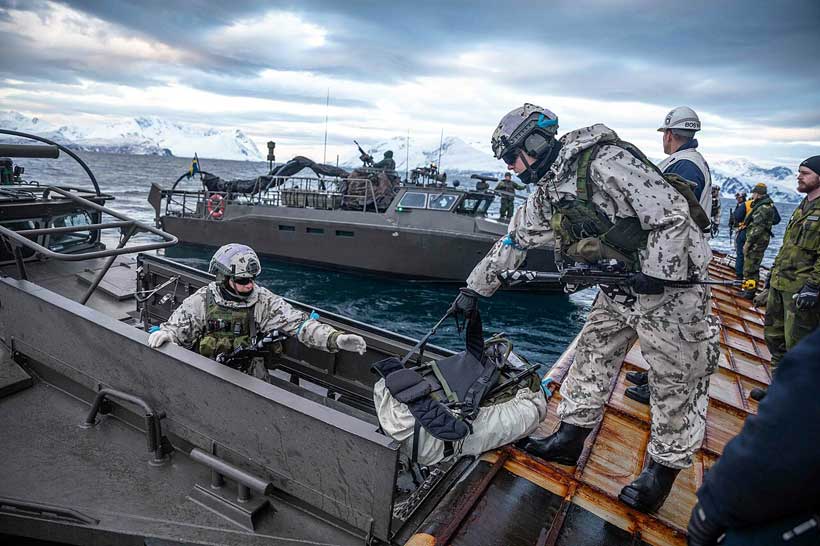
Sweden is NATO’s newest member, and its presence in the organization is invaluable. Having a foothold on the Baltic Sea, along with one of the world’s leading defense contractors, Stockholm’s naval presence, proficient conscription, and technology further enhance NATO’s force projection on the European continent.
In late 2025, NATO began planning for Forward Land Forces (FLF) in Finland, with Sweden taking the lead and serving as the template country. With a presence in Finland, Sweden brings not only a presence at Russia’s borders, not seen in 200 years, but also the valued experience and leadership needed for a quick reaction contingency on NATO’s Northern flank.
Sweden’s Capabilities in NATO
Sweden’s NATO ascension was officially confirmed on March 7th, 2024, after nearly two years of diplomatic standoff with fellow member Turkey. With Sweden’s immediate integration, NATO now has near oversight over the Baltic Sea and can deny Russia’s fleet freedom of movement in the Kaliningrad enclave.
Already having Cold War-era contingencies against Moscow, Stockholm brings a comprehensive strategy for national security and wartime crisis management. Despite having a small active-duty military of 25,600, Sweden can call up 88,000 personnel in a major wartime contingency.
The 200-year Swedish policy of neutrality allowed the country to build a self-sustaining defense industry that is not reliant on American military imports. Some of the defense inventory Sweden produces includes its own fixed-wing aircraft (Gripens), submarines (Gotland-class), and anti-ship missiles (RBS15), amongst others.
Sweden’s Crucial Role in the Forward Land Force
NATO’s new Forward Land Force, based out of Lapland in Northern Finland, will include a Swedish command structure. The core structure of the FLF (up to 4,000-5,000 troops) will consist of a battalion-sized unit from Stockholm.
On June 24th, 2025, at a NATO Summit, the United Kingdom, France, Denmark, Iceland, and Norway all expressed intent to help develop the FLF in Finland. Under the Swedish command, Finland, Norway, and Denmark are expected to send detachments, with the UK, France, and Iceland contributing staff officers.
If war were to come to Finland’s borders, the FLF would integrate into the Finnish Defence Forces as a frontline brigade to defend the Arctic North, with Swedish officers retaining command of the unit.
Sweden is no stranger to war against Russia, as the old Swedish Empire encompassed much of the Baltics, Finland, and parts of Russian territory. It was ultimately the Swedish-Russian War of 1808 and 1809 that forced Stockholm’s capitulation and led to a 200-year state of neutrality under the Treaty of Fredrikshamn.
With oversight in the High North, the Swedish Armed Forces (SAF) will also cover NATO operations within the Nordic and Baltic Seas that will involve aerial, naval, and brigade-sized elements. Overall, the FLF is part of NATO’s evolving force reconstitution under the Joint Force Command (JFC) headquartered in Norfolk, Virginia, USA.
How Sweden Can Enhance NATO’s Northeast Flanks
Alongside oversight of the Forward Land Forces, Sweden plays a crucial role in the Joint Nordic Air Command (JNAC). The concept of the JNAC originated with air force commanders from Sweden, Norway, Denmark, and Finland, following a consensus at a NATO Summit.
On March 16th, 2023, commanders from Stockholm, Oslo, Copenhagen, and Helsinki all signed the declaration at Ramstein Air Base. The initial concept of a Joint Nordic Air Command originated back in the mid-1990s and became a concrete initiative with Russia’s ongoing aggression in Ukraine.
Including over 250 aircraft between Sweden, Norway, Denmark, and Finland, the JNAC has a wide array of arsenals and systems to counter Russian encroachment in the Nordic region. Sweden’s contribution to the Joint Nordic Air Command includes the JAS 39E as a primary aircraft, with the Gripen C and D variants supplementing Stockholm’s role.
Despite being NATO’s latest addition. Sweden has utilized every opportunity to promote interoperability. The Swedish Armed Forces participate in NATO-wide exercises such as Steadfast Defender and Nordic Response, among others.
A primary reason Sweden had a smooth transition was the Swedish Armed Forces’ participation in pre-NATO overseas stabilization missions, including interventions in Bosnia, Kosovo, and Afghanistan. Furthermore, Sweden specializes in peacekeeping missions in Egypt, Cyprus, Congo, and Mali.
Lastly, the aforementioned Swedish navy in NATO specifically gives NATO an edge in the Baltic Sea, not only by fully encircling the Russian Baltic Fleet but also by focusing on maritime situational awareness. Stockholm, with its enhanced naval surveillance, continuously tracks every navy and merchant vessel in the Baltic Sea, helping NATO monitor and block Russia’s shadow fleet’s freedom of movement.
Gotland itself is Sweden’s unsinkable aircraft carrier, where the Swedish navy and neighboring NATO members can project naval dominance. Gotland Island is only 81 miles from the Baltic nations and 186 miles from the Russian enclave of Kaliningrad, which would give NATO a rapid naval reaction force in case Latvia, Estonia, or Lithuania were to come under attack.
Today, Sweden is arguably one of the last pieces of the puzzle NATO needs to enhance security on the Northern Flank, in the Arctic region, and in the Baltic Sea. Not just having a proficient officer corps, an independent defense industry, and a top-tier navy and air force, Stockholm also gives the alliance the power to close defense gaps and deploy quick reaction forces if needed.