
By Predrag Petrović
Director of Research at the Belgrade Centre for Security Policy
The collapse of the canopy in Novi Sad on 1 November 2024, which killed 16 people and injured dozens, as well as the repressive response of the authorities to protests by citizens and students demanding accountability for the tragedy, laid bare the true nature of the ruling party in Serbia.
Despite its declarative commitment to democracy, it has become clear that the Serbian Progressive Party (SNS) is a typical anti-system extremist movement seeking to replace the constitutionally defined democratic order with a system of one-man rule, whose power is legitimised through myths, conspiracy theories and the manufacture of enemies, and sustained through the use of verbal and physical violence against dissenters.
Anti-system extremism (ASE) is also present in Europe, where it has been on the rise over the past two decades. However, unlike European states where the carriers of ASE are mostly marginal movements and individuals, or parties outside government or at most junior coalition partners, in Serbia the dominant carrier of ASE is precisely the ruling party, which has continuously exercised power for thirteen years. A further peculiarity of Serbia is that SNS came to power with a clear commitment to the EU, democracy and the rule of law, which is even written into its Statute, yet in practice it has consistently and thoroughly destroyed the very system it governed.
Instead of democracy: autocracy, conspiracy theories and hate speech
Over 13 years in power, SNS has completely undermined Serbia’s constitutional order by establishing an informal system of state governance based on loyalty to Aleksandar Vučić. Today, formal public offices serve as a cover and a source of resources, while decisions are made outside state institutions. The entanglement of security structures with para-political and criminal actors has entirely displaced the separation of powers and the rule of law, leading experts to describe this order as a “politics of destruction” and a “silent coup”.
This “politics of destruction” is most visible in the constant violation of the Constitution and laws by the President of Serbia. As early as 2021, legal experts such as Svetozar Čiplić established that Vučić was violating the Constitution on a daily and repeated basis. The situation has certainly worsened since then, and today Judge Gordana Vidojković describes the Constitution as “a dead letter on paper”, and the system as resembling an “Eastern despotism”.
In order to legitimise the newly established informal system of governance, the concept of the so-called “Serbian world” was devised, implying the cultural, media and political unity of Serbs in Serbia and the region under the leadership of Aleksandar Vučić. In practice, this serves to homogenise the population, militarise society and delegitimise any internal opposition that criticises the authorities on any issue. This nationalist-authoritarian pattern provides fertile ground for a wide range of conspiracy theories that the regime systematically uses to criminalise dissenters and critics, through narratives about a “hybrid war” against Serbia, “colour revolutions”, “foreign mercenaries”, “internal enemies”, and similar. Although the authorities have used this tactic for a long time, one of the most extreme examples was the collapse of the canopy in Novi Sad, which regime officials and pro-regime media, without evidence, declared to be “sabotage” and a “terrorist attack”. The Speaker of Parliament, Ana Brnabić, called it a “planned act of sabotage” and the “beginning of a colour revolution”, later adding theories about a “vibration device” that allegedly caused the collapse, and insinuations that opposition politician Miša Bačulov was involved.
Conspiracy theories are further operationalised through hate speech, by which the ruling party directly and broadly targets, dehumanises and criminalises opponents, thereby creating justification for physical violence. Leading this are the highest state and party officials – Aleksandar Vučić, Ana Brnabić, Miloš Vučević and Vladimir Đukanović – who continuously use insulting and violent narratives towards dissenters, calling them “extremists”, “terrorists”, “foreign mercenaries”, “Ustaše” and “a bunch of layabouts”. Vučić described students as “people who want harm to their own country”, while Đukanović called for a crackdown on them: “It’s time to put a stop to that social scum… first in every debate, and God forbid, if necessary, physically as well.” Vučić labelled journalists from N1 and Nova S television as “terrorists”, and called an RTS reporter an “imbecile”.
Pro-regime media take up these messages of hate speech and amplify them further in order to provoke strong negative emotional reactions among audiences towards students and citizens protesting against the authorities. In this way, party and state officials, together with their media, systematically produce an atmosphere of fear, hatred and intolerance towards designated “enemies”, and encourage their supporters to take action against them.
Indeed, numerous attacks by ruling party activists on dissenters and professional media have been incited by such hate speech. In mid-2025, Reporters Without Borders established that attacks on professional journalists had drastically increased after Vučić publicly labelled them “terrorists”. The organisation found that in just two months, there were 34 attacks on media professionals, exceeding all annual cumulative data on physical attacks recorded in Serbia since 2020.
The link between attacks by SNS sympathisers and hate speech is also illustrated by a case in Niš, where a woman who injured Dean Natalija Jovanović with a knife stated in court that she had been incited by negative reporting in the pro-regime Informer. Numerous other attacks on journalists and critics of the authorities point to the same conclusion. The pattern is always the same: the highest state and party officials initiate hate speech, pro-regime media amplify it, and party loyalists carry out the physical attacks.
Paramilitary organisation and organised violence
An important feature of violent extremist movements is a paramilitary organisation. At the end of 2024, Serbian President Aleksandar Vučić informed the public about the existence of a hardline faction within SNS, which he labelled “the loyalists”. According to him, this group represents “keepers of the flame” and numbers around 17,000 members who swore a blood oath of loyalty to the current authorities in a church. Vučić describes them as predominantly pro-Russian oriented. The level of radicalism among the loyalists is such that the President himself described them as an extreme faction. Among them, Vučić stated, are his brother Andrej and another member of his family.
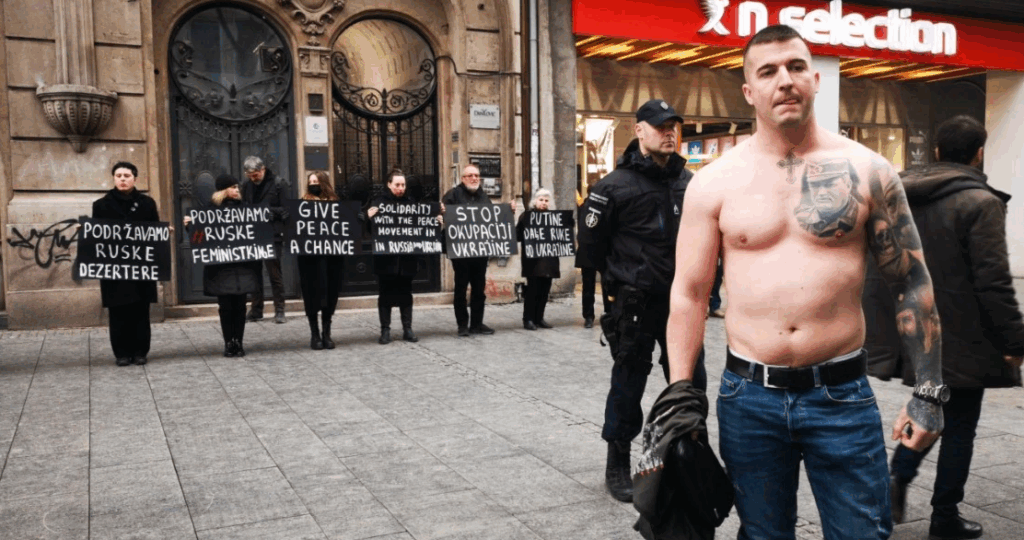
Although among the 17,000 loyalists there are people of various profiles and roles, the most visible to the public is the violent faction: men in black caps and clothing, with masks on their faces, mostly from criminal-hooligan circles and combat sports clubs. According to professional journalists, they are organised into several main groups led by Milan Radoičić and Luka Bojović; Vladimir Mandić and Dane Šijan, former handball players and owners of private security companies; Bojan Terzin, the best man of SNS president Miloš Vučević; as well as Damir Zobenica, a senior party official.
These groups operate under the political command of the ruling party and its affiliated structures, with the aim of breaking up protests, provoking incidents and intimidating protesters and critics of the regime. They are responsible for numerous serious violent incidents, such as the beating of a female student with batons in Novi Sad, attacks on students in Čačak, vandalising the homes of students involved in blockades, physical assaults on football fans with children who chanted against Vučić, and the kidnapping of a female student. It has become common for brutal and mass police beatings of demonstrators to be preceded by attacks by aggressive groups on the police.
Even more significant is the fact that many violent attacks by loyalists bear the characteristics of the criminal offence of terrorism. CINS established that from the collapse of the canopy until June 2025 there were 96 attacks on protest participants, almost half of which involved cars being driven into crowds.
The deliberate ramming of vehicles into people is a terrorist attack tactic whose use has intensified over the past 15 years. The use of a sonic weapon against peaceful demonstrators on 15 March 2025 also has the characteristics of terrorism. According to available data, the use of these devices went through informal loyalist channels, with the aim of provoking violent incidents and intimidating dissenters in order to deter them from future protests against the ruling party. This list should also include the kidnapping of a female student whom loyalists threatened and intimidated in Ćaciland.
Most spontaneous and organised violent attacks on critics of the authorities have been downplayed by the state leadership. The President of the Republic even pardoned thugs who broke a female student’s jaw with batons, as well as a young woman who drove her car into demonstrators and seriously injured several of them. At the same time, instead of preventing attacks by loyalists and bringing attackers before prosecutors, the police turn a blind eye and provide them with physical protection.
The public space between the buildings of the Presidency and Parliament, occupied by loyalists (the so-called Ćaciland), is secured by the police. All this indicates that Serbia could soon become a state of terror unless this extremist politics of destruction is brought to an end.
(Radar, 21.01.2026)