
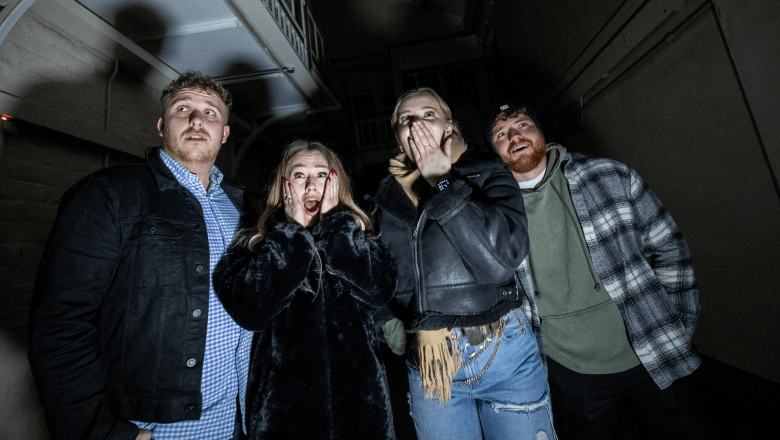
People make sense of disturbing places together, not alone: visit to prison museums and other dark heritage sites are shaped less by labels, displays or audio guides, and more by how people experience them together
https://www.kcl.ac.uk/news/new-research-suggests-people-make-sense-of-disturbing-places-together-not-alone
2 Comments
>The research shows that objects associated with punishment and suffering, such as whips or prison cells, take on different meanings depending on how people engage with them together. Shock, empathy, humour, discomfort and curiosity all emerge through interaction, not just through the artefacts themselves. In some cases, visitors use humour as a way to cope with disturbing material, while in others they align their body language or tone to signal shared seriousness or reflection.
>
>The findings challenge the idea that heritage sites can fully control visitor experience through design alone. While interpretation panels, audio guides and layouts matter, they do not determine how people understand or feel about what they encounter. Visitors actively negotiate meaning with one another, moment by moment, as they move through a space.
>
>The study also questions the assumption that some sites are inherently “darker” than others. What feels disturbing, shocking or meaningful varies between groups, depending on relationships, shared cultural understanding and the dynamics of the moment. In practice, the perceived darkness of a site is constantly shifting.
[Social interaction and dark tourism in prison museums – ScienceDirect](https://www.sciencedirect.com/science/article/pii/S0160738325002087)
Very interesting, yet relatable finding.
An anecdote, about how this principle was purposefully applied by an artist, might be the Holocaust Memorial in Berlin.
)For people who might not know it https://www.berlin.de/sehenswuerdigkeiten/3560249-3558930-holocaust-mahnmal.html)
The concrete poles are only far enough for one person to pass, so you can’t walk next to another. It shapes the experience of walking through this geometrical labyrinth, for the feeling of being alone, of being seperated from each other.
Also I recall different moods and thoughts, when visiting concentration camps and Stasi prisons with school classes and history teachers, as when now visiting them as lonely traveler.