
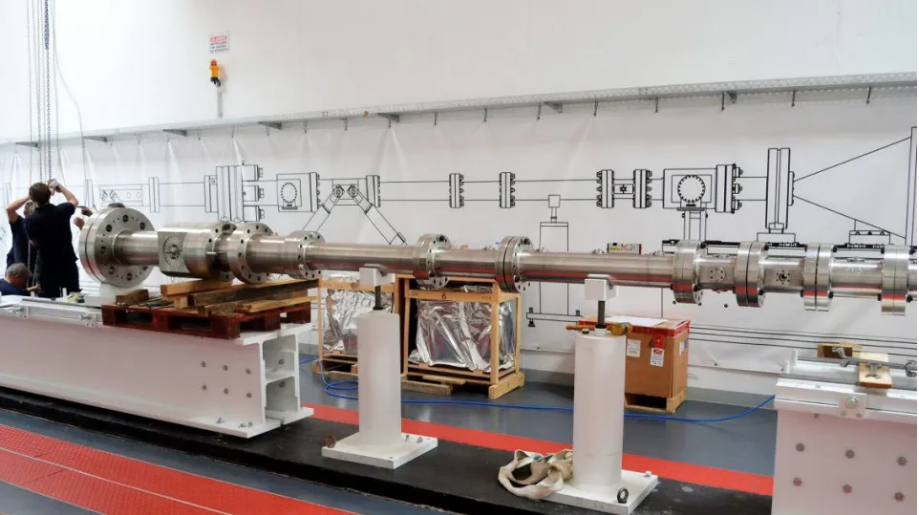
The test was carried out on 19 November by the Institute of Plasmas and Nuclear Fusion (IPFN), a unit of IST, in equipment that “will help to study phenomena that only occur when traveling several times above the speed of sound,” such as those associated with the re-entry of rockets and spacecraft into the Earth’s atmosphere or the exploration of the atmospheres of planets such as Mars, Venus and Jupiter or Saturn’s moon Titan.
In a statement, IST says that the test, carried out in “real conditions” in the ESTHER shock tube, located on the Loures campus, marks “Portugal’s entry into the experimental capacity to study these phenomena.”
The Técnico explains that the shock tube, operated remotely for safety reasons, “involves demanding physical conditions, namely the use of mixtures of hydrogen, oxygen and helium at very high pressures.”
The “hypersonic flow” produced corresponds to speeds five or more times the speed of sound in air, raising the gas to “extreme temperatures and pressures.”
The temperature exceeds that at the surface of the Sun, and the light from the generated shock wave resembles a flash of shooting stars.
According to IST, the equipment should, in the medium term, support the planning of missions of the European Space Agency (ESA), of which Portugal is a member state, and “contribute to the development of national skills in the hypersonic field, through partnerships with academic institutions and Portuguese companies.”