
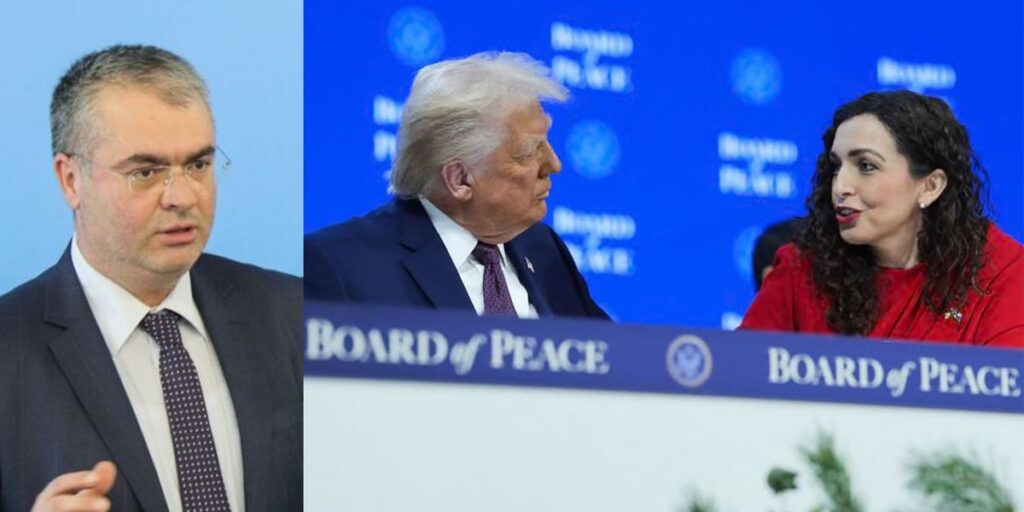
The Director of the Octopus Institute, Arben Fetoshi, has assessed that the signing of President Vjosa Osmani within the Davos Forum for the “Peace Board” initiative constitutes an important political and strategic moment for the Republic of Kosovo.
According to Fetoshi, in an international system paralyzed by the hegemonic appetites of Russia and China, the initiative of US President Donald Trump represents a necessary alternative for addressing current global conflicts. He emphasizes that Kosovo, as the “first victim” of the UN Security Council, has the moral and political legitimacy to support this new model of commitment to peace.
Fetoshi recalls that NATO’s intervention in Kosovo, without the approval of the Security Council, had overcome the Russian-Chinese veto, representing a “violation” of legality in the function of legitimacy and the protection of universal values.
Drawing an analogy with the United States’ historical role as a leader of peace and democracy, Fetoshi assesses that President Trump’s current efforts aim to neutralize new geopolitical threats coming from Russia and China.
According to him, regardless of the final configuration of the Peace Board – whether as a complement or as a challenge to the Security Council – for Kosovo this means advancing strategic relations with the US, reconfirming equal international subjectivity and recognizing its role as a factor of peace in the Balkans.
Fetoshi emphasizes that this initiative also constitutes a significant blow to Serbia’s narrative, which continues to try to present Kosovo as a source of instability in the region.
Finally, he assesses that the reluctance of some European powers to join this initiative reflects fears and dilemmas regarding existing international institutions, but does not diminish the importance of the Peace Board, which, according to him, highlights the deep crisis of the current international system and the lack of collective will to guarantee peace.
“In this context, Kosovo today also spoke with the language of its strategic ally: stability, partnership and international responsibility,” concludes Fetoshi. /Telegrafi/