
While Trump has pulled back on his tariff threats against European nations, his address to world leaders in Davos this week did little to allay their fears or inspire confidence in his appetite for cooperation.
As such, they’re hedging their bets.
Hours before agreeing to a mysterious “framework of a future deal” on Greenland, the president was on stage castigating allies and adversaries alike, underscoring his America First platform and the protectionist ideals that have defined his trade policy.
European Union leaders remained apparently unconvinced by Trump’s public change of heart on Greenland, and scheduled an emergency summit on the topic for Thursday evening.
The heads of state reportedly convened for a last-minute meeting in Brussels to discuss the terms of the deal. Despite the president’s about-face on European tariffs, EU foreign policy head Kaja Kallas said there was much to hash out.
“I think everybody’s relieved by the recent announcements,” she said, according to EuroNews. “We have also seen that in this one-year period, we are ready for a lot of unpredictability.”
“We need to still discuss our plans for different scenarios because everything could change,” she added. “Every kind of disagreement that allies have, like Europe and America, is just benefiting our adversaries who are looking and enjoying the view.”
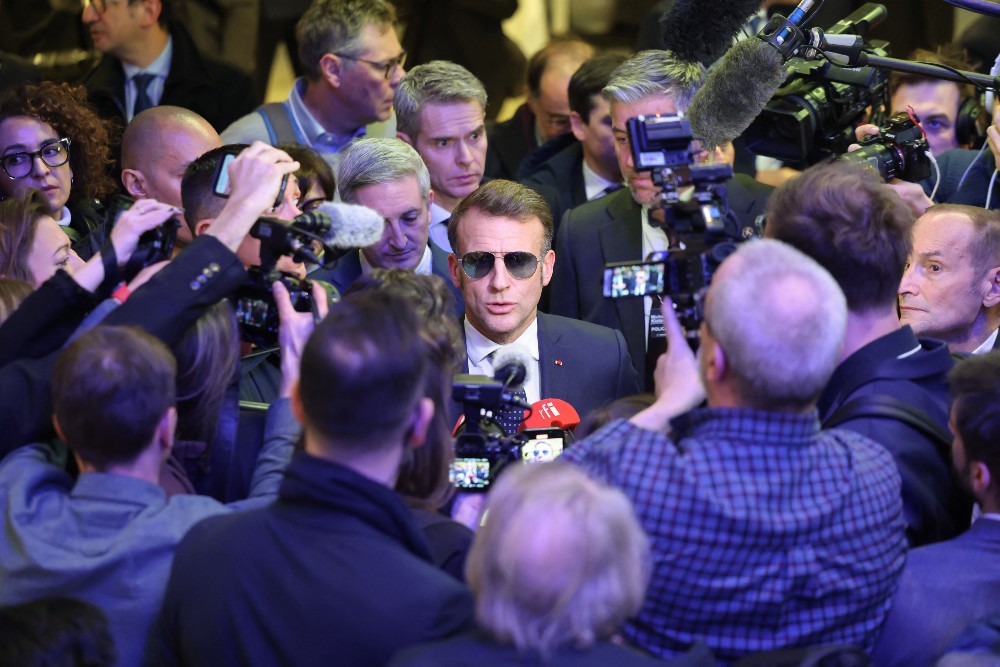
French President Emmanuel Macron said the bloc remains “extremely vigilant” in the face of tariff threats from the U.S., even suggesting at Davos that the EU’s anti-coercion trade tool could be used to counter American import tax hikes. Earlier this week, the EU halted the finalization of its U.S. trade agreement, which was brokered by Trump and President of the European Commission Ursula von der Leyen last summer.
“What we must conclude from this is that when Europe responds in a united manner, using the instruments at its disposal when it is threatened, it can command respect—and that is a very good thing,” he said while in Brussels for the meeting.
After vowing to raise import taxes on eight of Greenland’s European allies over the weekend, Trump abruptly walked back his plan following a discussion with NATO Secretary-General Mark Rutte at the World Economic Forum on Wednesday.
While the president did not release details in the moment, diplomatic and security sources told the New York Times later that the tentative agreement likely includes elements like the creation of a new NATO mission in the Arctic region to guard against potential Russian interference and an update to a 1951 pact between the United States and Denmark that would give the U.S. broader access to Greenland’s resources and control over certain areas, among other provisions.
But Denmark was not a part of Wednesday’s talks. Danish Prime Minister Mette Frederiksen indicated that the conversation between Trump and NATO leader Rutte was “good and natural,” however, “only Denmark and Greenland themselves can make decisions on issues concerning Denmark and Greenland.”
“We can negotiate on everything political; security, investments, economy. But we cannot negotiate on our sovereignty,” she added.
Prime Minister Jens-Frederik Nielsen of Greenland reiterated the stance Thursday, saying the country has some “red lines” that it will not cross in terms of “territorial integrity.”
“We have to respect international law, sovereignty,” the politician said. If Greenland was forced into a choice between its current situation and aligning with the U.S., “We choose the Kingdom of Denmark, we choose the EU, we choose NATO,” he said.
Global markets rallied on Wednesday following a bout of swift selloffs on Tuesday, illuminating the powerful influence of President Donald Trump’s tariff threats—and conversely, his TACO moments, on the international economy.
Canadian Prime Minister Mark Carney’s rousing Davos address sought to mobilize so-called “middle powers” to come together in collaboration amid a “rupture in the world order” that has left them at the whim of hegemons like the U.S.
“It seems that every day we’re reminded that we live in an era of great power rivalry, that the rules-based order is fading, that the strong can do what they can, and the weak must suffer what they must,” he said.
But “other countries, especially intermediate powers like Canada, are not powerless,” he said. In fact, America’s neighbor to the north was “amongst the first to hear the wake-up call, leading us to fundamentally shift our strategic posture” and work to “diversify to hedge against uncertainty” in the face of a breakdown in its most important trading relationship.
Canada is currently working toward trade agreements with India, ASEAN, Thailand, the Philippines and the Mercosur countries, and recently concluded strategic partnership negotiations with China and Qatar.
The strategy’s aim is “creating a dense web of connections across trade, investment, culture, on which we can draw for future challenges and opportunities,” he said, before adding, “the middle powers must act together, because if we’re not at the table, we’re on the menu.”