
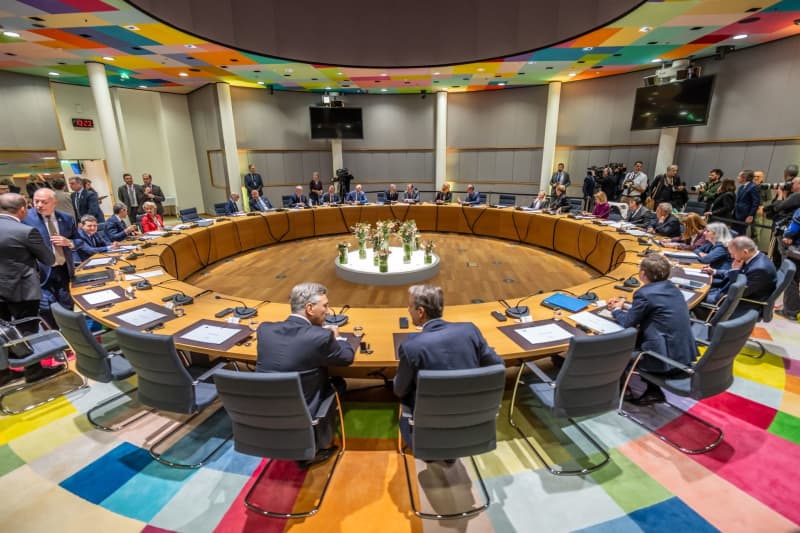
The European Union remains ready to defend itself against economic coercion if necessary, said European Council President Antonio Costa after consultations with EU leaders in Brussels.
“The European Union will continue to stand up for its interests and will defend itself, its member states, its citizens and its companies, against any form of coercion,” said Costa.
“It has the power and the tools to do so and will do so if and when necessary,” he said.
US President Donald Trump unexpectedly withdrew plans to impose new tariffs on European allies over Greenland on Wednesday after he had threatened to impose an additional 10% tariff on goods from eight European allies from February 1 over their support for Denmark.
Trump had recently threatened several times to take over control of Danish-administered Greenland.
After talks with NATO Secretary General Mark Rutte on Wednesday, Trump surprisingly withdrew his threat of punitive tariffs against the eight, saying that a framework for a future agreement on Greenland and the entire Arctic region had been established.
“Looking ahead, we remain ready to continue engaging constructively with the United States on all issues of common interest.”
“The goal remains the effective stabilization of the trade relations between the European Union and the US,” he said, adding that the focus should move to the implementation of the trade deal struck last year.
Strengthening the EU’s ‘resilience and robustness’
EU leaders gathered in Brussels took stock and learned from the roller-coaster week with Trump that shook trans-Atlantic relations to the core.
“I am very grateful that President Trump has refrained from his original plans to take over Greenland. And I am also grateful that he has refrained from imposing additional tariffs on February 1,” said Merz, whose country was one of the tariff targets.
The German chancellor said that the “we will have to strengthen the resilience and robustness of the European Union.”
“The European Union, the European part of NATO, must be able to defend itself,” Merz said, adding that despite progress “we are still a long way from achieving everything we need to achieve.”
In addition, the EU has to improve its competitiveness, he said.
EU ‘not willing to junk 80 years of good relations’
Despite the setback, several EU leaders called for continued close cooperation with the United States.
Polish Prime Minister Donald Tusk urged to protect relations and cooperation with Washington even in the current circumstances.
For Poland, the US remains by far the most important partner when it comes to security, Tusk said.
“The trans-Atlantic relations have definitely taken a big blow over the last week,” said EU top diplomat Kaja Kallas.
The first year after Trump’s return to office have taught the EU “that these relations are not the same as they were,” she added.
“On the European side, we are not willing to junk 80 years of good relations and we are willing to work for this.”
EU has considered trade ‘bazooka’ and retaliatory tariffs
Before Trump backed down, the EU had been considering different retaliatory measures, including the bloc’s anti-coercion instrument, the so-called “trade bazooka,” under which access to the EU market can be restricted.
“If Europe reacts in a united manner and uses the instruments at its disposal, it can command respect when it is threatened,” said French President Emmanuel Macron.
Under discussion was also the possibility of imposing additional tariffs on a list of goods with a total trade volume of €93 billion ($108 billion), including industrial and agricultural goods such as motorcycles, beef, whiskey and citrus fruits.
The list had been prepared last year but was suspended before it entered into force as the EU and the US struck a trade deal in July.
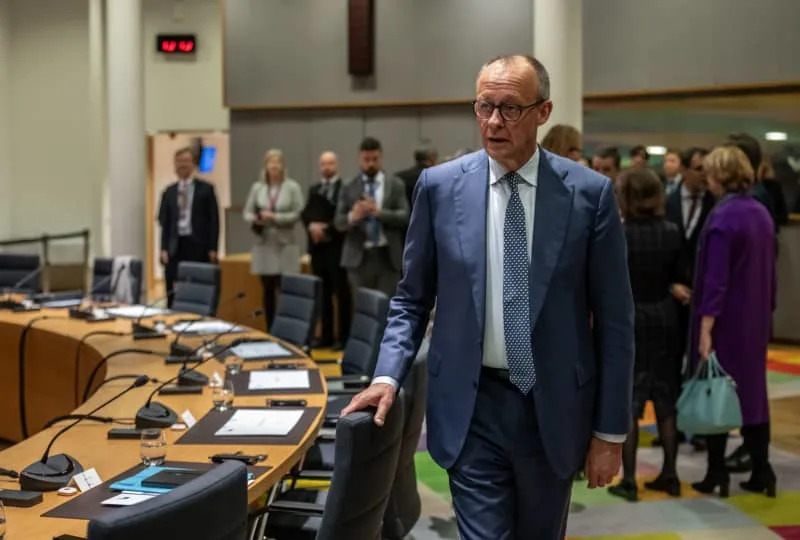
German Chancellor Friedrich Merz arrives at the hall for the special EU summit in Brussels. At the one-day meeting of EU heads of state and government, the EU is discussing its relationship with the US. Michael Kappeler/dpa