
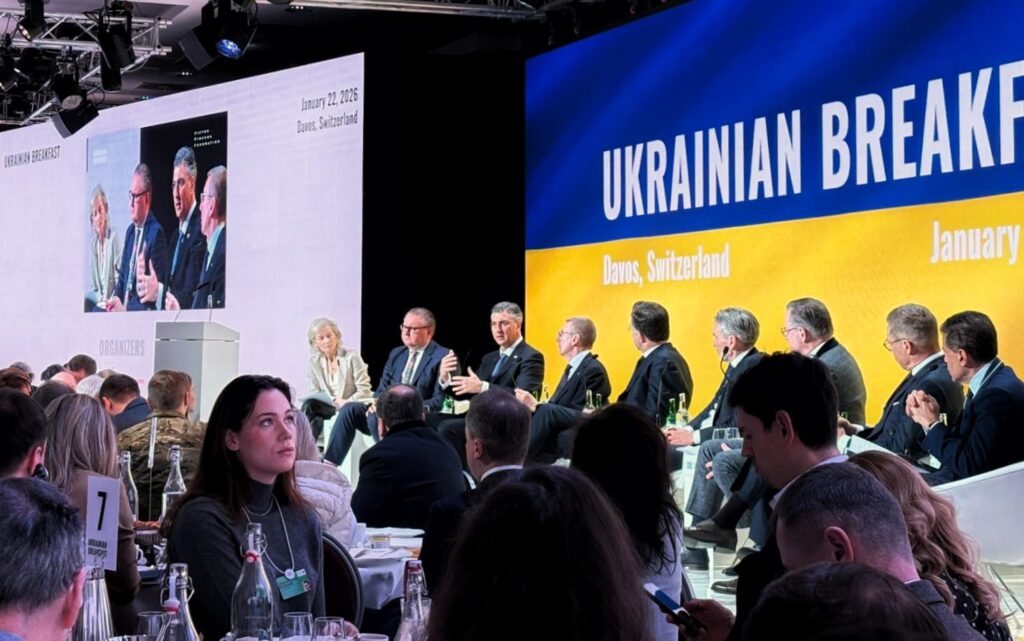
Prime Minister Andrej Plenković participated today in Davos at the “Ukrainian Breakfast” panel organized by the Victor Pinchuk Foundation and Yalta European Strategy.
On that occasion, he reiterated Croatia’s strong support and solidarity with Ukraine, which, among other things, stems from our own experience as a victim of the Greater Serbian aggression of the Milošević regime in the early 1990s, which at one point also had 27 percent of the occupied territory.
Some of the members of the European Union, he added, also have bilateral agreements with Ukraine that clearly define support for Ukrainian membership.
He recalled that he signed such a contract on behalf of the Croatian Government with President Zelenski in December 2021.
In his opinion, there are three important elements of the current situation in Ukraine. The first is the peace process, the second is integration into the European Union, and the third is reconstruction.
Although the main prerequisite is the end of Russian aggression against Ukraine, he pointed out, at the moment we do not see it stopping.
In addition, all the economic consequences of the packages of sanctions did not translate to the political changes in Russia, which is a key problem, he emphasized.
Regarding Ukraine’s membership in the European Union, Prime Minister Plenković said that the approach to the enlargement so far was based on the so-called merit-based approach of every country that aspires to be a member. Now we see signals of a different approach, which is a geopolitical approach.
This is, in his opinion, the only real chance for Ukraine’s faster integration into the European Union.
It is crucial for Ukraine not to cede its occupied territory
He also highlighted two key elements for further enlargement, namely the absorption capacity of the European budget and the decision-making process.
Therefore, the Prime Minister said, one thing is political aspiration, and another is the actual consensus and its implications.
Of course, the key to all of this is to end the war.
In this context, Prime Minister Plenković stated that all peace agreements have two aspects. The first is the moment in which they are signed, and the second is the historical consequences several years later.
His advice to President Zelensky, Prime Minister Plenković said, is to never leave an ink of the pen on the paper that would de jure give up Ukrainian territory.
This is crucial for the legacy of this generation of Ukrainians and everything they have done so far, not only for Ukrainian interests but also as a clear precedent for the stability of the international system and law in the future.
The peaceful reintegration of the Croatian Danube is a unique experience that can help Ukraine
Plenković recalled that at the moment when the Croatian armed forces liberated the vast majority of the occupied territories in just four days, Croatia, as a country of four million inhabitants, had as many as 200,000 armed soldiers – and despite the international embargo on arms imports.
“That is precisely why the unique Croatian experience on the European continent can be of great value to Ukraine, especially when it comes to the process of peaceful reintegration of the occupied territories, completed in 1998.”
He pointed out that today the Croatian Army is undergoing a comprehensive modernization process, switching from Eastern to Western military technology.
“We have or are acquiring new combat aircraft, tanks, American military equipment, helicopters in operational use, and we have also developed our own production of FPV drones.”
We are fully aware of the suffering of the Ukrainian people, and we especially want to help in these difficult moments during the winter, said Prime Minister Plenković, speaking about the assistance that Croatia is providing to Ukraine, including through donations of transformers and generators from our electrical company HEP.
Finally, he expressed great respect and gratitude to the Ukrainian soldiers for everything they have done for their country, but also for the freedom of Europe.
The panel was also attended by the President of Finland Alexander Stubb, the President of Latvia Edgars Rinkēvičs, the Prime Minister of Belgium Bart De Wever, the Prime Minister of the Netherlands Dick Schoof, and NATO Secretary General Mark Rutte.
The panel was also joined by the US President’s Special Envoy Steve Witkoff.