
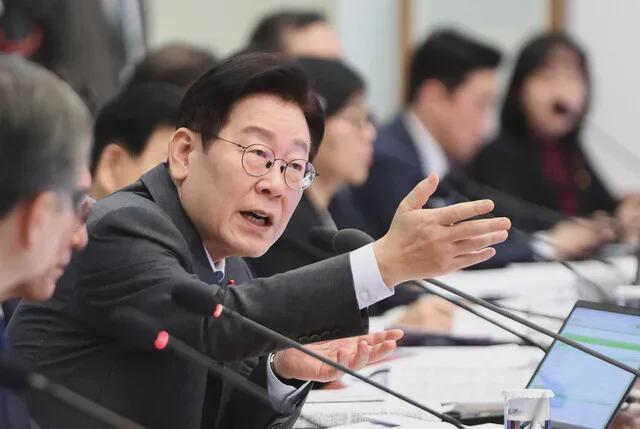
After spending his campaign and early days in office advocating for renewable energy, the Korean president has called for opinions to be canvassed on nuclear energy
The fact that President Lee Jae Myung acknowledged the “overwhelming public support” for nuclear power and called for “reasonable discussion free from ideology” in a Cabinet meeting on Tuesday stands in stark contrast to previous statements that appeared to favor renewable energy policies.
On the campaign trail and as recently as September, Lee has repeatedly stressed that building nuclear power plants is a policy that cannot meet the demand of Korean industries. Energy policy experts believe the president’s mention of the “overwhelming public support” for nuclear power is itself a sign of policy change.
Lee did not convey any clear directive to look into building new nuclear power plants in a conversation with Climate, Energy and Environment Minister Kim Sung-hwan during the Cabinet meeting. However, after noting the public’s support for nuclear power, he did mention the tone of recent discussions marked by “ideological agendas and political fighting” and ordered “the collection of sufficient feedback,” leaving room for his remarks to be interpreted as tacit approval for the construction of additional nuclear facilities.
In remarks made in September at a press conference on the 100th day of his tenure, Lee emphasized, “It takes 15 years to build a nuclear plant. In a situation where we are facing an immense and pressing need for electricity, renewable energy is the system capable of supplying it the quickest.”
It appears that the president’s change of heart on the nuclear issue has been influenced by demands from industry, which believes that providing a stable supply of the energy required by future industries will be difficult through renewable sources alone. Some close to Lee believe a statement by SoftBank CEO Masayoshi Son last year that energy was the “weak link” in Korea’s AI industry may have served as a turning point.
In an interview with the Hankyoreh on Friday, Kim Yong-beom, the chief presidential secretary for policy, described the necessity of building additional nuclear plants.
“AI and semiconductors are hippos that consume a lot of electricity. The shortage of semiconductors has sent the price soaring to the point where they can’t even be sold, and we may face a situation where we can’t supply the electricity that Samsung and SK require,” Kim said.
A series of polls showing support for more nuclear power plants far outweighing opposition in the lead-up to local elections may have also weighed heavily on the president.
A Gallup Korea survey of 1,000 voters nationwide conducted last week found that 54% of respondents believed that Korea should build more nuclear power plants, more than twice the proportion of those who believed more plants should not be built (25%). (The survey was conducted Jan. 13-15 over the phone and had a 95% confidence level and margin of error of plus or minus 3.1 points.)
“A survey conducted by the Ministry of Climate, Energy and Environment also found that support for building nuclear plants is far higher [than opposition],” a senior Blue House official said.
Lee Heon-seok, the head of policy for the civic group Energy Justice Actions, said that the recent talk of nuclear power is in part due to the upcoming elections.
“With the local elections coming up in June, it’s about time for the Democrats and the administration to be making policy decisions. That’s why suddenly even the president is coming out and saying that there’s ‘overwhelming support’ for nuclear power after both the party and administration have avoided the nuclear power debate up until now,” he said.
“In his comments today, President Lee was essentially giving guidelines to the expert commissioners tasked with coming up with the 12th master plan for energy supply,” Lee noted.
https://www.hani.co.kr/arti/english_edition/e_national/1240986.html
Posted by Substantial-Owl8342
1 Comment
We can’t even get a better powerline system because NIMBY is so prevalent. They need to solve the waste problem before proceeding.