
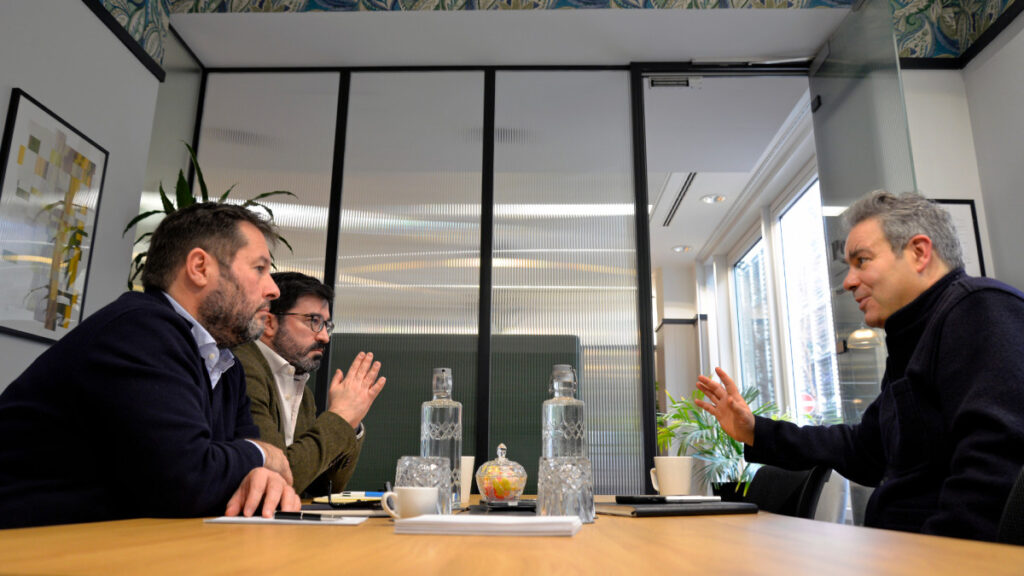
Donald Trump has not only shaken US politics: he has accelerated a deep fracture in the West. This is the central thread running through the conversation that Marc López Plana, editor and director of Agenda Pública, and Toni Timoner, Board member at Agenda Pública, hold with Mark Leonard, founder of the European Council on Foreign Relations (ECFR) and one of the most influential analysts of European geopolitics. The interview takes place in London, at the ECFR’s headquarters.
For Leonard, the rupture is already a reality. “The West is dead,” he says—not as a rhetorical provocation, but as a political diagnosis: the United States is no longer perceived as a reliable ally. The ECFR data he cites are stark: only 16% of Europeans now see the United States as an ally, while in countries such as Spain, France or Germany many more already regard it as a rival or even an enemy. Trump, Leonard explains, “is no longer positioning himself as the leader of the free world,” but as the head of a country that puts its own interests first and questions the very value of alliances.
This shift, Leonard argues, has already changed the way the world views Europe and the United States, has lowered the perceived cost of moving closer to China, and has consolidated a multipolar landscape. The conversation also explores how this division of the liberal West is reshaping the European Union, fuelling the rise of the radical right and forcing Europeans to rethink their security, their sovereignty and their place in an international order in which, as Leonard warns, “the old order is over and it is not coming back.”
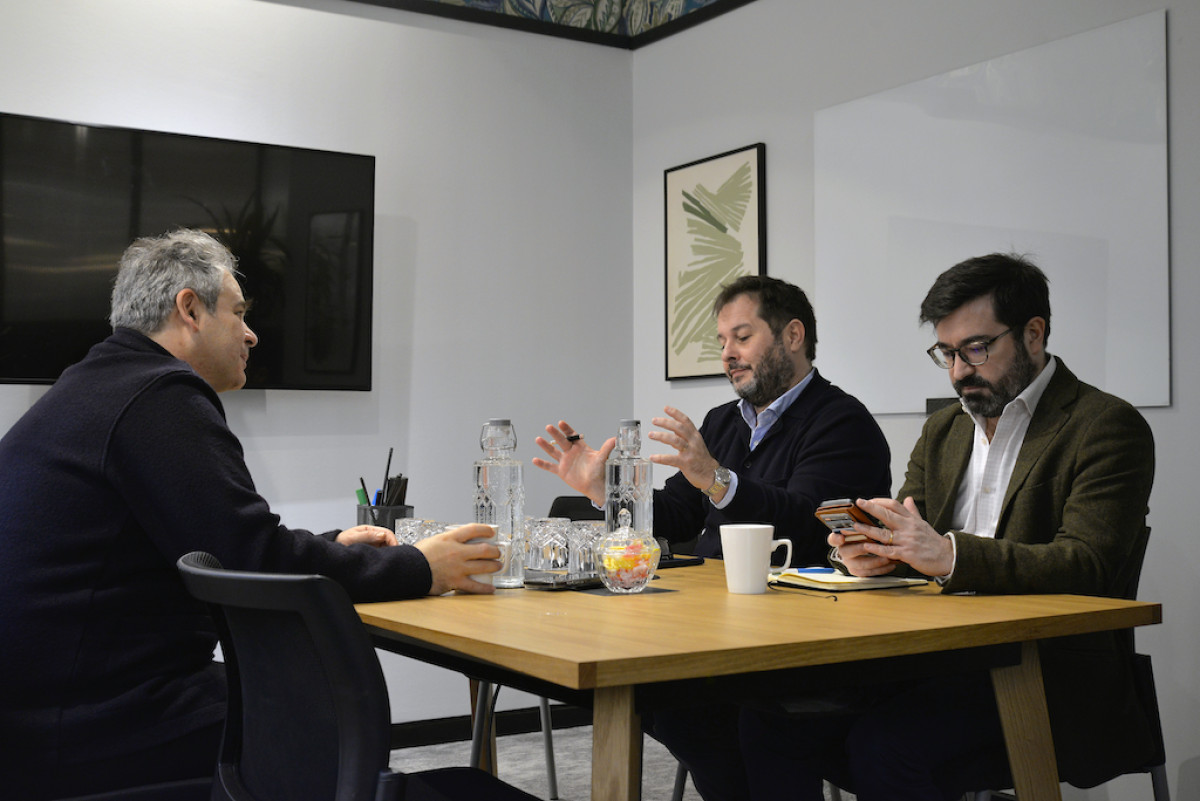
Marc López Plana, editor and director of Agenda Pública, posing questions during the interview. Foto: Agenda Pública / Mark York
Antonio Timoner (A. T.): In
The United West is Dead, you echo — deliberately or not — Nietzsche’s “God is dead”. In the death of God, we have nihilism. That suggests that we may have some international nihilism. What does that imply, and how do you see that developing? Is this a setback, or a permanent mindset, a permanent setting?
The West is a very inspiring and beautiful idea that comes out of the Enlightenment and has a powerful heritage. But it’s also a product of a very different world where Europeans and Americans were in the centre, in the cockpit of history. Lots of other people around the world felt they were victims of this Western ascendancy, expressed through two revolutions we started in the UK: empire and industry — the industrial revolution and the capitalist expansion that took over the whole world.
And lots of positive things came in its wake. But it was also an extremely violent and disruptive period for lots of people who had no say. It was a two-tier Enlightenment, extended to some people and not to many others. We’re now in a world where many of the people who were on the wrong side of that Western ascendancy want to write their own stories and have their own say.
So it’s natural that we are contending with a much more plural world with multiple ideas of modernity. That’s happening, paradoxically, at the same time as this counterrevolution within the West — and that’s what worries me more.
There are blind spots at the heart of the form that the politics of the West has taken over the last few decades. There are lots of positive things that came out of this period of liberalism, but many people haven’t been conscious enough of the downside.
“Neoliberalism has generated a lot of wealth, but it’s been very unequally distributed, and many people found themselves on the wrong side of that”
The downside of liberalism is hyper-individualism and the loss of collective identities. Neoliberalism has generated a lot of wealth, but it’s been very unequally distributed, and many people found themselves on the wrong side of that. It’s also created disruptions. Many of the big problems politics is dealing with now are problems of interdependence: the economic and financial crisis, COVID, the climate emergency, and migration — and failures to manage it.
That’s behind a lot of this counter-movement within the West, which will hopefully lead to a correction, particularly among progressive forces. Politics is being set up in a post-liberal way, and there’s a thirst for more collective identities.
On the left, that’s often taken the form of identity politics: people look at things through the prism of gender, race and sexuality. On the right, it’s a return to a more ethnically based blood-and-soil nationalism.
The big challenge now is whether you can find forms of collective identity that don’t fragment society into ever smaller tribes, and don’t fall back into a 19th-century blood-and-soil tradition of nationalism.
There’s been a failure on the left to do that, partly because in many countries the social democratic left made an accommodation with neoliberalism and globalisation and gave up on the role of the state as a shaper of economic activity. It’s been a failure of political imagination. The right does have that: an ability to imagine things being different, to take action, and to exercise political agency.
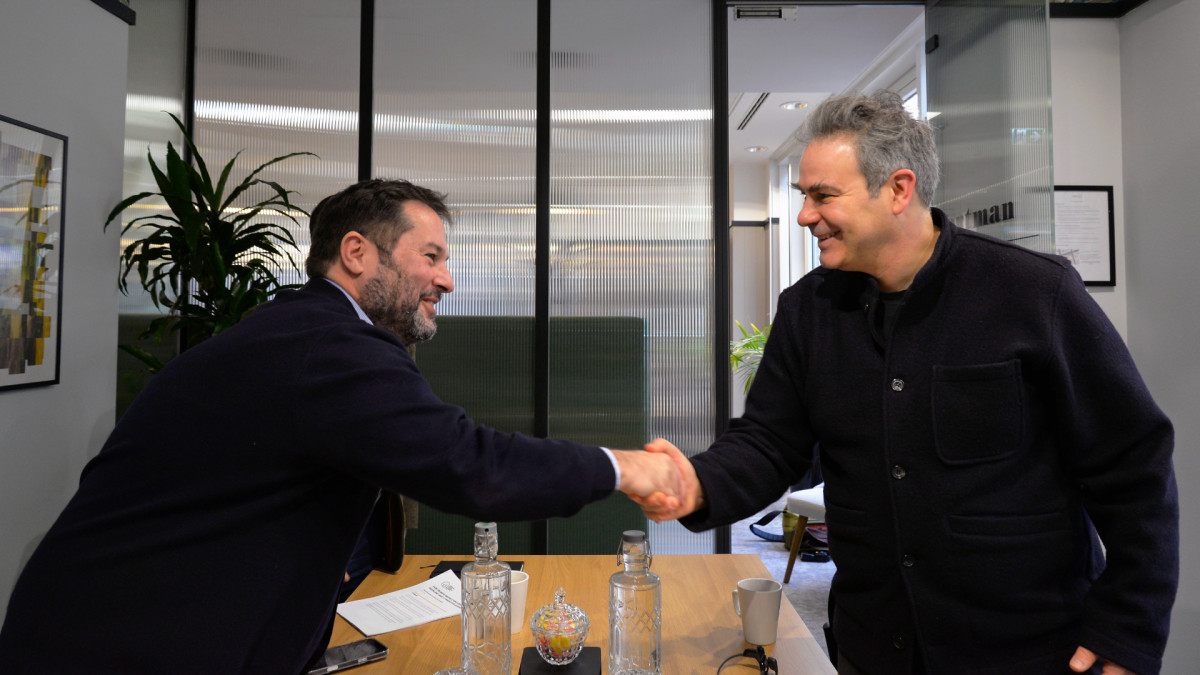
López Plana and Leonard greet each other. Photo: Agenda Pública / Mark York
Marc López Plana (M. L. P.): Is China the real winner?
In our poll, we basically: “Make China great again”. Trump’s making China great again. The poll showed that, in many people’s minds, a lot of our assumptions about how the world works are being challenged.
We looked at that through three main principles. One was what’s happening with the US, where there has been a big fall in credibility, and in people’s ideas of American power.
But the most shocking thing for me is the number of people who see America as an ally — which is why we said that the West is dead. Only 16% of Europeans see America as an ally, and 20% see them as a rival or an enemy. That rises to 28% in Spain, Germany and France — almost twice as many people seeing America as an enemy as an ally.
So there has been this perception of change in the US, reflecting the fact that Trump is no longer positioning himself as the leader of the free world: he wants to put America first and to be a normal country. He sees alliances as a rip-off rather than a positive thing. It’s not surprising that other people don’t see America as an ally anymore.
The second thing is China’s rise. What we found is that most people in most countries think China is going to become more powerful in the future — and that it will dominate in a range of technological areas. Most people think China is going to be the dominant player when it comes to EVs, the green transition, and things like that.
“Maybe the most interesting thing in this debate is that Trump has derisked the idea of having a close relationship with China”
They also think their country will have a closer relationship with China. In some countries, we asked people before — a year ago and three years ago — if they were forced to choose between being in a Chinese world order or the American sphere of influence, what they would choose. Before, most people went for the US. That’s still the case in a lot of places. But in every country we surveyed, the number of people who want to be in the American sphere of influence has gone down, and the number who want to be in the Chinese sphere has gone up. Some countries have flipped: South Africa is the most striking one.
Maybe the most interesting thing, in terms of making China great again, is that Trump has derisked the idea of having a close relationship with China. When we asked people whether they thought they could have a good relationship with both, in every single place that we surveyed, almost all of them thought they could.
In other words, he has normalised the idea that we’re going to have a multipolar world where you can have multiple relationships. I used the term “polyamory” a few years ago, free love. Instead of alliances — Catholic marriages — what you have is free love where everyone can be friends with everybody else.
Then the third thing we looked at was where Europe fits into that mix. It’s not just that Europeans think the West is dead because they don’t trust America as an ally anymore. The rest of the world is also looking at us differently.
The most fascinating thing for me was Russian perceptions: in the past, America was always the number one enemy. Now Europeans are seen as the number one enemy. Many more people than before see America as a potential ally or partner to Russia. That’s also reflected in what Ukrainians think: many saw America as their main ally; now, by quite a big margin, they see the European Union as their main ally.
Then even more interesting than that was that it’s not just in this — and that is understandable given the 28-point plan and everything that’s been happening — but the Chinese also. We asked the Chinese: “When you look at America and Europe, do you think that the similarities between those countries are more important than the differences? Or do you think that the differences are more important than the similarities?”
In the past, when we did this survey four years ago or something, we called our report United West, Divided from the Rest. Everyone in most parts of the world thought that Americans and Europeans were more or less the same, but now that’s not the case. So quite a few more Chinese people think that the differences are important. Even China is starting to see Europe as a different actor from the US, rather than just being Robin to America’s Batman.
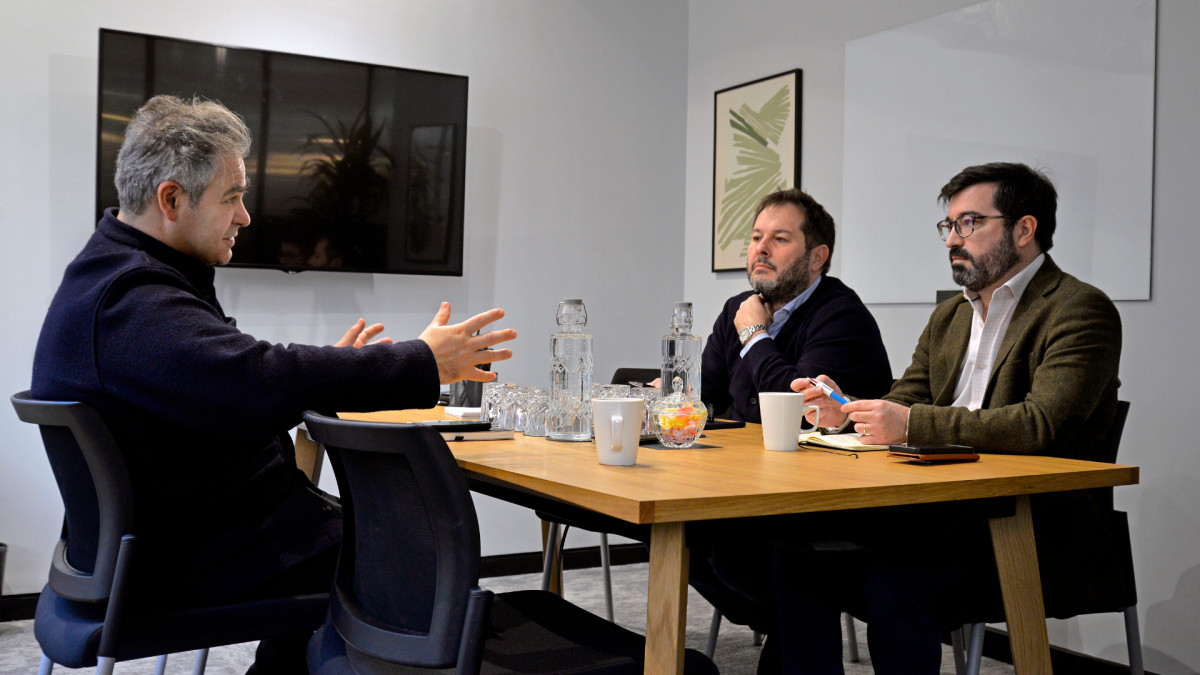
Mark Leonard is the founder of the ECFR “think tank”, created in 2007. Photo: Agenda Pública / Mark York
M. L. P.: Where does liberal democracy fit in here?
I’ve been working on a book which is going to come out in April, and it’s called Surviving Chaos: Geopolitics When the Rules Fail. I made this distinction between two ways of looking at the world: the architects and the artisans.
The architects think about big ideas for global order and how you structure the world, and then they try to make the world look like that. There have been times in history when that was a powerful thing. Certainly after the Second World War, it was architects who built this liberal international order that we have.
Artisans try to understand the way things are. Rather than building structures from scratch, they reuse and adapt what exists; they go with where the tide is going. They are more flexible. The archetype of that is the way China has thought about the last few decades because it couldn’t control things in the same way that the West could. It has tried to insulate itself from the chaos outside, while working out what it can control and where the world is going.
Then you try and put yourself in a place where you’ll benefit from the way the world’s going. Xi Jinping, his absolute all-time favourite phrase, which he echoes all the time, is that we’re going to see great changes unseen in a century, by which he means that the world is going to go through massive disruptive systemic changes to everything.
There’s a whole cottage industry of think tanks in universities and party bodies that have been looking at what these great changes are. Typically, it’s about technological change with AI and quantum computers and new materials. It’s about climate change, which is fundamentally not just changing our climate, but the whole way that we consume energy and the way that our economies run. It’s about economic change and the way that capitalism is changing.
“There is hope that the European Union can be a space that defends the values it was founded around: open society values”
When it comes to liberal democracies, rather than thinking about having a global structure which protects liberal democracy, you need to work out how to defend your liberal democracy at home. As a European, there’s a big challenge to democracy in all of our countries. That’s one of the big battlegrounds within our individual countries.
But there’s also a hope that the European Union can be a space which stands for the values that it was founded around — open society values. But what we need now is less universalism and more exceptionalism: to recognise how many of these ideas came out of our history and particular circumstances.
They’re fragile. We need to work out how to defend them. A lot of that is going to be about reimagining, and having the political imagination to defend them at home. That goes back to where we started: the end of the West and the need to find new political visions that are attractive to people who felt left behind by liberalism, and who feel angry, frustrated and hurt about what’s happened over the last few decades.
M. L. P.: What does it mean for European far-right parties? You had many conversations with far-right leaders. What does this division in the West mean for them?
In a weird way, there’s a new West which is being born. So for them, it’s less of a division.
One of the interesting things, if you look at these opinion polls that we do: when we started doing polling, the biggest Atlanticists in many countries were the supporters of the mainstream parties. In Germany, it was supporters of the Christian Democrats mainly, but also the SPD to a certain extent. In France, it was the Socialist Party and the Republican Party before. In Spain, it was the PP and the PSOE.
What’s interesting is that the people who are the most anti-American now tend to be the people who were the most pro-American before: they feel hurt and betrayed and they don’t like Trump. And a lot of these nationalist parties on the far right, which were not that convinced about America, looked to Donald Trump as a leader in what they’re standing for.
Actually, the most Atlantic people in a lot of countries are now the people who support the Rassemblement National in France, the AfD in Germany, Reform in the UK, Vox in Spain, other sorts of parties like that outside the political mainstream.
If you look at J.D. Vance’s speech at the Munich Security Conference, he’s almost offering an alternative Western project, which is a return to a Judeo-Christian ethnic national idea of what a Western identity is. That is quite a big shift.
These parties are being transformed through this process because they used to basically be nationalist parties concerned about sovereignty. But a lot of these parties are now becoming part of a transnational political movement — a revolutionary movement — led by Donald Trump in the US.
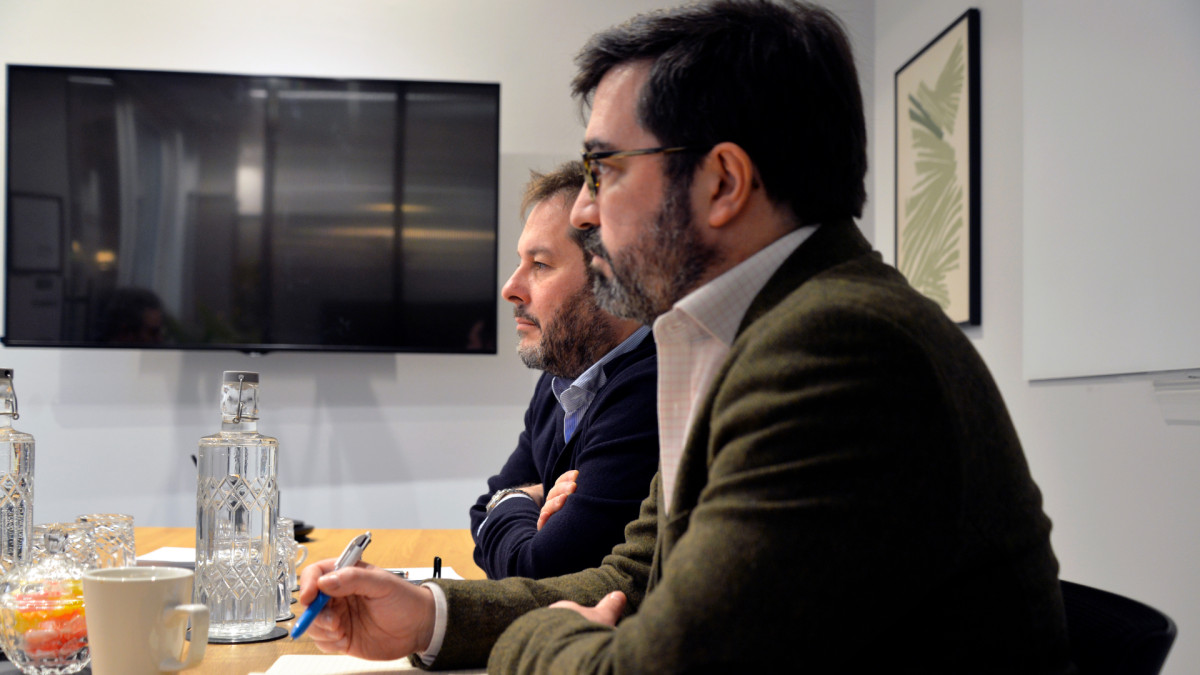
López Plana and Timoner show interest in Leonard’s views. Photo: Agenda Pública / Mark York
A. T.: To what extent can they work together? Historically, they have only been united in contexts where they identified a common adversary.
They have quite a lot of work to be done in dismantling the liberal consensus of the last period of time. A lot of these parties hate each other.
I had a conversation with somebody in the AfD in Germany about European politics and which people he liked in other countries. He said: the people we like the most in France are Le Pen’s party. But they don’t want to have anything to do with us because part of their detoxification strategy is not having anything to do with us — we’re seen as too radical. So we work with Éric Zemmour’s party. But we don’t like them: we think they’re too liberal.
Then we went around Europe and it was a similar story everywhere. In Poland, they liked the Law and Justice Party. But PiS was too anti-German to want to have anything to do with it.
So there are a lot of tensions between them. They don’t all get on. And every single one of these parties is trying to move from the fringes to the mainstream. Often they need to legitimate themselves in national discourse — and one way is by not talking to each other.
They disagree on some things in a fundamental way. On Russia, for example, some of these parties are very pro-Russian, some are anti-Russian. But at the same time, there is quite a lot they do agree on. The European Parliament is an interesting laboratory for this because these parties are often well represented there. As we know, there isn’t a single group: they’ve found it impossible to all work together effectively.
There’s much less cohesion between them than there is between the socialist parties or the parties in the EPP, the centre-right parties. But they are becoming better organised, and on a lot of big topics their influence has come not necessarily from winning votes, but from changing how mainstream parties talk about things.
“If you look at trade and migration, a lot of what mainstream parties are doing is not that different from what far-right parties are doing”
If you look at trade and migration, a lot of what mainstream parties are doing is not that different from what far-right parties are doing. They’ve managed to shape and frame these debates in a dramatic way in a short period of time. That’s also where some of their influence comes from: they don’t necessarily need to win power themselves. If they can shape the way issues are framed and push policies and ideas out of the sphere of acceptable politics, that is a dramatic way of influencing power.
M. L. P.: What does it mean for the European Union that these parties are winning in a lot of European countries?
It’s a big challenge for the EU. Even if they don’t come to power, they’ve changed the nature of the European Union. But it’s not just them: it’s a combination of the internal and the external.
I’ve written in the past that for the first eight decades of its existence, the European Union was a peace project, but since 2022, it’s been a war project, in that most of the energy that’s gone into European integration has come out of dealing with the war with Russia since the full-scale invasion of Ukraine.
You’re going from a liberalising union — focused on removing barriers — towards a union that’s much more about security, and rebuilding control and sovereignty against hostile forces, whether military, economic, technological, or attempts at influencing our elections.
So the logic of the EU is still there, the institutions are still there, but the logic driving their actions is very different. There are still some things on autopilot. The trade deal with Mercosur, for example, started decades ago in a completely different world, and it finally comes to fruition.
But that, in a way, is an exception. We’re not going to see many more things like that in the future. It’s not necessarily about dismantling the EU, but repurposing it — changing the logic behind it. That’s already happened in many areas.
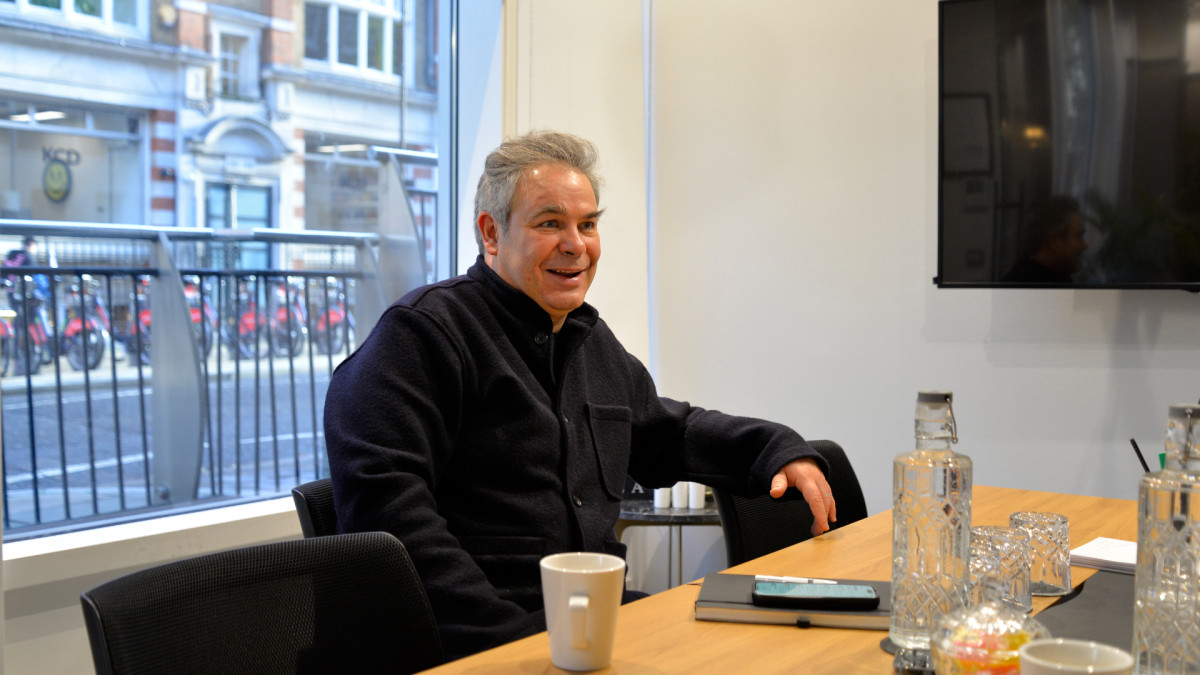
Across six different works, Leonard explores geopolitics and geoeconomics. Photo: Agenda Pública / Mark York
A. T.: If the EU is repurposed by these parties, what is left of that soft power? In your book you argued that this could be Europe’s century because of its ability to exert that influence, that soft power.
People often misunderstand what Joseph Nye meant by soft power. He distinguishes between material and non-material forms of power; soft power is non-material, hard power is forcing people to do things.
But actually quite a lot of the power the EU has used is hard power. That chapter on passive aggression in my book is about hard power. We basically say: here’s our rule book, 80,000 pages. Here’s our market. If you want access, you follow the rules and submit to our courts and judges. It’s up to you — take it or leave it. That’s hard power.
It has also had soft power effects, and it’s had a dramatic effect on our neighbourhood. But there are limits. One is that we’re going through a big reshuffling of economic, political and military power in the world.
Europe is not declining per se. We’re still growing, slowly, and we’ll do better than many countries. But we’re growing less fast than many other parts of the world. Our relative share of the world market has shrunk.
One of the shocking things people look at — partly because of Brexit, but also because of other things — is that when I wrote that book, the EU’s single market was about a third of global GDP. It’s now much less: under 20%. The power of giving access to the market is still real — it’s a big market — but it’s at least a third less than it was 15 years ago. If you go forward another 15, 20, 30 years, it will be smaller and smaller.
So our ability to dictate terms unilaterally is going to lessen. That means, first, accepting more pluralism: there will be other systems, and we’ll have to be better at bargaining rather than dictating.
“One reason there are massive migration pressures on Europe is because it’s a great place to live: hundreds of millions of people, if they could, would love to move here”
Then there’s the question of actual soft power: how much are people genuinely inspired by what’s going on in Europe? Personally, there’s nowhere I would rather live than Europe. In the opinion surveys we’ve done, many people feel that too. One reason there are massive migration pressures on Europe is because it’s a great place to live: hundreds of millions of people, if they could, would love to move here. That’s partly jobs and a developed economy, but also social rights, culture, ideas.
But what’s happening now — and Europeans are coming to terms with it — is that a lot of our so-called soft power was really hard power. The fact that lots of people around the world speak English is partly about the beauty of the language — Shakespeare and others — but probably more about the fact that English-speaking people conquered large parts of the world. Companies settled in different places; through force of arms, legal systems and civil services were set up; norms were established. That led to a diffusion of ideas.
But now that these countries have more power and resources, there’s a backlash and a desire to shape their own future in a post-colonial mindset, replacing the liberal imperialism of the last few decades. That’s a big challenge for Europeans. Unless we find a different language, people don’t really want to be lectured by Europeans anymore. If we’re not so much more powerful that we can face people down, then it’s often counterproductive.
To preserve the attractiveness of what we do, we need a different way of talking to other players — more respect, more agency for them, and more humility from us. Some of it is tactical. People find it annoying when Europeans talk as if they have no interests — as if we’re just representatives of higher values.
One of the refreshing things about Donald Trump is that in the past, when the US invaded Iraq, politicians would say it was about spreading democracy and human rights. Critics would say it was about Iraqi oil. But in Venezuela, Trump didn’t say, “We’re here to defend democracy”. He said, “We’re here to grab the oil”. That’s horrifying on one level, but also refreshing because people suspect that’s what the intent was anyway. Now it’s stripped away: there’s honesty, and you can deal with it.
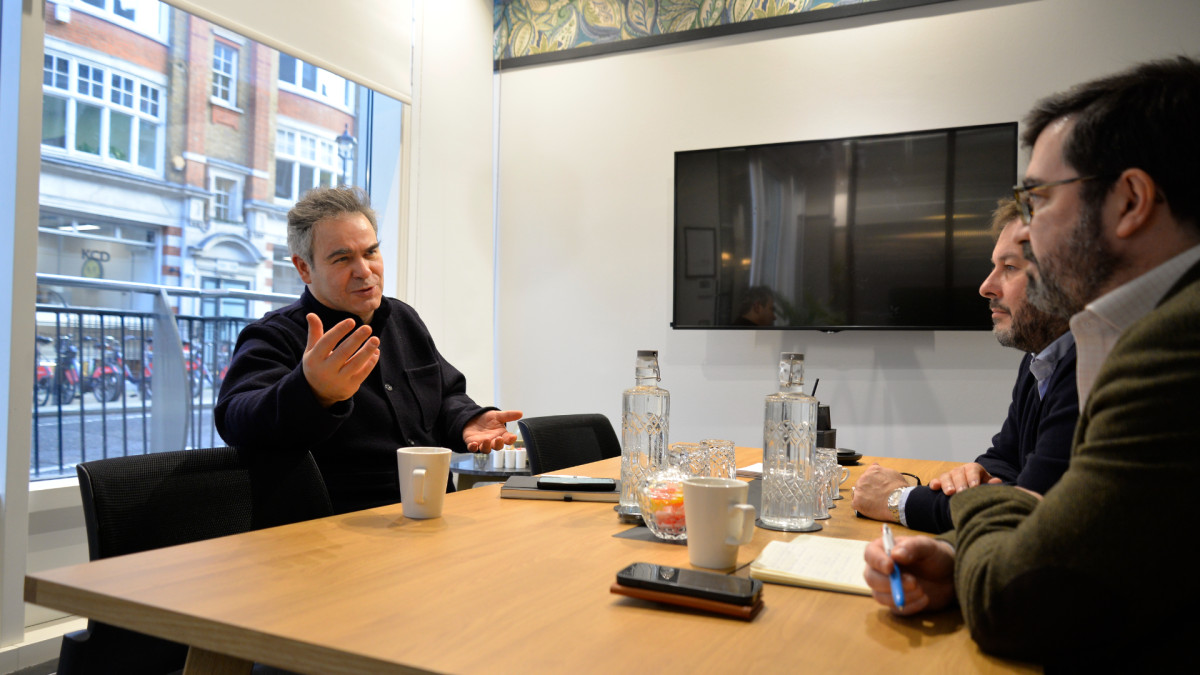
Mark Leonard distinguishes between the EU’s use of soft power and hard power. Photo: Agenda Pública / Mark York
M. L. P.: What is the correct behaviour in front of Trump? I think European elites don’t quite understand him.
Trump is a complicated, inconsistent, unique character — not easy to deal with. European governments and leaders have done a good job of flattering him and handling him. I’m less worried about what they do in meetings; I’m more worried about what they think is going to happen and what they do around the meetings.
It should be clear by now that, for Europeans, the old order is over and not coming back. We can’t rely on a return to an exceptional America that saw itself as the head of a liberal international order and was willing to defend its allies as it did over the last few decades.
“Washington is moving away from free trade, accepting high levels of migration, and an alliance-based foreign policy willing to get deeply involved around the world”
There are unique qualities about Trump. If he died tomorrow, the tone of voice and some of the craziness would disappear. But there are big structural trends in America, tied to this crisis of liberalism. Washington is moving away from free trade, accepting high levels of migration, and an alliance-based foreign policy willing to get deeply involved around the world. That’s not going to change.
So we need a more transactional relationship with the US. We need to do more ourselves, stop being overly dependent, and be able to raise the cost for American governments when they do things we don’t like.
The Chinese way of dealing with trade wars and tariffs has been very different from the European approach — and more successful. They struck back hard using rare earths, magnets and choke points, and forced Trump to back down and capitulate to countermeasures. When I was in Beijing in September, lots of Chinese people contrasted the European approach — basically giving in — with their approach of pushing back. But it’s not the same situation because China doesn’t depend on the US in Ukraine in the way Europeans do.
The challenge for Europeans is to move from high dependence while things could go badly wrong in Ukraine. A wrong peace — a total capitulation — could open the door to decades of instability and problems with Russia. Europeans want to use as much leverage as they can to avoid that.
In that context, flattering him and doing what they’re doing can make sense. But quietly, they also need to build capacity: reduce dependence on the US as fast as possible. I was very disappointed we didn’t use the anti-coercion instrument when the tariffs were introduced. That was something Europeans could have done. I would have liked a more robust response. Trump respects that, and tends to respond quite well to people pushing back with real power.
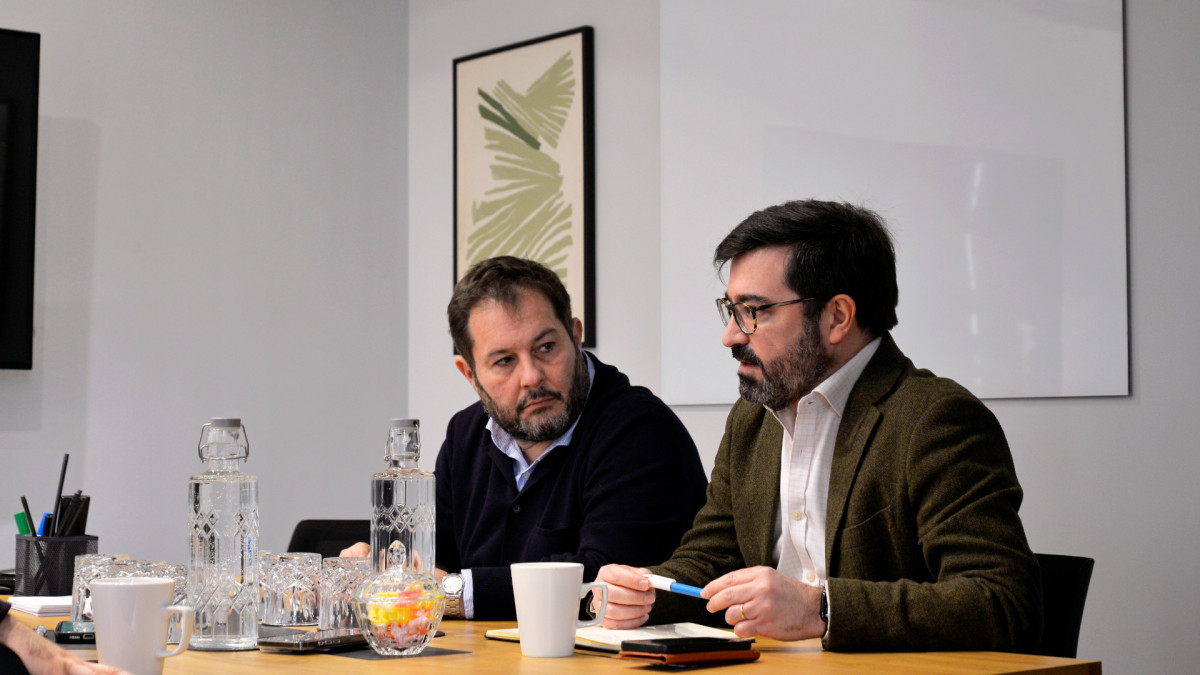
Timoner questions the effectiveness of Europe’s governance model. Photo: Agenda Pública / Mark York
A. T.: Is Europe at a disadvantage because we have a problem of governance? We talk about building up capabilities, but we need concerted action.
Governance can slow us down. But by and large, we find ways around it. If Hungary blocks something, the EU can be flexible and develop different formats — coalitions of the willing — or use loans if you can’t get everyone to agree on using Russian assets. It takes longer, but if things are serious enough, the EU finds a way. We saw it in the euro crisis and during COVID.
One big reason it’s been difficult is that I grew up in the Cold War, when many governments were spending 4-5% of GDP on defence. If Americans were willing to carry on paying for our defence in that period, it’s not edifying that we didn’t step up, but it’s a natural thing. That deal is now over.
And it’s not necessarily governance. You can see it in Spain: Pedro Sánchez doesn’t want to ask Spanish people to pay more for defence. He could do it if he had to. If Russian tanks were gathering on the Pyrenees, then you probably would spend more.
M. L. P.: It’s true that Pedro Sánchez has increased spending up to 2%. That’s a lot, given Spain’s context.
It’s a lot for anyone. Frankly, I’m more worried about how we spend the money than how much we spend. One of the tragedies of European defence spending is how little capability we get for it. That reflects the fact that it didn’t matter as much — it wasn’t existential. People weren’t spending to build capabilities; they were spending to create jobs in certain parts of the country and help certain politically important companies.
M. L. P.: With this governance, is it possible to compete with China and to compete with the United States?
It depends on the issues. One of the difficulties we have is that the European worldview is being more profoundly challenged than anyone else’s right now.
“When the full-scale invasion of Ukraine happened, I said this is as much an identity crisis as a security crisis”
When the full-scale invasion of Ukraine happened, I said this is as much an identity crisis as a security crisis. The EU’s philosophy was about shifting from hard power to soft power; moving away from nationalism; developing universal norms. What we had to do immediately after the invasion started was to turn our backs on some of these hard-won advances, which we thought were civilisational advances. That’s not easy.
One reason France and Germany were quite silent immediately after the invasion was that their worldview was collapsing. At the same time, a lot of Eastern European countries said: “We always said it was bullshit. We said hard power was important, that nationalism was important, because we’ve been under crazy transnational things under communism beforehand, and now we’re rediscovering our national identity, and sovereignty is important.”
That was more of a shock for someone like Macron or Steinmeier than for other countries. It took time to calibrate it, because the worst thing is to lose the big lessons of European history that led us to build the EU.
But at the same time, it’s clear you need a different set of rules inside the EU than for dealing with countries outside — Russia, China, the US — where, in the jungle, you need to obey the law of the jungle. We want to make sure European space isn’t a jungle: inside, you want interdependence and pooled sovereignty. But outside, you need to behave more like a great power.
You’re never going to have the level of executive freedom that an American President or a Chinese President has. You deliberately don’t want Ursula von der Leyen or António Costa to have that power. So it’s going to be messier and slower.
But there are things we can do that others can’t. And we don’t want to invade other countries and annex territory. But we do need to be able to respond quickly when people mess with our interests — and to make it painful and expensive.
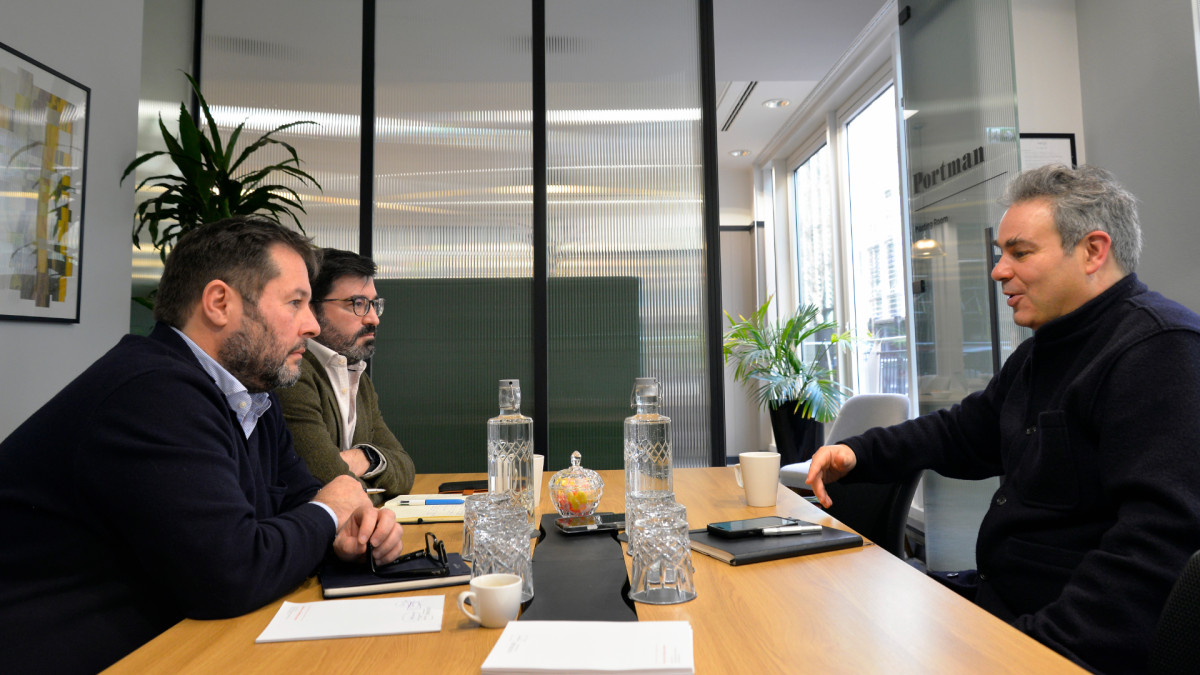
López Plana and Timoner were received in one of the ECFR offices. Photo: Agenda Pública / Mark York
M. L. P.: What could happen with the peace agreement in Ukraine?
On the one hand, the war has been terrible for the European economy and politics. It’s helped a lot of these right-wing parties succeed. We don’t want a forever war on the European continent. At the same time, a bad peace could unleash decades of confrontation with Russia.
Europeans should have moved earlier to try to create a settlement — a good settlement. It’s clear there are going to have to be horrible compromises. Ukraine is going to lose de facto control over large parts of its country; that will be very difficult to accept.
But what matters more, within Ukraine and for Europeans, is the nature of the Ukrainian state that emerges. Some things are essential. One is that Ukraine should be able to choose its political destiny and not have forced neutrality imposed. That’s why there is this big debate about Ukraine joining the EU.
“It’s in our interest to make sure Ukraine is in our sphere of influence and helps defend us from Russia, rather than becoming a Russian asset that puts pressure on Eastern Europe”
There are technical barriers which make it impossible to see Ukraine as a normal member state of the EU on the timescale people talk about — 2030 or 2027. It’s not going to happen. At the same time, it’s not realistic to see Ukraine as a buffer state outside European space. It’s in our interest to make sure Ukraine is in our sphere of influence and helps defend us from Russia, rather than becoming a Russian asset that puts pressure on Eastern Europe. The geopolitical orientation is central.
The second thing is that Ukraine can arm itself properly. It was very worrying, the idea Russians had at the beginning of limiting Ukrainian forces to 85,000 troops. The good news is that those very low levels have been removed. For all the talk of security guarantees, the biggest guarantee is turning Ukraine into a porcupine that can defend itself — with access to weapons.
There are other details. But we’re unlikely to see peace in the very near future because Russians think they are winning and can get a better deal than what’s being offered. I don’t know if they’re right. But it’s good we’ve shifted from simply extending the war to thinking about how to get a peace that works for Ukraine and Europe.
It’s going to unleash difficult questions: the economic costs of helping Ukraine rebuild will be enormous and mainly borne by the EU and European countries.
It raises difficult questions about enlargement and borders in Europe, which will be politically toxic. Any country that has been a beneficiary of EU funding would become a net contributor overnight if Ukraine came in. So it’s a complicated story — and a big challenge for the next two or three years.
M. L. P.: What about the Spanish perspective of Europe?
It’s interesting to see how the Spanish government is positioning itself, because it’s quite different from what most other governments are doing on a lot of these big issues.
On Trump and the US: Sánchez has decided that Trump represents a philosophical and political threat, and that the best way of dealing with it is to run against it, in the way Mark Carney did in Canada. He has a different tone of voice when he discusses Trump.
“In some ways, [Pedro Sánchez] is going against the current of where European politics is going, but he is a great political survivor”
He also has a different stance on migration from what a lot of other countries have done. Some of that is geography — Spain is further from the front line in Ukraine — and some of it is the political system and the challenges he faces. He’s using the fight against the far right to marginalise the centre-right and to unify his coalition on the left.
So that has to be part of it. But it’s notably different from what a lot of other social democrats have done, particularly on migration — compare Sánchez to Denmark or the UK, or almost any other country.
In some ways, he’s going against the current of where European politics is going. But he’s a great political survivor. Lots of people have underestimated him at every stage in his career.
Thank you.