
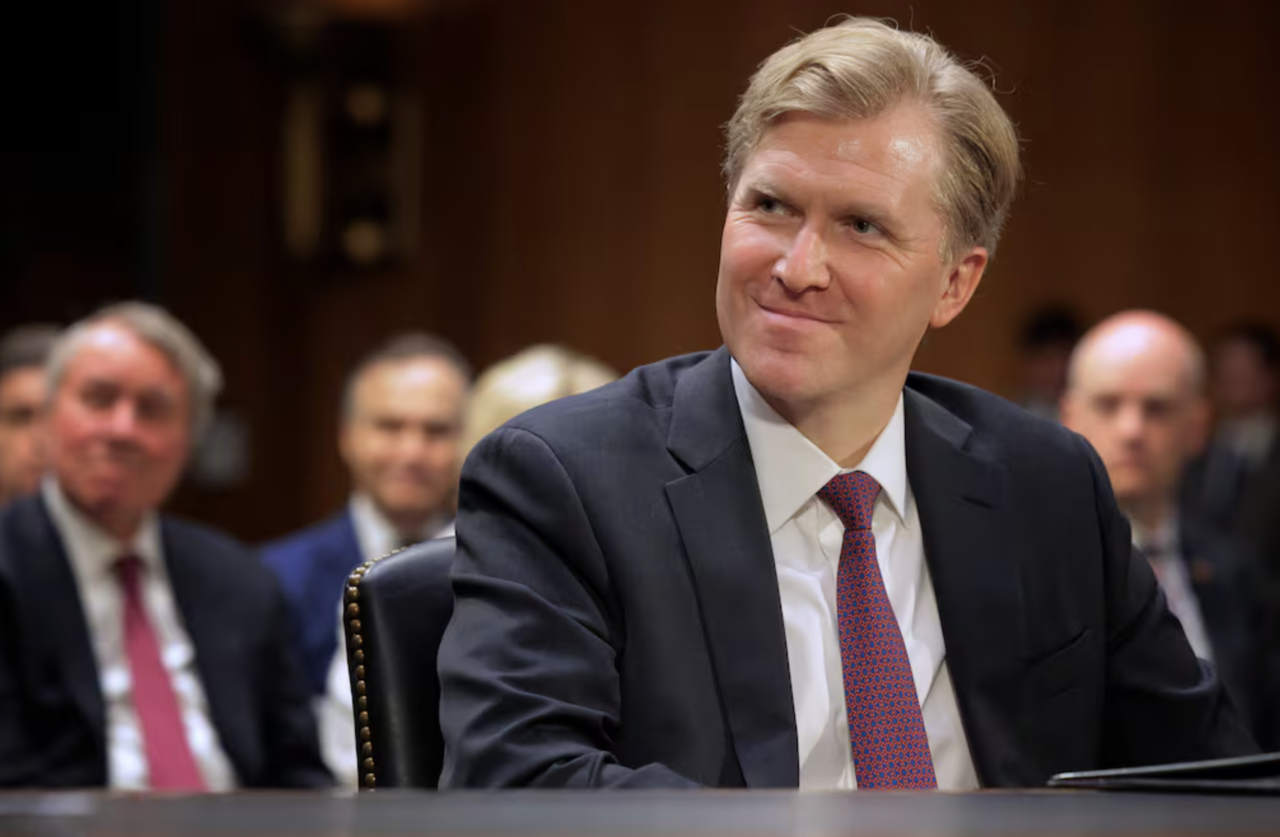
 Elbridge Colby, under secretary of defense for policy, speaks at a Senate Armed Services Committee hearing at the US Capitol in Washington on March 3, 2025. (Getty Images)
 The United States’ drive to increase the role played by its allies is likely to take more concrete shape following a senior US defense official’s trip to Seoul days after the release of the Donald Trump administration’s 2026 National Defense Strategy.
According to the US Department of Defense, Elbridge Colby, undersecretary of defense for policy, is traveling to South Korea and Japan to meet with defense and government officials. US defense officials said Colby departed for Asia on Saturday.
While details of his itinerary were not disclosed, he was expected to arrive in Seoul on Sunday and travel to Japan later in the week.
His visit comes shortly after the Trump administration released the 2026 National Defense Strategy on Friday, a supporting document to the National Security Strategy published in December 2025.
During his visit, Colby — who played a central role in drafting the National Defense Strategy — is expected to brief senior South Korean foreign affairs and security officials on the document and its implications for alliance posture, defense spending and regional deterrence.
The NDS outlines Washington’s defense priorities and strategic direction under the second Trump administration, with a strong emphasis on reshaping alliance burden-sharing in the Indo-Pacific region.
In the document, the Department of Defense said, “we will seek to make it as easy as possible for allies and partners to take on a greater share of the burden of our collective defense.”
In assessing South Korea, the strategy said, “with its powerful military, supported by high defense spending, a robust defense industry, and mandatory conscription, South Korea is capable of taking primary responsibility for deterring North Korea.”
At the same time, it added that such responsibility would be assumed “with critical but more limited US support.”
The allies have discussed ways to recalibrate their respective roles as part of broader efforts toward “alliance modernization,” under which Seoul would take the lead in conventional deterrence against North Korea, while Washington continues to provide extended deterrence against threats such as North Korea’s nuclear weapons.
In particular, discussions on the transfer of wartime operational control, or OPCON, are expected to feature during Colby’s visit.
OPCON was handed over to the United States during the 1950–53 Korean War, with peacetime operational control returned to Seoul in 1994. The Lee Jae Myung administration has been actively pursuing the transfer of wartime OPCON, setting a target year of 2030.
Washington, for its part, has increasingly emphasized the “strategic flexibility” of US Forces Korea, a shift that has coincided with renewed momentum for the OPCON transition.
Following a ministerial-level meeting between the allies in November last year, Seoul and Washington agreed in a joint statement to push ahead with verification of the Full Operational Capability of the future Combined Forces Command headquarters in 2026.
The planned command is designed to serve as a wartime headquarters led by a South Korean four-star general and to assume operational control from the current US-led Combined Forces Command once the transition is completed.
If the FOC assessment is completed this year, the two sides are expected to set a target year for the OPCON transition. One year prior to the transfer, the allies would conduct verification of Full Mission Capability — a largely qualitative evaluation that analysts say could ultimately be finalized through political discretion.
The NDS also emphasized the use of incentives to encourage greater allied contributions, stating that “incentives work and will be a critical part of our alliance policy, through arms sales, defense industrial collaboration, intelligence-sharing, and other activities that leave our nations better off.”
During a summit on the sidelines of the Asia-Pacific Economic Cooperation meetings in South Korea last year, Lee and Trump discussed South Korea’s potential pursuit of nuclear-powered submarines, with consultations on the issue continuing.
The new strategy document identifies China, Russia, Iran and North Korea as the primary threats facing the United States.
It warns that despite aging or poorly maintained conventional forces, North Korea continues to pose a direct threat not only to South Korea and Japan but also to the US homeland.
flylikekite@heraldcorp.com