
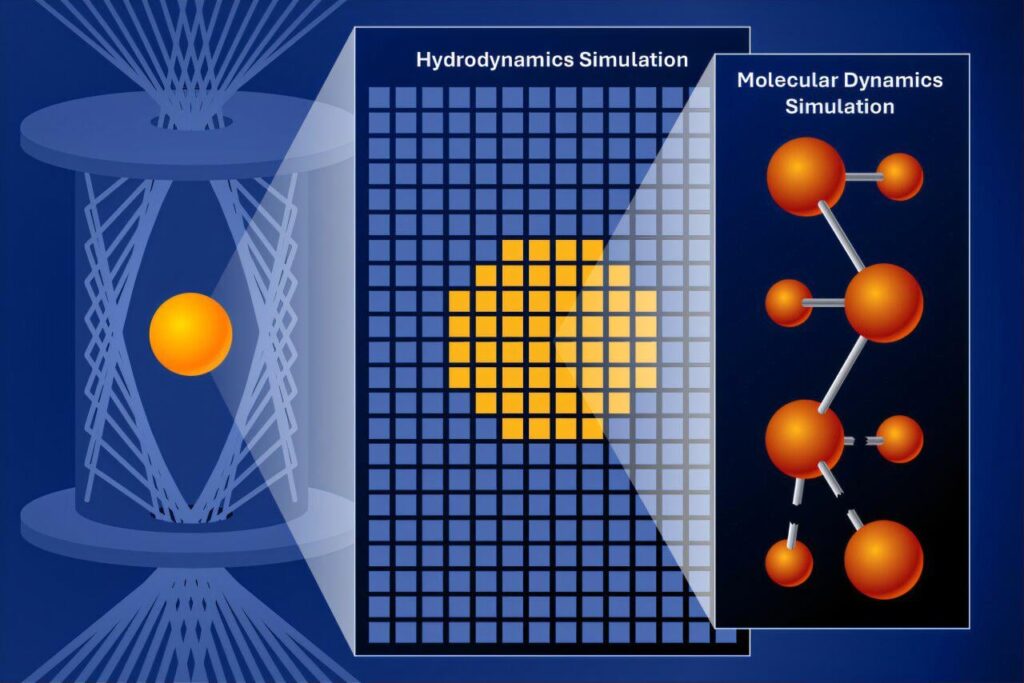
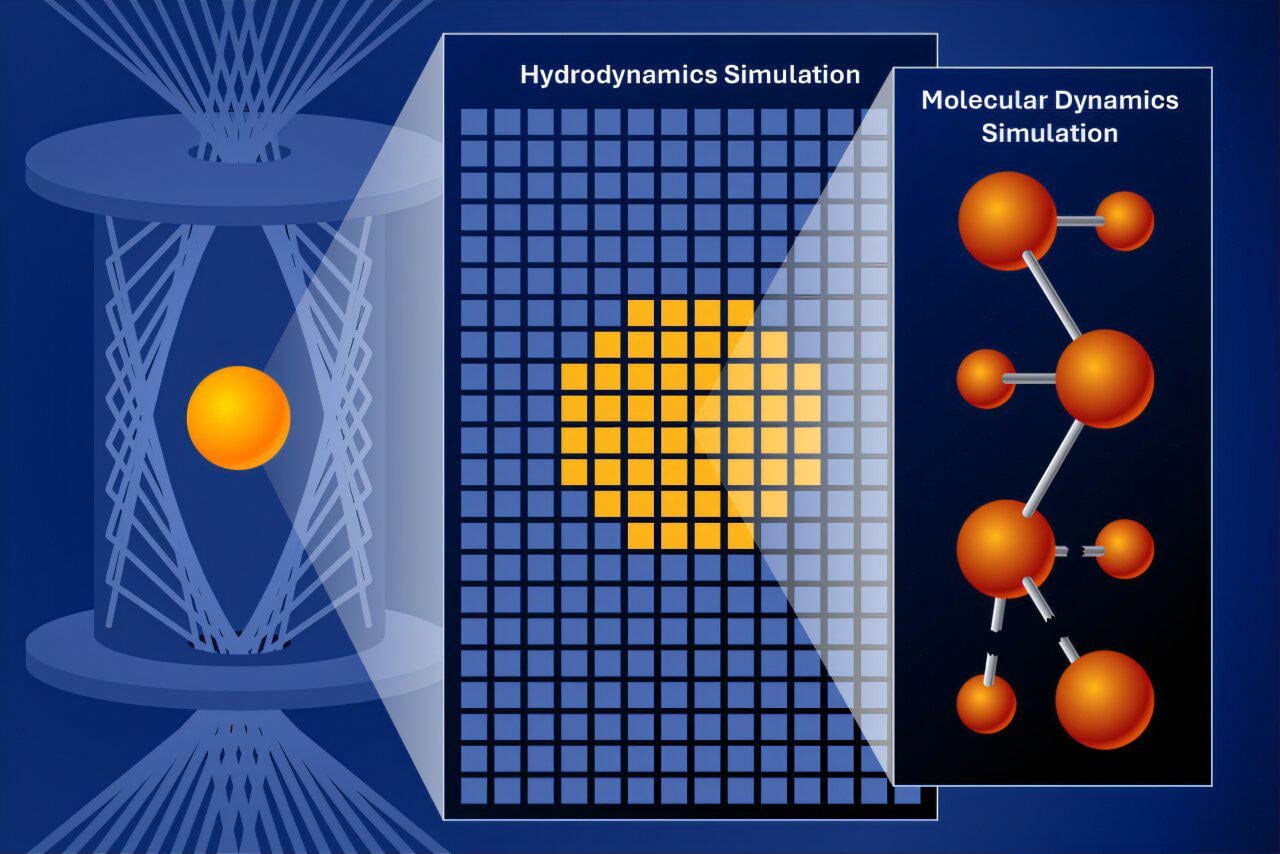
In a study published in Physical Review E, researchers at Lawrence Livermore National Laboratory (LLNL) and the University of California, Davis have created a new framework that couples tiny, atom-scale simulations to code that describes the macroscopic world, all within the same simulation.
To create this tie, the team combined a hydrodynamics code from LLNL with a molecular dynamics code from Sandia National Laboratories. The former describes big-picture conditions and how they evolve over time at specific locations. That information feeds into the latter, which calculates how individual atoms in the material respond to those conditions. The work provides a crucial advantage: both simulations run concurrently. The atomistic simulations are conducted "on the fly" alongside the large-scale code.
The method could have an entire suite of applications, from studying fusion to planetary science to astrophysical phenomena like asteroid impacts.
Publication details
Tim A. Linke et al, Advancing material modeling in hydrocodes using a concurrent finite-element and molecular dynamics multiscale framework, Physical Review E (2025). DOI: 10.1103/vqc2-v6wl
https://phys.org/news/2026-01-code-microscopic-insights-macroscopic-world.html