A China-Europe energy alliance could deliver a new world order
https://www.telegraph.co.uk/business/2026/01/23/china-europe-energy-alliance-deliver-new-world-orde/
Posted by goldstarflag

A China-Europe energy alliance could deliver a new world order
https://www.telegraph.co.uk/business/2026/01/23/china-europe-energy-alliance-deliver-new-world-orde/
Posted by goldstarflag
29 Comments
Europe and China are natural allies in the world’s emerging bloc of electrotech economies.
The new line of strategic cleavage in global affairs is the clash of interests between those betting on total electrification, led by China, versus those betting on the old energy order, now led with ideological fervour by Donald Trump’s America.
Three quarters of humanity live in countries that run fossil deficits on their trade accounts and are bleeding their national wealth to the other quarter, which collects the rent.
This has been tolerated for lack of alternatives and because global shipping lanes have been secure. It will not be tolerated any longer.
The split has consequences that go far beyond primary energy. It determines how countries will shape their transport and industrial systems over the next twenty years.
Trump has sharpened the issue by seizing Venezuela’s oil and openly declaring his aim to gain a global stranglehold over fossil energy. This is coupled with an equally brazen pattern of weaponising commerce and supply chains to lash out at anybody who thwarts him.
Trump’s national security strategy exhorts Europe to reward Vladimir Putin, and openly states the goal of “cultivating resistance to Europe’s current trajectory”.
Given that, it is no longer tolerable for Britain and Europe to maintain such heavy reliance on imports of oil and liquefied natural gas (LNG) from the US or from any country under Trump’s spell or subject to his coercive reach.
The imperative is to electrify even faster as an urgent matter of national security, and that is one way to read the British government’s £15bn plan announced this week for solar panels, heat pumps, and batteries.
Even before Trump lost all inhibitions, serious energy analysts were warning that the era of globally traded fossil fuels was under threat, because trade was no longer politically safe.
“The energy transformation is on the cusp of re-accelerating. It will be driven by the quest for security, with nations creating a diversified energy mix of joules to insulate themselves from geopolitical, macro, and financial risks,” said a report for the Carlyle Group entitled the New Joule Order.
Carlyle said the open trading system of the last 80 years has been a function of American and allied power, with “the US Navy as its muscle”.
Pax Americana allowed a constant stream of oil tankers to criss-cross the oceans unmolested, just as Britain’s Royal Navy kept the sea lanes open for everybody as a collective good in the 19th century.
That marvellous American gift to the world expired last year. This year, Trump has actively joined the pirates.
China’s leaders have been fretting over the Malacca dilemma for over two decades, afraid that the US Seventh Fleet could blockade the shipping artery that lets through 70pc of the country’s oil imports and much of its LNG.
The Communist Party has a long memory. It has not forgotten that Washington imposed a crippling oil embargo on Maoist China after the revolution in 1949.
The energy think tank Ember says China accounted for two thirds of the entire increase in global fossil demand from 2012-2022. Today, it is the world’s largest combined importer of oil and LNG by far. It will not be tomorrow.
The other reason why China will never buy the oil and gas that Trump wants to sell – and exploit as leverage – is that it is moving with breakneck speed to ditch the legacy energy system of the 20th century, and entrench its commercial dominance over the more advanced electro-technologies of the 21st Century.
There is no need to rehearse the figures. Anybody who is paying attention knows by now that sales of combustion cars in the world’s largest car market have crashed to around 40pc on a rolling monthly basis, and will be close to irrelevant by the end of the decade. They know that trucks are following the same trajectory. Fossil use is already declining in Chinese manufacturing and buildings.
I notice repeated claims that the International Energy Agency (IEA) has thrown in the towel on green-tech and now thinks that world demand for oil will continue growing briskly for a long time to come.
The IEA thinks no such thing. It included a new scenario in its World Energy Outlook to placate Project 2025 hardliners in Washington, knowing that its institutional survival was at stake.
The genuine view of IEA officials is that global oil demand will either plateau for a few years before starting to go into a gradual but irreversible decline, or that it will all happen faster and demand will collapse in the 2030s.
China is now streets ahead in electrification, reaching a third of its final energy consumption. It has installed 1,700 gigawatts of solar and wind capacity, already blowing through its 2030 target. The scale is galactic.
“China is showing that a highly electrified energy system centred on wind and solar generation is entirely compatible with a modern, growing, highly industrialised economy,” says Ember. Vietnam is copying the model. So are others.
Joe Biden launched a belated bid to stay in the game with the Inflation Reduction Act. “That’s a battleship we’re stopping and turning back,” said Chris Wright, Trump’s energy secretary, speaking in Davos.
America is a complex country and Wright has not succeeded in stopping electrotech progress, but the overall picture is that the US will be left behind with a pre-modern grid and low levels of electrification as China snatches the better energy prize.
Which leaves Europe awkwardly straddled between the two. It wants to cut fossil dependency and switch to safer home-grown energy – and it wants to do something about runaway climate change, lest we forget that unfashionable detail. It has some policies in place to achieve these objectives, up to a point.
But it also has powerful vested interests in combustion cars, boilers, gas turbines, pipelines, and the paraphernalia of the old molecule economy. A few months ago, it looked as if Europe might be drawn back into the American energy sphere. Trump’s serial provocations have ended that.
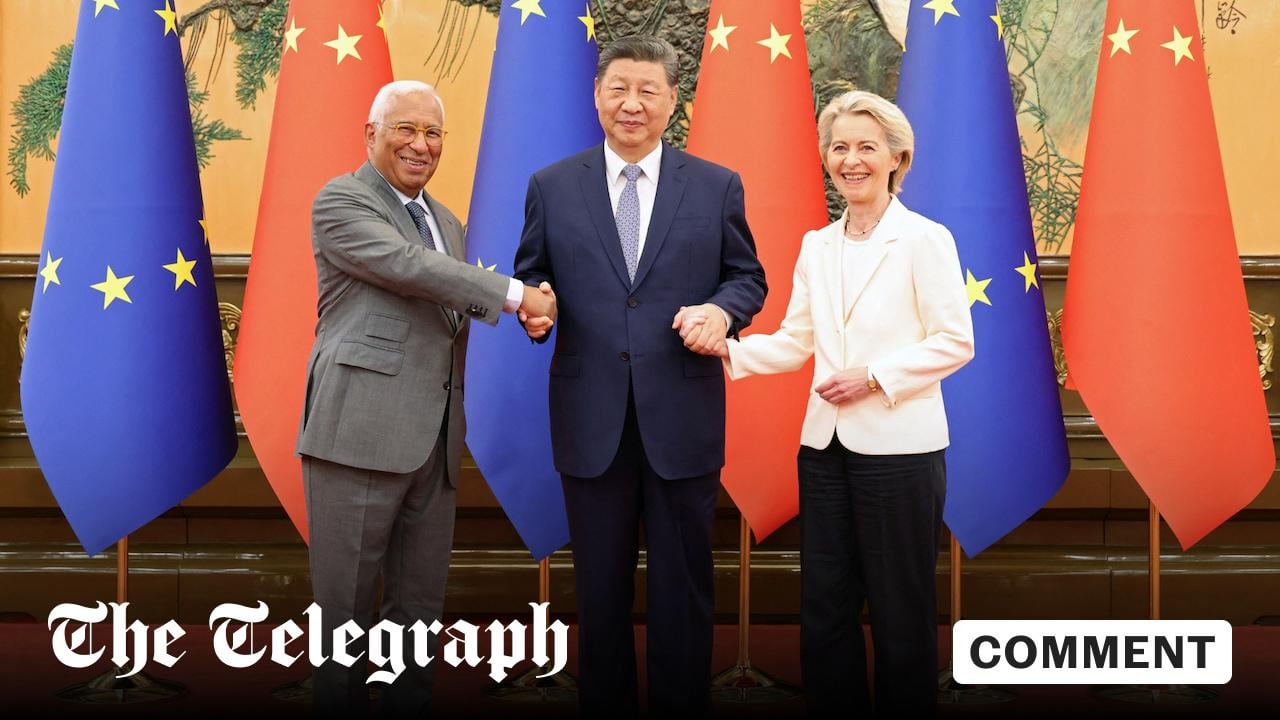
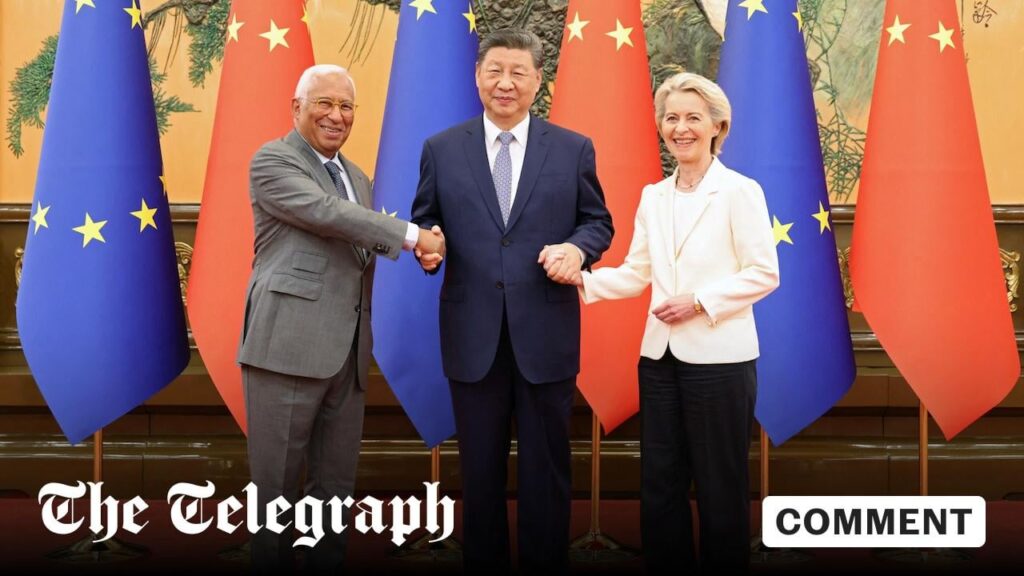
The question now is whether China and Europe can put aside their profound differences and form a tactical front against the global aggressor. There was talk of a Sino-European front after Trump’s “liberation day”. It came to nothing. Xi Jinping seized on the transatlantic rift to hit Europe while it was down.
Europe, in turn, has another quarrel with China. It is suffering the full brunt of the China shock 2.0, the final dumping ground for China’s $1.2tn (£890bn) trade surplus and its pathological excess capacity.
It takes a lot to throw these two foes together, but Trump may have pulled it off over the 10 days that shook the world, culminating in the Greenland disgrace.
China and Europe are reaching a modus vivendi of sorts over tariffs on electric vehicles. Chinese vice-premier He Lifeng was in Davos this week making sweet overtures to the Europeans and denouncing “the law of the jungle, where the strong bully the weak.”
Meanwhile, Trump’s hubristic cabinet was in nearby rooms acting like a pack of hyenas, dishing out insults, ridiculing all efforts to cut CO2 emissions and proclaiming the gospel of coal.
Trump’s advisers like to talk of a “reverse Nixon” where they bring Russia in from the cold and split the Sino-Russian axis.
They may soon find themselves the victim of a reverse triangulation with a twist as China outwits them, swooping into the Ukraine war to broker a peace deal and then detaching Europe from the defunct Atlantic alliance.
I say go for it 👍
1) Europe and China have a common interest to partition Russia.
2) Without Europe, the US loses its position as global hegemon.
The contours of a tripolar world emerging.
If it’s in our common interest, we should go for it.
Dementia Diaper Don 7D chess in action
We should run towards being self sufficient.
Having said that, since we can’t do that right now for many many reasons, we should try to not be too dependent on a particular nation.
First it was Russia, now it’s too much US.
A deal with China can be a good thing while we try to get renewable energy and stuffs (nuclear) going for all.
This is bad wtf
The West cannot treat China as an ally until it has removed any reliance on Taiwanese and South Korean semi-conductor businesses. That people here don’t see this risk is rather embarrassing.
But both sides are energy importers…
I can for obvious reasons buy the argument that we should stop relying on oil and gas but what does that have to do with China? Just because they want that too doesn’t mean we have anything to collaborate about. What’s the supposed ‘energy alliance’ to be? Relying on Chinese solar panels and EVs? No thank you, I’d much prefer domestic development.
yes and would be a great response to any Trump’s threat against us
So we are once again learning that trusting and even allying with authoritarian states (Russia and the energy reliance we allowed ourselves to get in to) and states that are very quickly slipping in to authoritarianism (US) is a really bad thing and that we need to keep these types of states at arms length and work on self reliance and partners with more reliable democratic nations.
Sooo lets buddy up even more with another highly authoritarian dictatorship!
I’m not saying we cut ourselves off from the world but we need to be really really careful with what we do, especially when it comes to dictatorships.
a lot of the language used is also quite laughable “The question now is whether China and Europe can put aside their profound differences and form a tactical front against the global aggressor.”
saying “put aside profound differences” really downplays how evil the CCP are, how anti democratic and authoritarian they are, also the Idea that the CCP are not also a global threat when they have been funding other highly authoritarian anti western states, bullying other nations through tarrifs and market manipulation (dumping) and engaging in a global investment programme that has had mixed results and could be seen as debt trapping, China has also engaged in very hostile diplomacy towards other Asian states over martime rights and the 9 dash line.
I know I’m going to get a lot of the same comments as things like this always get “BUT AMERICA/EUROPE HAS ALSO DONE BAD THINGS AND IS DOING BAD THINGS! Ok and I don’t support those either.
“B…but China is more stable and less erratic” yeah that isn’t really automatically a good thing, China is a more stable and calculating highly authoritarian state doesn’t really seem to be a positive, we could also say this of Russia, we kinda knew what trajectory they were taking after engaging in constant land grabbing wars and foreign interference, doesn’t make it any better.
“New World order”, its been the world order since the 1500’s. Europe and china almost always where at the front
Probably the most retarded hypothesis: China and Europe share values……
NO. We should stop being dependent on dictatorships, period.
Europe should diversify in its relations with other countries, but the focus should be self sufficient on everything as soon as possible: energy, defense, rare materials, technology, social media
It takes time before we can reach that goals, but the recent past has learned us that Europe should never ever rely on a big brother (or daddy) anymore
Fam we are an entire continent why do we need energy from anywhere else
Is Trump going to penalize them with additional tariffs? No because it is al about Trump’s ego why he would do that against Canada.
Carney has outclassed Trump in so many ways.
How about we don’t? China makes it very clear that they are not our friend, let alone ally. China openly supports Russia in its war on European soil and will not end that partnership even if we try to be buddies. China also steals from us and infiltrates our society with its citizens.
We have to maintain ties with both China and the US, but we should reduce dependencies on both. We should not put all of our eggs in one basket.
China wants and needs dependency on them – it’s fundamental to their long term strategic model .
As long as our interaction and relationships are framed in this context – and with our experience with Russia and US proves is that we have to be as independent as a block as they are.
If we are not, another nation has leverage and calls the shots.
If we have leaders that make decisions about our future and ignore this – then they are stupid and they need to be replaced as it’s making us all vulnerable.
Only a fucking idiot would trust China. I dont want to support communist dictatorship who hates everything we supposedly stand for, just to spite Americans.
Until China invades Taiwan and starts to blackmail us with microchips
China maintains a policy that a single supplier can’t provide over 20% of their energy needs. We could do the same.
I dislike a lot about China but Europe and China together could practically make a huge green shift.
We should be energy independent. Renewables + nuclear.
We cannot exchange one master for another
Somehow this is due to Biden and Norway for not giving the orange dude his own nobel prize
It’s not like I want to ally with China it just doesn’t make any difference anymore and at least they don’t make war threats
If China helps in regime change in Russia, maybe.