
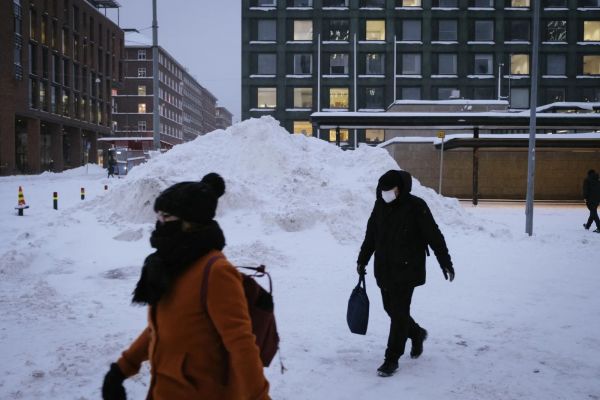
Donald Trump wants oil at $50. But the statements and actions of the White House have so far led to an increase in prices. Meanwhile, the “Beast from the East” is returning to Europe and in Finland gas prices have jumped to almost $ 700 per thousand cubic meters.
Oil
Despite Donald Trump‘s desire for oil to be at $ 50, raw materials continue to rise in price. The cost of the benchmark North Sea Brent rose over the week from $ 64.1 to $ 66 per barrel.
Prices went up after US President Donald Trump imposed new sanctions against nine Iranian tankers and announced that the US military armada was heading to The Persian Gulf.
An aircraft carrier and guided-missile destroyers will arrive in the Middle East in the coming days, a US official told Reuters.
Iran produces 3.2 million barrels per day and is the fourth largest OPEC member in terms of production.
In addition, production at the Tengiz field in Kazakhstan has stopped. Chevron declared force majeure due to a fire on the transformers of a gas turbine supplying the fishery with electricity. This was a new blow to the export of Kazakh oil. The marine terminal of the Caspian Pipeline Consortium has been trying to put the second remote mooring device back into operation after the attack of the Ukrainian Armed Forces since November and is operating at reduced capacity.
JP Morgan estimated that Tengiz provides half of the production in Kazakhstan and the delay will last until the end of February, reducing production in the country by 700 barrels per day.
Gas
This week, the price of gas in Europe jumped, but stubbornly went up. Deliveries for a month in advance from the TTF exchange went up from $ 458 per thousand cubic meters to $ 488.
Arctic air masses, called the “Beast from the East,” are returning to the continent, while Europe is already actively consuming gas from storage facilities. Total stocks dropped to 46%. While in Germany and France — up to 38%, and in the Netherlands — up to 32%. The latter provide not only for themselves, but also for neighboring states, which poses a risk in case of prolonged frosts.
“The situation as a whole is quite tense, given that winter in Europe began just three weeks ago, and no one knows what the weather will be like in February-March,” says Alexey Grivach, Deputy director of the National Energy Security Fund (NWF).
In his opinion, with such a pace of selection, the reserves in UGS in the Netherlands will run out by the end of the second decade of February.
“LNG import capacities may not be enough to maintain a reliable gas supply. Perhaps they are considering the possibility of deconservating production on Groningen in case of emergency. But whether this will lead to new earthquakes in the region, no one knows now either,” the expert adds.
Meteorologists predict that the “Beast from the East” will start from the eastern part of Europe and will arrive there today, on Saturday. It has already hit Finland and The Baltic States. If, secondly, the cost of fuel jumped to $ 625 per thousand cubic meters, then in Finland — up to $ 680, according to the EEX.
At the same time, the cost of gas in Germany and Austria is already higher than on the TTF exchange, and at the end of the week it reached $ 526.
High LNG supplies and stable exports from Norway support gas supply. However, stock speculators are now betting on rising prices, which have already risen in the United States. There is also an Arctic storm and prices have reached the highest level since 2022. The question now is how long this will last.
Coal prices in Europe reacted sluggishly to gas quotes due to CO2 emission quotas. Deliveries for a month in advance from the Antwerp-Rotterdam-Amsterdam hub (ARA) went up from $ 97.8 per ton to $99.5.