
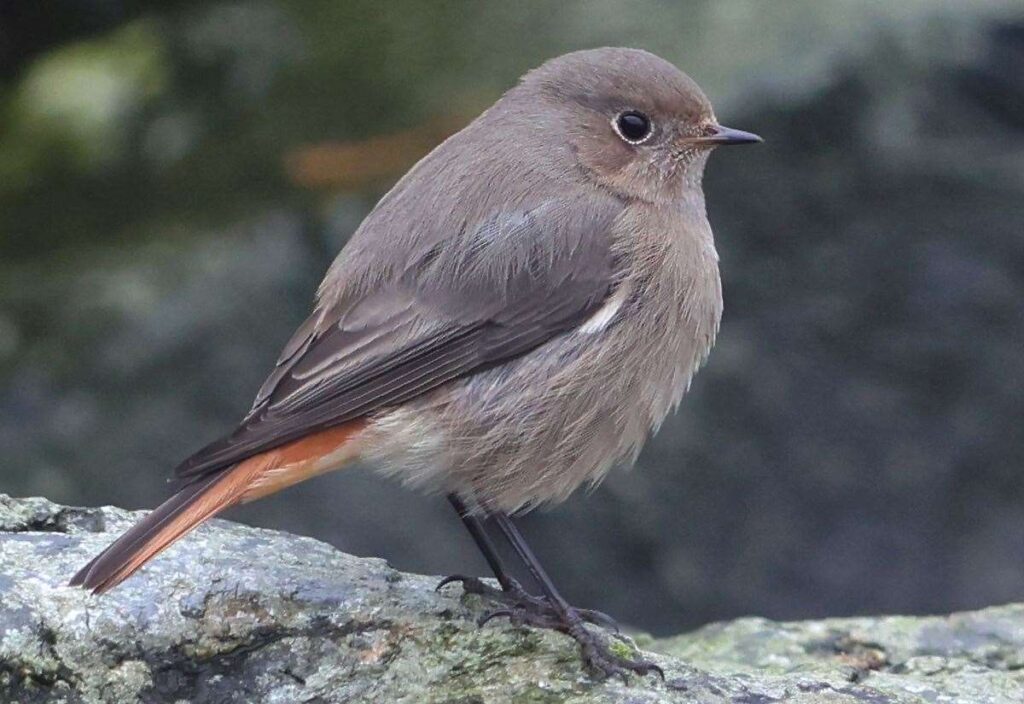

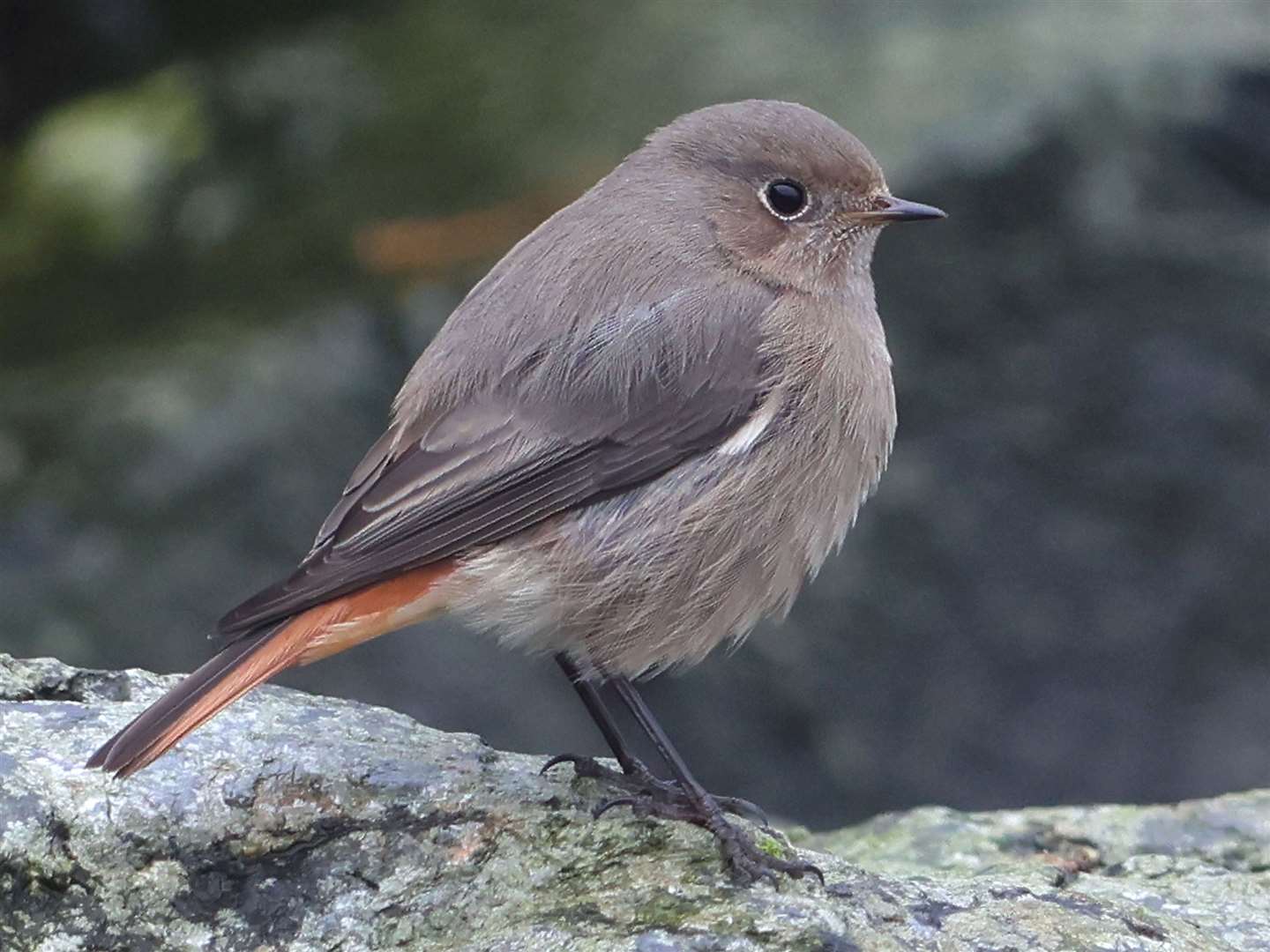
 This black redstart, a scarce migrant, made an unusually early appearance at Sandwick a few days into the new year. Photo: Jim Nicolson
The black redstart is a scarce migrant which sometimes overwinters in Shetland.
Black redstarts breed throughout much of central and southern Europe. They winter in western and southern Europe, migrating as far south as South Africa.
However, the RSPB estimate that around 400 spend the winter in Britain. The birds reaching Shetland are probably coming from populations in northern Europe.
About the size of a robin, the common name black redstart refers to the adult breeding male, which has dark grey-black plumage and a contrasting orange-red tail with a central dark band.
Non-breeding males have duller plumage with greyish fringes. First winter black redstarts and females are dark brown-grey and also have vivid orange-red sides to the tail.
The colourful tail is frequently quivered, when the bird is perched or foraging, and is clearly seen in flight.
Black redstarts mainly eat insects and other invertebrates but also take seeds and berries.
Foraging in weedy, stony habitats, winter visitors and passage migrants often favour beaches and rocky areas.
These birds breed in mountainous regions, nesting on rocky crags, scree slopes, cliffs, and in boulder fields.
However, they have adapted to urban life where they nest in abandoned buildings and industrial structures. Black redstarts started breeding in Britain in 1926.
Bombed buildings created further suitable nesting and feeding sites following the Second World War.
Nicknamed the “bomb-site bird”, they spread throughout London, later establishing populations in other urban areas.
However, the population has decreased, and now there are fewer than 50 pairs of breeding black redstarts mainly occurring in parts of south east England, East Anglia and the West Midlands.
This was a quiet week for bird news, although a great crested grebe was recorded near Brae.
Great crested grebes breed throughout most of Europe, including Britain and Ireland. They are rare migrants to Shetland, most likely originating from populations in southern Scandinavia and eastern Europe.
Most are observed on the sea, or on fresh water, between October and April. The largest of European grebes, the great crested has a body length of 46-51cm. In winter plumage, it has a distinctive white head and neck along with a pink bill.
Excellent swimmers and divers, great crested grebes feed on fish and aquatic invertebrates.
Driving along a road bordered by moorland, I noticed, in the car headlights, a mouse scurrying across the tarmac. This was a long-tailed fieldmouse, also known as a wood mouse and, in Shetland, as the “hill mouse”. These mice, unlike house mice which live in and around buildings, are found in a variety of habitats including moorland, grassland, woodland and gardens.
Their fur is reddish brown on top and whitish below. Shetland field mice are slightly larger than elsewhere and have brighter coloured fur. The long-tailed field mouse is one of the commonest small mammals in Britain.
They live in burrows underground where they make nests of moss, leaves and grass. They also use these underground burrows to store nuts, berries and seeds to eat during the colder months. In winter, these small mammals often share nests.
Mainly nocturnal, the long-tailed fieldmouse is an agile climber with good night vision and an acute sense of smell. Omnivores, they have a varied diet which also includes insects, snails, worms and other invertebrates. Research has shown that they will way-mark areas with small objects, such as leaves or twigs, to help them navigate.
This kind of spatial behaviour has not been found in other mammals except humans.
During the breeding season, females defend territories and raise litters of between four-seven young.
Field mice are short-lived, with an average life span of a year, although they can live for up to 20 months. They are an important food source for many predators.
Like all land mammals which are found in Shetland, the long-tailed fieldmouse was brought here by humans.
It was previously thought that these mice had arrived as stowaways with Norse settlers.
However, when the site at Old Scatness Broch was excavated, remains of this species were found in deposits dating to the middle part of the Iron Age, 200 BC- AD400, proving that the “hill mouse ” is a long time Shetland resident.
Do you want to respond to this article? If so, click here to submit your thoughts and they may be published in print.