
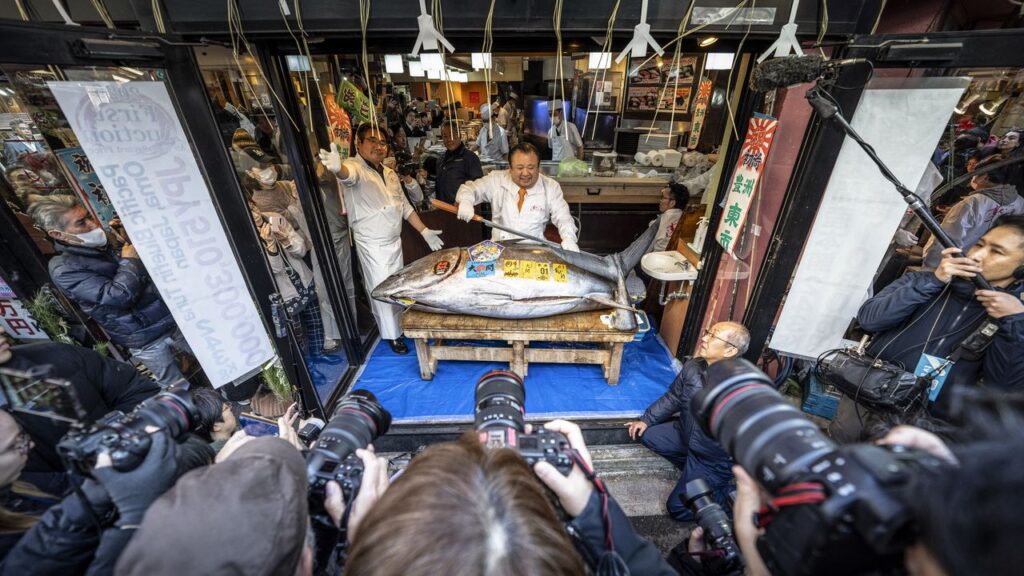
The January 5, 2026, New Year auction at Tokyo’s Toyosu Market saw an all-time high set for the first tuna of the year: ¥510 million, or ¥2.1 million a kilogram. A dive into the record-setting sale ends with a question: Could it go higher next time?
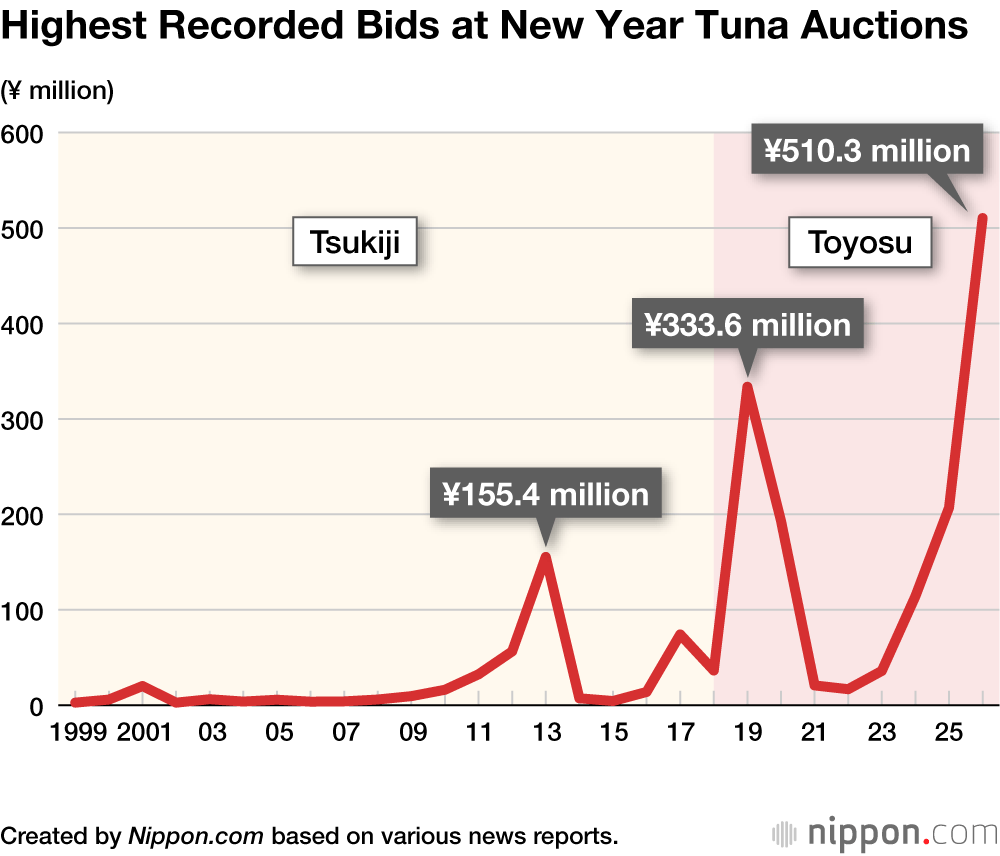
On January 5, the New Year’s tradition of the first tuna auction was held at the Toyosu Market in Kōtō, Tokyo. A Pacific bluefin tuna landed in Ōma, Aomori Prefecture, fetched a record-shattering ¥510.3 million, the highest price ever paid at the event. Weighing 234 kilograms, the fish sold for an astonishing ¥2.1 million per kilogram. The coveted ichiban maguro, the top-priced tuna of the New Year’s auction and a traditional good-luck symbol, was secured by Kiyomura, the company behind the sushi chain Sushi Zanmai, led by president Kimura Kiyoshi. The previous record, set in 2019 at ¥333.6 million for a 278-kilogram tuna, had also been won by Kiyomura.
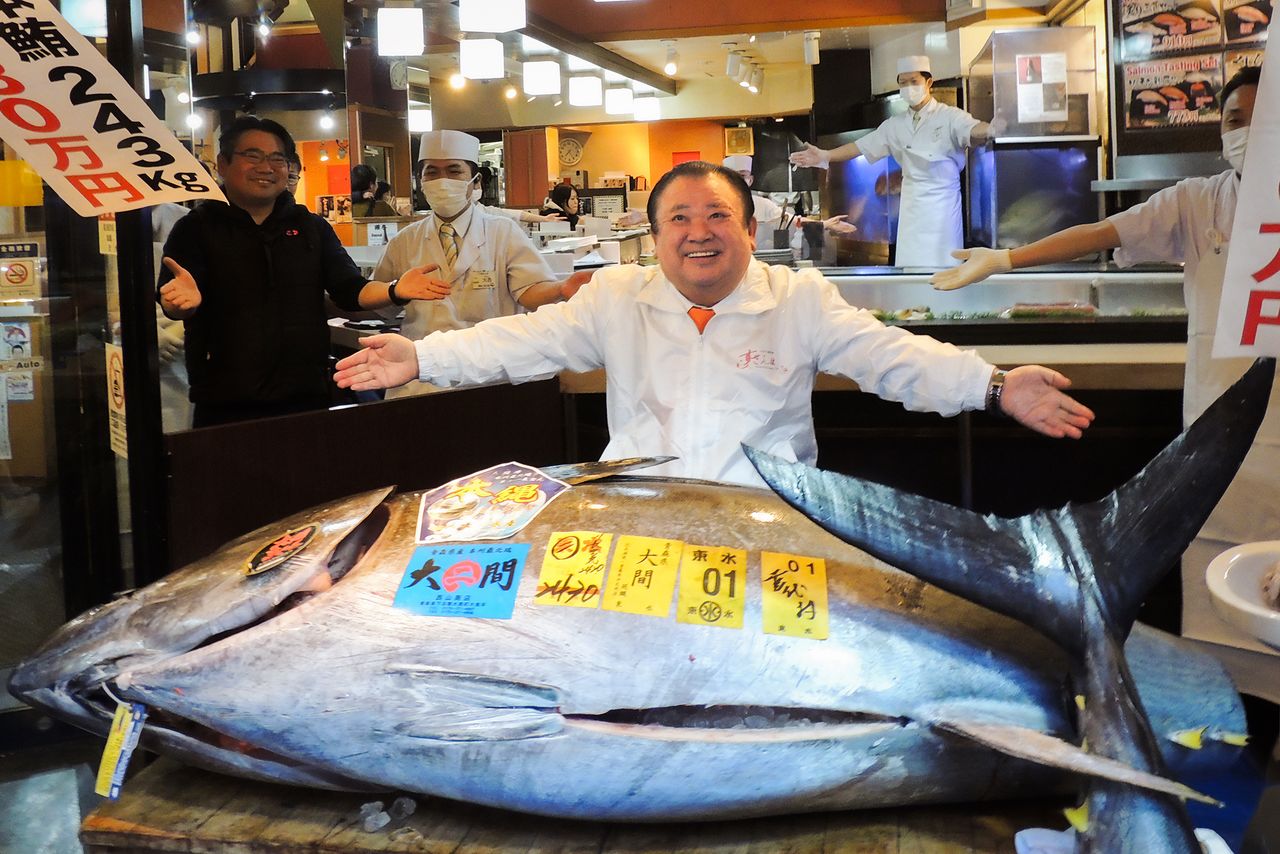
President Kimura Kiyoshi strikes his trademark pose while unveiling the ¥500-million-plus ichiban maguro at the Sushi Zanmai flagship store. (© Kawamoto Daigo)
Until 2000, during the era of the Tsukiji Market, prices for the first auctioned tuna did not reach ¥10 million. In 2001, the first New Year of the twenty-first century, a celebratory “bonus” price of ¥20.2 million was recorded, but eye-catching highs remained rare for some time. Prices began climbing in the 2010s, and in 2013 a 222-kilogram tuna sold for ¥155.4 million (¥700,000 per kilogram), marking the first time the auction crossed the ¥100 million threshold. That winning bid also went to Kiyomura, and images of President Kimura posing with arms outstretched earned him the nickname “Tuna King,” winning him recognition both in Japan and abroad.
In 2019, when prices reached the ¥300 million mark, the Tokyo Metropolitan Central Wholesale Market had just relocated from Tsukiji to Toyosu, making it the first New Year’s auction at the new site and an exceptional celebration. At ¥1.2 million per kilogram, the price seemed unlikely to be surpassed anytime soon. Yet this year, amid rising prices and a surge in inbound tourism spending, that benchmark was decisively eclipsed, setting a new historic record.
Bidding Soars Through ¥500 Million Barrier
As the auction’s start time of 5:10 am approached, the area lined with domestically caught bluefin tuna was packed shoulder to shoulder. In addition to Kiyomura, crowds gathered around representatives of Yamayuki, a Toyosu-based intermediary that had won the ichiban maguro for five consecutive years through last year. The scene crackled with anticipation.
Following greetings from market officials, a ceremonial hand clap was performed. The ringing of bells, chiming brightly through the hall, signaled the start of the first auction for the ichiban maguro. Bidders use a finger-signaling method that indicates the price per kilogram. While bids are normally raised in ¥100 increments, the opening auction’s top tuna saw gestures flying in extraordinary ¥100,000 steps, sending prices rocketing skyward with seemingly no ceiling. President Kimura later reflected on the moment: “I was like, wait, wait, what? The price just kept climbing. It felt like a roller coaster.”
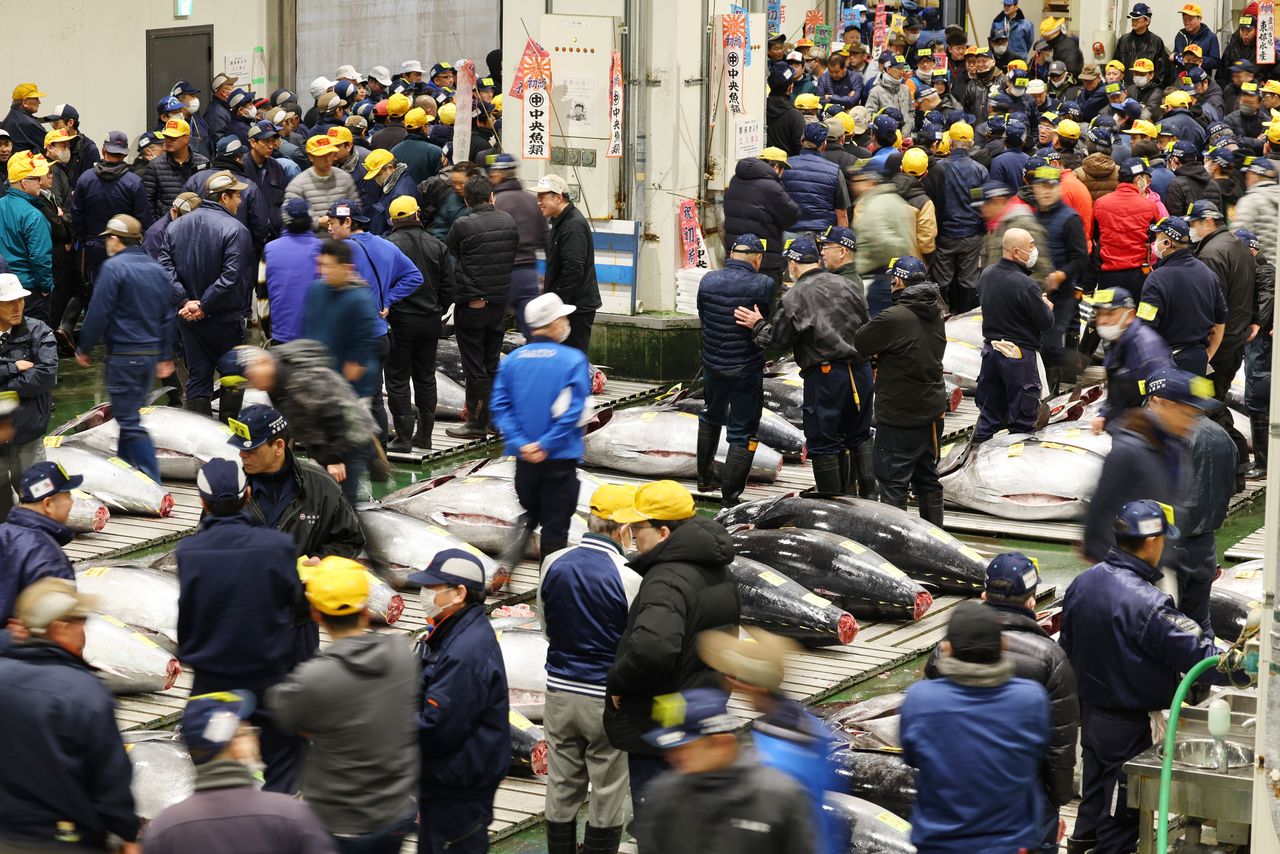
The tuna wholesale area at Toyosu Market, filled with energy during the first auction of 2026. (© Jiji)
There was a reason the contest became so intense. Yamayuki, acting on behalf of the Onodera Group, which operates establishments such as the sushi restaurant Sushi Ginza Onodera and the high-end Japanese dining brand Nadaman, was aiming for a sixth straight victory in the top-tuna auction. Yamayuki’s president, Yamaguchi Yukitaka, is so highly regarded he is often called the “God of Tuna.” In 2025, he secured the ichiban maguro with the second-highest price on record, ¥207 million.
This time, Yamayuki pushed the bidding to ¥2 million per kilogram—for this 243-kilogram fish, a total of ¥486 million—then stopped just short of the ¥500 million mark. Moments later, Kiyomura raised the bid to ¥2.1 million per kilogram, winning a hard-fought back-and-forth battle. In an interview with Jiji Press, Yamaguchi did not hide his disappointment. “I’ve gone head-to-head with Kiyomura many times, but this one really hurt,” he said. “I was prepared to cover the difference myself even if it exceeded the Onodera budget, but there’s an opponent involved, so I couldn’t bite that bullet.” The Onodera Group had reportedly already made preparations to unveil the ichiban maguro to the public, making the loss all the more bitter.
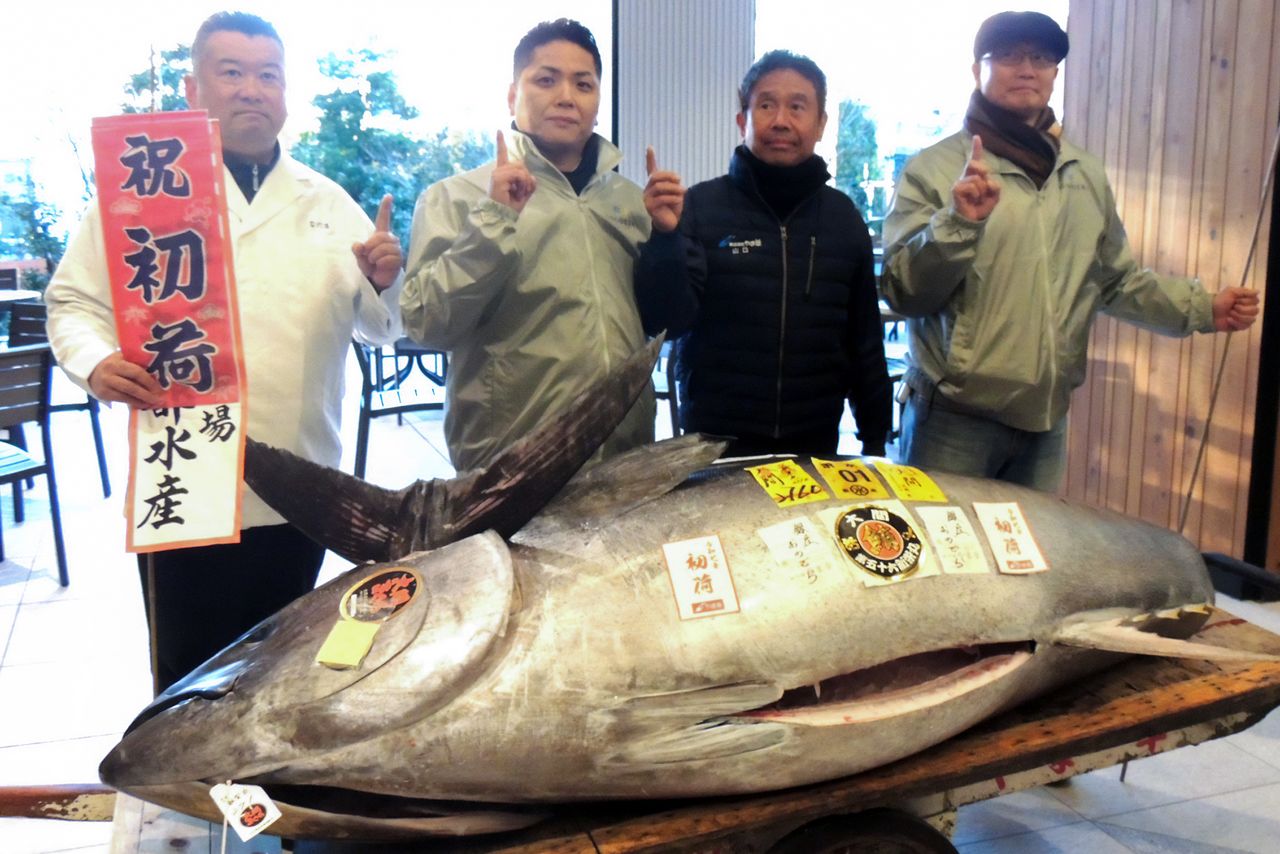
President Yamaguchi Yukitaka of Yamayuki, second from the right, with representatives of the Onodera Group, after winning the ichiban maguro at the 2025 New Year’s auction. (© Kawamoto Daigo)
Just 1/65 the Price for the Runner Up
As the two rivals went head-to-head, the winning bid soared far beyond the tuna’s intrinsic market value. But as in most years, this audacious figure was widely reported as a feel-good piece of New Year’s news.
For Kiyomura, this marked its first time in six years to claim the ichiban maguro. Even so, President Kimura Kiyoshi said he has always taken pride in the fact that “every year, I bought what I believed was the very best tuna I could see.” During the intervening years, however, he acknowledged having deliberately tempered that fixation, due to restraints including the COVID-19 pandemic, and then the late 2024 capsizing death of the Ōma fisherman who had landed the ichiban maguro sold in 2019 was involved in a capsizing accident at the end of 2024. Explaining why he reentered the fray this year, Kimura said, “There were a lot of tuna lined up at the auction, but this one, above all, was the best.”
In fact, many observers expected a tuna weighing more than 320 kilograms, landed in Ōma on January 4, to claim the top price. However, the judgment of experts at Toyosu Market differed. Tuna exceeding 300 kilograms can be difficult to handle due to factors such as large bones, which reduce usability. Instead, the tuna selected weighed 243 kilograms and received high praise for its well-rounded shape and rich fat content.
Meanwhile, the second-priciest tuna at the first auction, also from Ōma, sold for ¥7.83 million, calculated as 174 kilograms at ¥45,000 per kilogram. While this would be an exceptional price under normal market conditions, it amounted to just one sixty-fifth of the top tuna’s winning bid and attracted little attention. The extraordinary price commanded by the ichiban maguro reflects a singular fixation on securing first place. Given the immediate media exposure that follows, finishing second simply does not carry the same value.
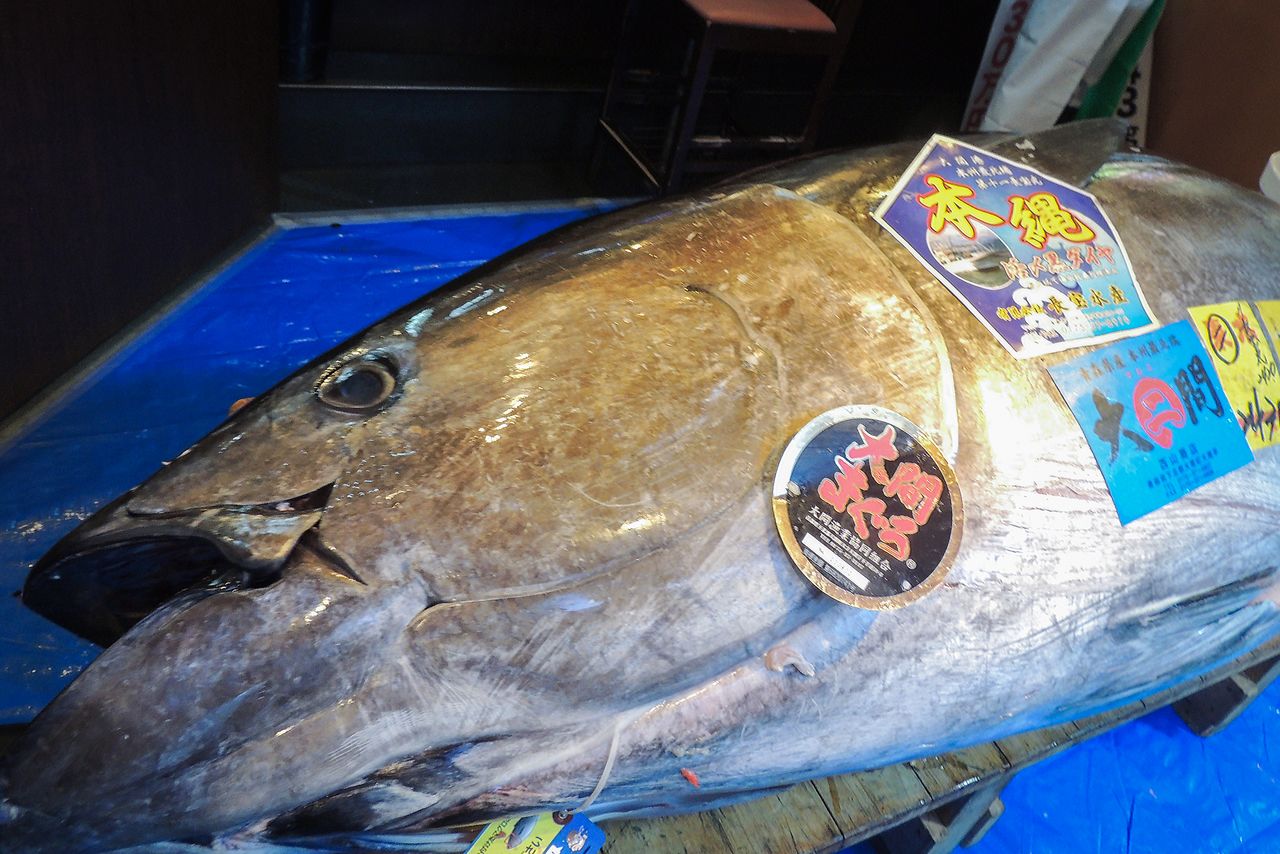
The Ōma-caught tuna that set a record price of ¥2.1 million per kilogram. (© Kawamoto Daigo)
A Publicity Strategy Aimed at Media and Tourists
President Kimura Kiyoshi announced a magnanimous approach to serving the ichiban maguro. “We will not factor in rising prices and will offer it at our usual rates,” he said, listing prices of ¥398 for a sushi serving of lean tuna, ¥498 for medium fatty tuna, and ¥598 for fatty tuna, all before tax. He acknowledged that this would result in a significant loss. “Cash flow will be tough from here on out. I will have to work very hard,” he said with a wry smile. At the same time, he stressed the symbolic importance of the gesture, adding that he hoped people would eat the auspicious tuna and feel uplifted at the start of the year. The move reflects a publicity strategy that is keenly aware of media coverage, both domestic and international, and inbound tourism, using the ichiban maguro not only as a culinary centerpiece but also as a message of optimism and momentum.
The promotional impact of being prominently featured on nationwide television news and in newspapers from the very first working morning of the New Year likely carries value far beyond the price itself. Proof of this was evident shortly after 7:00 am, when the ichiban maguro was unveiled at the Sushi Zanmai flagship store in the Tsukiji Outer Market. Large vertical banners prominently displaying the hefty price of the fish were already lined up outside. Given the store’s strong popularity with inbound visitors, English-language banners were also prepared. This was no surprise, as the restaurant has a keen awareness of overseas audiences and even expanded to Los Angeles in 2025. The company’s sharp commercial instincts are hard not to admire. Overseas media were also present at the scene. Considering the steady stream of international visitors who flock to Tsukiji each day, the value of the ichiban maguro as a publicity asset is impossible to measure.
In 2026, victory went to Kiyomura, but the competition over the ichiban maguro shows signs of growing even more intense. Alongside Yamayuki and Onodera , the possible entry of dark-horse bidders is likely to further heat up the rivalry. Prices are also soaring for the ichiban uni, the top sea urchin. At this year’s first auction, 400 grams of Hokkaidō-grown purple sea urchin fetched an extraordinary ¥35 million. Given these trends, the prospect of a single tuna commanding ¥1 billion can no longer be ruled out.
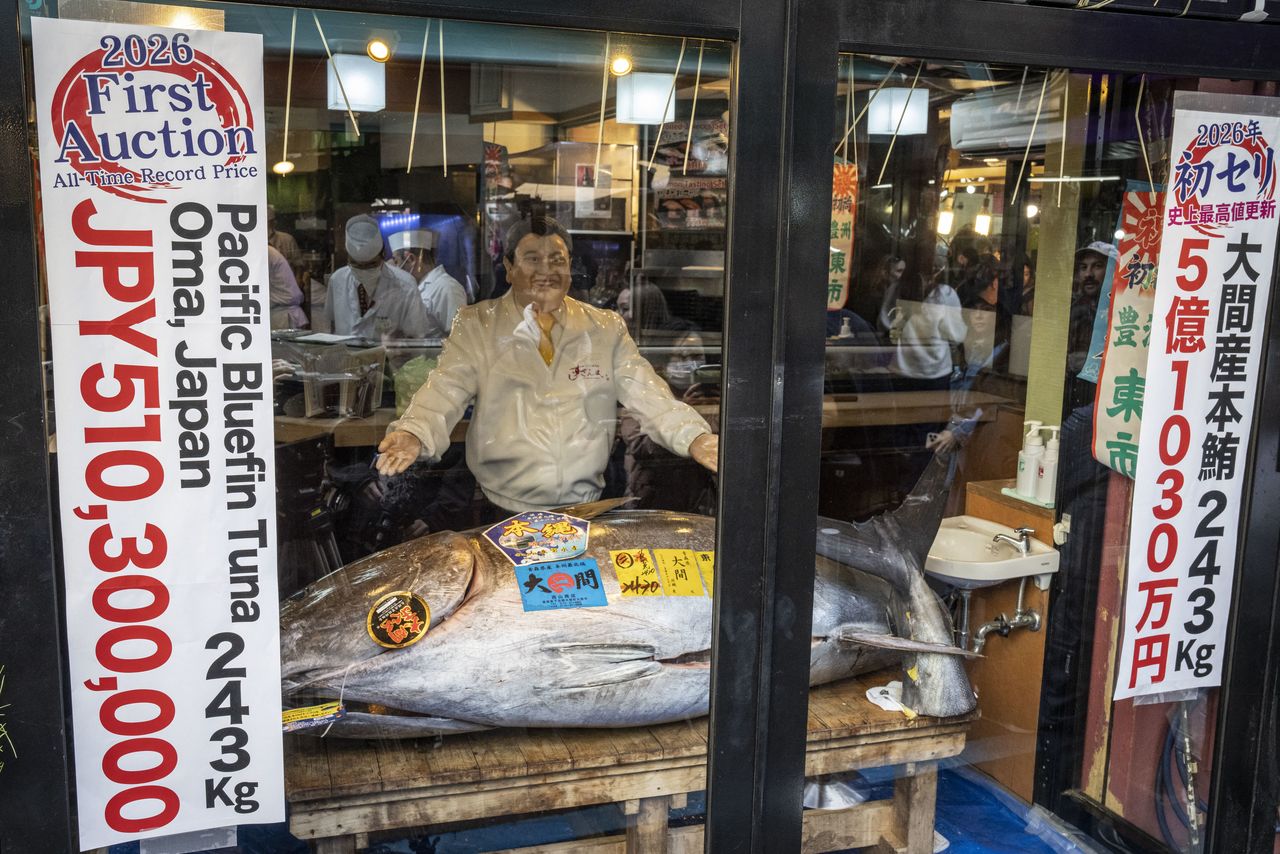
English-language banners were displayed at the storefront alongside the ichiban maguro and a figure of President Kimura. (© AFP/Jiji)

(Originally published in Japanese. Banner photo: Reporters crowd around the ¥510 million ichiban maguro and President Kimura Kiyoshi at the Sushi Zanmai flagship store in Tsukiji. © AFP/Jiji.)