
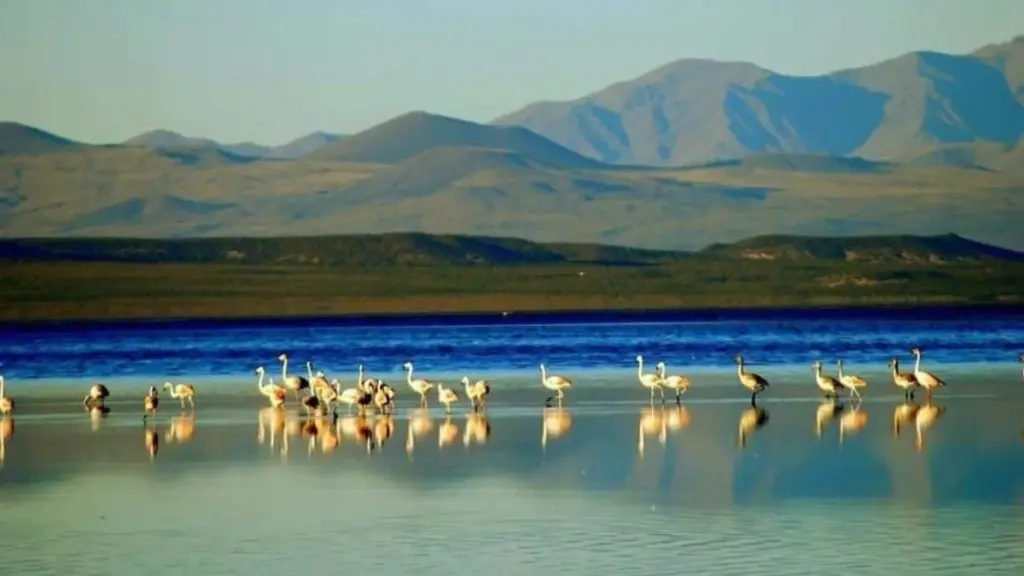
The Llancanelo Lagoon, located in the south of the province of Mendoza, has been officially incorporated into the Western Hemisphere Shorebird Reserve Network. In this way, the wetland is consolidated as a key site for the conservation of migratory species in America.
This distinction recognizes the ecological value of the protected natural area located in Malargüe. Additionally, it reinforces Mendoza’s role within the continental system of wetland conservation.
Thus, Llancanelo joins a network that connects essential territories for birds that travel thousands of kilometers each year.
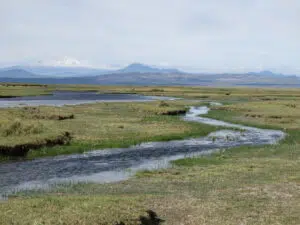 Laguna Llancanelo. Foto: Fundación Humedales.
A vital point in extreme migratory routes
The recognition is based on a scientific study conducted between February 2023 and February 2025. From this work, it was confirmed that the lagoon functions as a site of rest and feeding for birds that can fly up to 16,000 kilometers.
Among the most relevant results, it was found that the wetland regularly hosts more than 1% of the world population of Baird’s sandpiper. This indicator is one of the most important international criteria for defining priority conservation areas.
During the surveys, more than 4,300 individuals were recorded in January 2024 and a peak of 5,458 specimens in December of the same year, highlighting the ecological magnitude of the site.
Conservation and environmental commitments
The incorporation of Llancanelo is part of global environmental commitments. In this sense, the protection of the wetland aligns with objectives of biodiversity conservation and sustainable use of ecosystems.
Moreover, the recognition promotes the creation and strengthening of protected areas. It also encourages scientific research, environmental restoration, and ecological education as central pillars.
In this way, the protection of the lagoon not only benefits migratory birds but also strengthens the region’s environmental framework.
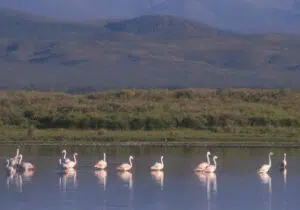 Laguna Llancanelo. Foto: Patrimonio Natural.
What is the Western Hemisphere Shorebird Reserve Network
The Western Hemisphere Shorebird Reserve Network is an international initiative that identifies and connects strategic wetlands from Alaska to Tierra del Fuego. Its goal is to ensure the survival of birds that depend on multiple sites along their migratory routes.
Each reserve fulfills a specific function, whether as a breeding, feeding, or resting area. Therefore, the loss of one of these points can affect entire populations on a continental scale. The inclusion of Llancanelo reinforces this ecological network and provides a fundamental link in western Argentina.
A landscape that interacts with other Mendoza wetlands
Mendoza has other natural spaces of high environmental value. The Los Horcones lagoon, within the Aconcagua Provincial Park, offers an accessible environment where high-altitude nature manifests strongly.
Meanwhile, the Laguna del Diamante Reserve, located 220 kilometers southwest of the city of Mendoza, stands out for its mountain landscape and the presence of the Maipo volcano reflected in its waters.
Together, these territories confirm that the province hosts key ecosystems. With Llancanelo within the hemispheric network, Mendoza reinforces its role in the environmental conservation of the continent.