
Government revives plan to build two large reactors by 2038, deploy SMRs by 2035
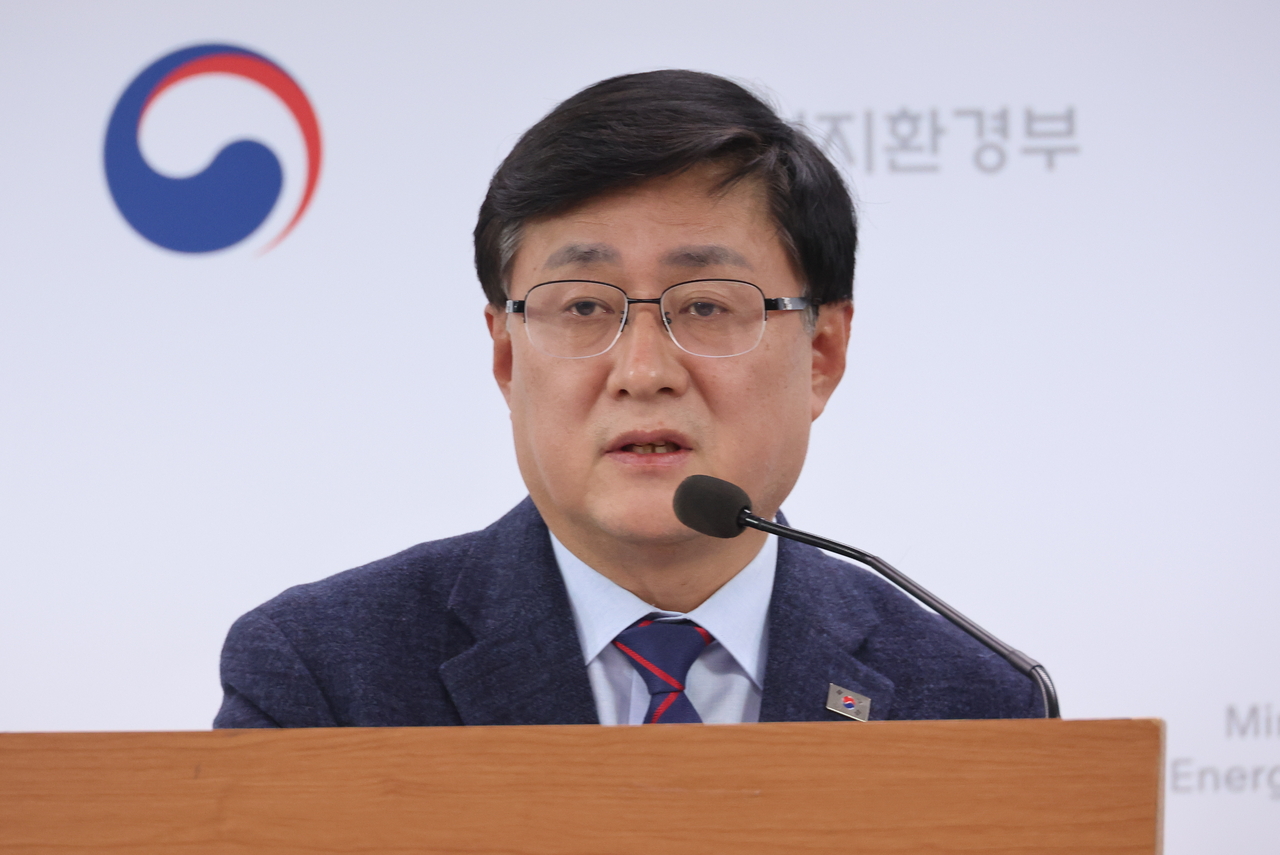 Climate Minister Kim Sung-whan speaks to reporters at the government complex in the administrative city of Sejong on Monday. (Yonhap)
 South Korea has decided to move forward with two new nuclear reactors by 2038, closing the door on months of debate and reviving a power roadmap set under the previous administration.
Climate, Energy and Environment Minister Kim Sung-hwan said Monday that the government will proceed under the 11th Basic Power Supply Plan, which calls for the construction of two large-scale nuclear reactors with a combined capacity of 2.8 gigawatts, scheduled for completion in 2037 and 2038, respectively. The plan also includes the deployment of a 0.7-gigawatt small modular reactor by 2035.
Korea Hydro & Nuclear Power will begin a public bidding process to select host sites in the coming months, with the aim of securing construction permits in the early 2030s.
The move restores the roadmap finalized in February last year under the previous administration, when the 11th Basic Power Supply Plan was adopted with bipartisan backing. After taking office in June, however, President Lee Jae Myung called for a review of the plan, citing insufficient public input, casting doubt on whether the nuclear projects would proceed.
Uncertainty deepened as Kim’s stance shifted. After initially calling new reactors under the 11th plan “inevitable,” he later said construction would depend on public deliberation, while President Lee questioned the projects’ feasibility due to site and safety constraints.
Concerns over stable power supply in the AI and electrification era later drove another turn. Kim recently criticized the contradiction of exporting nuclear reactors while refusing to build them domestically, breaking with the Moon Jae-in administration’s nuclear phaseout policy.
“While it would be ideal to rely entirely on renewable energy, Korea’s reality as an isolated power grid makes that extremely difficult,” Kim said during Monday’s briefing, stressing that nuclear power remains unavoidable.
The government’s position was reinforced by a nationwide public survey conducted from Jan. 12 to 16 by Gallup Korea and Realmeter at the ministry’s request. Nearly 90 percent of respondents said nuclear power is necessary, while more than 60 percent supported proceeding with the reactor construction plan under the 11th roadmap.
Despite the show of public support, critics argue that the consultation process lacked depth. Observers noted that policy forums focused largely on technical issues — such as improving operational flexibility at nuclear plants — rather than broader concerns such as radioactive waste management and safety risks. Survey questions were also criticized for gauging general impressions rather than informed judgment.
The delay has also drawn criticism that the government squandered time. Under the 11th plan, construction of a large nuclear reactor typically takes nearly 14 years, meaning that even an immediate site selection would leave little margin to meet the 2037-38 completion targets. President Lee himself has questioned the value of policies whose results would materialize only a decade later.
Kim said the government will now move faster, centering the energy mix on nuclear and renewable power while phasing out coal. He added that the ministry will expand energy storage systems and pumped-storage hydropower to address the intermittency of renewables and introduce load-following measures to make nuclear operations more flexible.
He also left open the possibility of additional nuclear projects beyond the two reactors currently planned.
“We are not intentionally closing the door,” he said. “We will assess what level of nuclear capacity is appropriate for Korea’s energy mix under the 12th basic plan.”
jwc@heraldcorp.com