
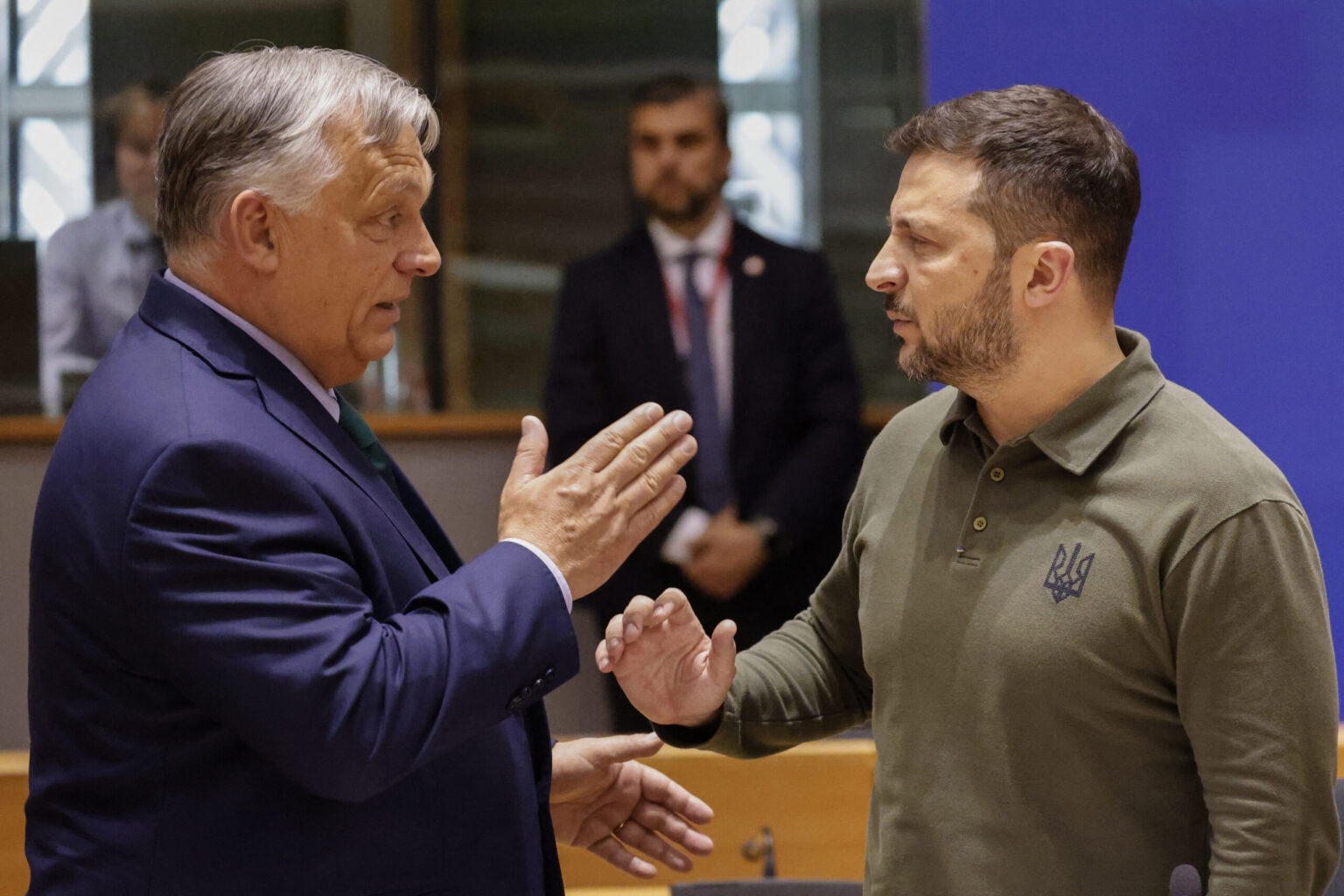
Hungarian Prime Minister Viktor Orbán accused the Ukrainian government of trying to influence the outcome of Hungary’s upcoming parliamentary election. His remarks came after Ukrainian President Volodymyr Zelenskyy criticized Orbán in his speech at the World Economic Forum in Davos, and Ukrainian Foreign Minister Andrii Sybiha claimed that the Hungarian prime minister is committing ‘yet another crime against Hungary’ by blocking Ukraine’s EU accession.
‘The Ukrainians have gone on the offensive. They’re issuing threats and openly interfering in the Hungarian elections,’ Orbán wrote in a post on X over the weekend, referring to Zelenskyy’s remark that leaders like Orbán ‘deserve a smack upside the head.’ ‘Their goal is to secure funds and force their way into the European Union as soon as possible,’ Orbán continued, adding that Hungary has the right to ‘say no’ to their accession. ‘We do not want Hungarian families’ money to be sent to Ukraine, and we do not want Hungary to be dragged into a war,’ he added, stressing that ‘Hungarians cannot be threatened or intimidated.’
Orbán’s post came after a document circulated among EU leaders ahead of the summit in Brussels on 21–23 January, outlining a controversial 10-year ‘Prosperity Framework’ plan aimed at Ukraine’s post-war recovery. As Hungarian Conservative reported, the 18-page proposal—drafted by EU and US officials—seeks to mobilize up to $800 billion in public and private funding to support reconstruction, stabilize Ukraine’s finances and infrastructure, and accelerate Kyiv’s integration into the European Union once a durable peace with Russia is achieved. The strategy envisages restoring Ukraine’s access to sovereign debt, leveraging private investment, and committing substantial resources from the 2028–2034 EU budget, including up to €100 billion in conditional aid tied to reforms.
Budapest has strongly criticized the plan, with Orbán warning that such extensive financial obligations and accelerated accession goals pose economic and political risks to the bloc.
Speaking to reporters in Brussels, Orbán said that ‘in the next 100 years there will not be a parliament in Hungary that will vote in favour of Ukraine joining the European Union,’ pointing to deep divisions between the neighbouring countries rooted in shared and sometimes troubled history, as well as the struggles of the ethnic Hungarian community in Transcarpathia to fully and freely embrace its cultural identity.
The statement sparked backlash in Kyiv, with Sybiha saying that on the day ‘Ukraine joins the EU’, it will be framed as Orbán’s ‘headline’ in the Verkhovna Rada to ‘remember’ his ‘lies for the next 100 years.’
In another lengthy post, Sybiha argued that Orbán’s rhetoric is aimed not at the Ukrainian state but at ethnic Hungarians in Transcarpathia, calling that stance ‘the height of your cynicism.’ He accused the Hungarian prime minister and his government of not caring about the ‘well-being and security of Hungarians living in Ukraine’ and of wanting to use them ‘as hostages to [his] geopolitical adventures,’ including to ‘continue laundering money through various schemes and funds abroad.’
Sybiha insisted that ‘by blocking Ukraine’s accession to the EU, Viktor Orbán is committing yet another crime against the Hungarian people and Hungary itself.’ He framed EU membership as a path to peace, writing that ‘Ukraine’s accession to the EU will bring peace, guarantee security and well-being to all of Europe and for the entire Hungarian nation,’ and contrasted that with Russian President Vladimir Putin’s desire to ‘prolong the war.’ Sybiha added that by obstructing accession, Orbán is fulfilling ‘Putin’s wishes’ and making Hungary ‘an accomplice of the Kremlin regime.’
In an especially sharp and controversial historical comparison, Sybiha wrote that ‘today, Orbán is acting not even like Miklós Horthy, but like Hitler’s henchman Ferenc Szálasi,’ and asserted that ‘Hungary does not deserve to once again find itself on the wrong side of history—as an accomplice of a new form of inhuman ideology represented by the Putin regime.’ He concluded by telling Orbán: ‘As for the elections, you should not be afraid of Ukraine. You should be afraid of the Hungarian people, who are tired of your lies, your kleptocracy, and your hatred.’
Hungarian Minister for Foreign Affairs and Trade Péter Szijjártó responded to Sybiha’s blunt accusations by saying that his Ukrainian counterpart had ‘just announced’ that Kyiv is ‘participating in the Hungarian elections.’ He added that the Zelenskyy administration is ‘running under the name Tisza’, referring to the leading opposition party led by Péter Magyar, who has been accused of having connections with figures linked to the Ukrainian security service. Concluding his post, Szijjártó warned Sybiha to ‘be careful’ or he would ‘lose…more than [he] would think,’ suggesting that Kyiv’s support for Tisza could further strain relations between the two countries’ leaderships in the event of another victory for Orbán and his Fidesz party in April.
The Hungarian government has long accused both Brussels and Ukraine of interfering in Hungarian domestic politics by supporting Orbán’s opposition. Ahead of the 2022 parliamentary election, Zelenskyy openly criticized Orbán for his neutral stance on the war in Ukraine and his cautiousness towards sanctions on Russian energy and sending military support to Kyiv. Speaking after his re-election, Orbán named Zelenskyy as one of the ‘opponents’ he had overcome in the campaign.
After Péter Magyar and Tisza entered the political arena, the Brussels establishment quickly moved to support them politically and with resources. Tisza was welcomed into the European People’s Party (EPP) soon after finishing second with 29 per cent of the vote in the 2024 European elections, with EPP President Manfred Weber claiming that ‘Tisza will end the politics of corruption in Hungary’ in 2026. ‘Viktor Orbán will retire,’ he added. Péter Magyar is campaigning on a pro-European platform, aligning with Brussels on most issues, including taxation, energy, and foreign policy.
It is not only Orbán and his government who have raised concerns about potential interference in Hungary’s elections. Controversial businessman and internet celebrity Tristan Tate warned followers to watch the vote ‘closely’, saying he suspects ‘another EU scam is incoming,’ referring to the annulled first round of Romania’s presidential election in December 2024—widely seen as a move by the EU establishment to manipulate the outcome in its favour.
Related articles: