
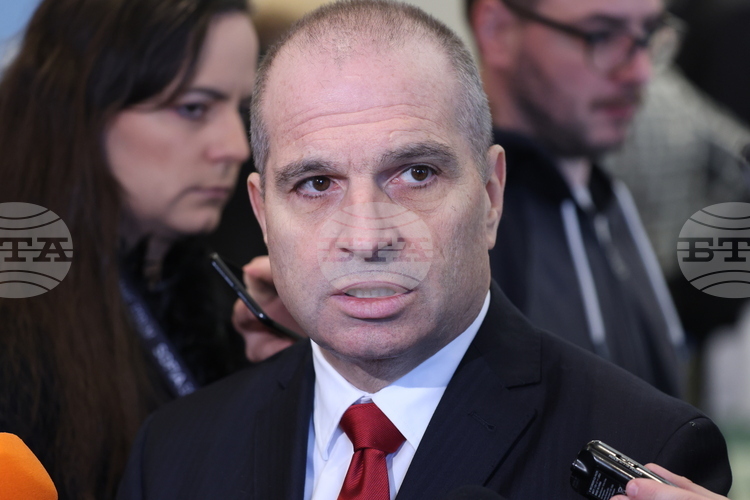
The economic losses from the blockades at the borders with Serbia and North Macedonia will be very large for all countries, not only for Bulgaria, outgoing Deputy Prime Minister and Minister of Transport and Communications Grozdan Karadjov said on Tuesday. He was speaking to journalists during the Sofia Economic Forum VI, held at the Sofia Balkan Palace Hotel.
“Such blockades, apart from violating some of the fundamental rights – the right to free movement and the right to the free transport of goods, lead to very serious economic consequences, not only for the transport sector, but for all other economic sectors that depend on deliveries. And that is practically the entire economy,” Karadjov added.
According to him, similar blockages at border crossings usually do not lead to resolving the problems that concern Bulgaria’s neighbouring countries.
“It is better to sit down and talk with the institutions, in this case, the European institutions. Neither the government of Bulgaria, nor that of any other EU Member State, has anything to do with this decision. That is why it is right to engage in dialogue with the European institutions and seek a mutually beneficial compromise. There is no need for the countries themselves – Serbia and North Macedonia, and their economies to suffer just as much as ours, punishing each other in this way,” Karadjov said.
He explained that ministers in European countries participate in various formats on transport-related issues, and what they can do is call on the European Commission to start negotiations with the two countries as soon as possible, while borders are opened until a solution is found. Bulgaria alone has no right to take such decisions, he added.
Karadjov also said he would initiate requests to open time windows at the borders with his counterparts in Serbia and North Macedonia, but expressed doubts that such an option would be realized, as the right to strike is something local governments can hardly circumvent without risking escalation.
“No one wants an escalation of relations; rather, de-escalation is being sought,” he stressed.