
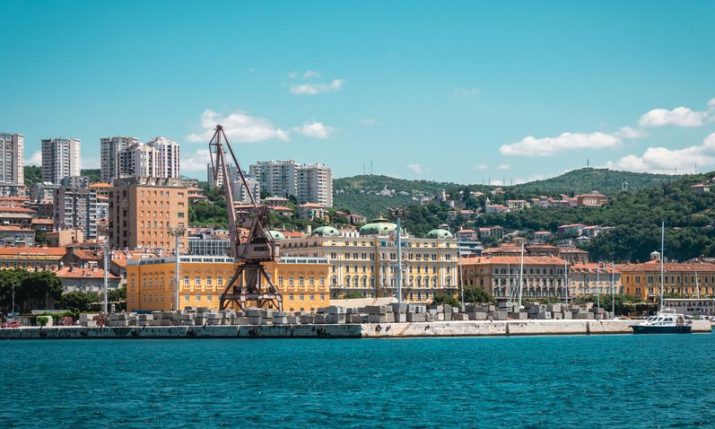
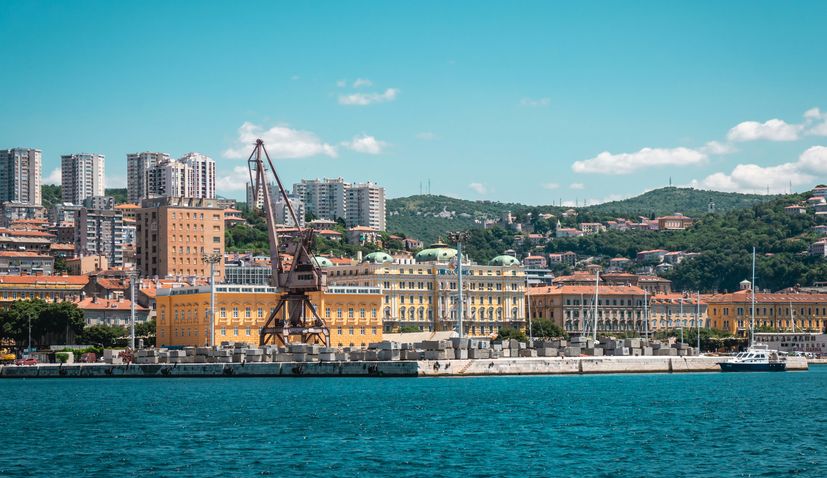
Rijeka port
Following the World Economic Forum in Davos and renewed global debate on energy security, the future direction of energy policy has once again come into sharp focus.
Messages from US President Donald Trump, including calls to reduce tensions over Greenland and his clear emphasis on fossil fuels, have reignited discussions about Europe’s energy independence and long-term strategy.
Energy analyst Ivica Jakić has told HRT that within this shifting global landscape, Croatia finds itself at a critical crossroads, with a real opportunity to position itself as a leader in the production of e-methanol, a low-carbon fuel increasingly seen as essential for the future of global shipping.
According to Jakić, Trump repeated his long-standing “drill baby drill” narrative, promoting intensive fossil fuel exploitation while openly criticising the United Kingdom’s investments in offshore wind farms in the North Sea.
Trump questioned the logic of renewable investment in an area that also contains significant natural gas reserves.
Jakić also highlighted Trump’s remarks about removing wind parks in the United States, interpreting them as a clear signal of a renewed reliance on fossil fuels. However, he noted that the US still maintains strong energy stability through its extensive network of nuclear power plants, an often overlooked element of American energy security.
Jakić also challenged Trump’s claims that China lacks substantial solar capacity, stressing that such assumptions underestimate the speed of China’s energy transformation.
China has long dominated global solar panel production, supplying European markets for decades. While domestic solar generation was not initially a priority, the country focused instead on massive hydroelectric projects such as the Three Gorges Dam, with a capacity of around 12,000 megawatts.
Today, China is constructing what will become the world’s largest hydroelectric power plant, with an installed capacity of approximately 26,000 megawatts.
At the same time, it is rapidly expanding solar power generation while gradually shutting down coal-fired power stations to reduce carbon emissions.
Crucially, China is linking renewable electricity production with hydrogen generation, which Jakić describes as the country’s primary energy carrier of the future. Over the next five to six years, hydrogen is expected to play a central role in decarbonising China’s steel industry.
To continue exporting steel to Europe, Chinese producers must comply with strict “green steel” criteria, including full traceability and proof that production relies on renewable energy rather than fossil fuels.
Jakić argues that China is already anticipating European regulatory demands, and moving faster than Europe itself.
E-methanol: a strategic opportunity for Croatia
Against this global backdrop, Jakić believes Croatia is exceptionally well positioned to seize an emerging opportunity in e-methanol production.
He points out that the Croatian Government has previously demonstrated an ability to act decisively in strategic energy matters, citing the stabilisation of the JANAF system and the rapid development of the LNG terminal, including its expansion.
Now, he argues, similar agility is needed to adapt to new fuel markets, particularly e-methanol, which is increasingly becoming the fuel of choice in maritime transport.
E-methanol is produced by combining captured carbon dioxide with hydrogen. In this process, CO₂, normally viewed as a harmful greenhouse gas, is converted into a low-carbon liquid fuel suitable for powering ships.
The cement industry is identified as a key source of CO₂, and one that is already under pressure to reduce emissions in order to obtain “green cement” certification. This creates a natural synergy between industrial decarbonisation and fuel production.
Ports, CO₂ sources and hydrogen potential
“Hrvatska has exceptional preconditions,” Jakić told HRT, pointing to Croatia’s coastline, developed ports, existing fuel storage infrastructure, and accessible CO₂ sources in Split, Pula and Našice.
Combined with the country’s potential for hydrogen production, these factors create a strong foundation for e-methanol development.
Ports such as Rijeka are already seeing a growing number of vessels equipped with dual-fuel engines, capable of running on e-methanol.
Between 2027 and 2030, Jakić estimates that most large container ships, carrying between 25,000 and 40,000 containers, will rely primarily on e-methanol.
This transition is already attracting international interest. Major energy companies, including Spain’s Repsol, are deploying specialised vessels across the Mediterranean to collect CO₂ from cement plants and use it for e-methanol production. That fuel could then be supplied directly to ships operating in Croatian ports.
Jakić warns that Croatia must act quickly to secure its role in this emerging market. Without a clear strategy and timely investment, there is a real risk that foreign companies could capture local resources and dominate e-methanol supply chains in the region.
“There is a genuine danger that others will take control of resources right in front of us if we fail to respond in time,” he concludes.