
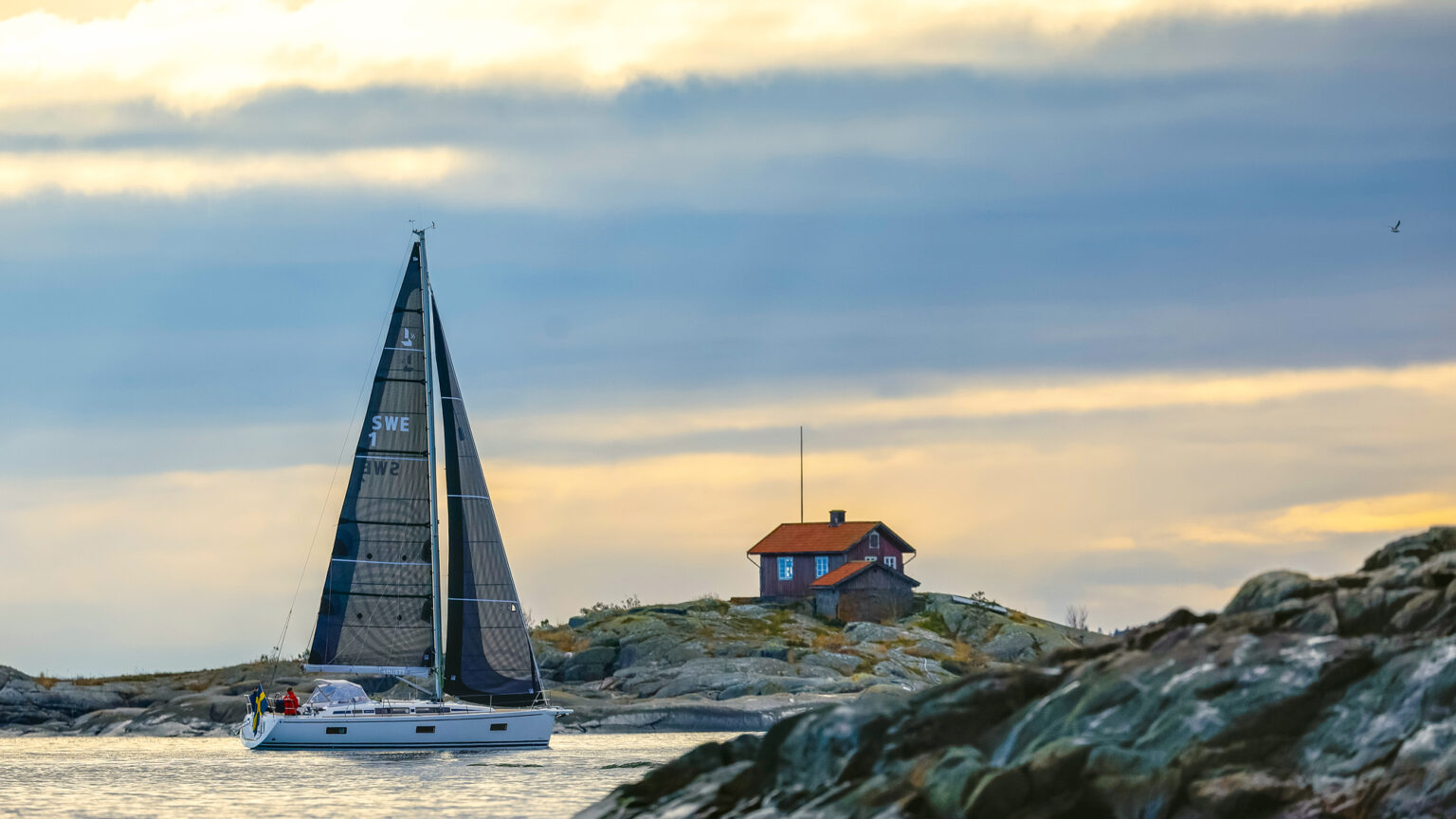
Civilisation gradually fell away as the road rolled onwards in the car’s headlights; cities gave way to villages, which gave way to forests. Suddenly, snuggly-lit timber cottages appeared, nestled amid modern sheds housing ranks of sleek yachts nested down for the winter.
Rosättra Båtvarv is about as far from an industrial centre as you can imagine, but it’s here, at the oldest working boatyard in Sweden, that a select group of craftsmen and women busy themselves with building what they believe to be the most beautiful boats in Sweden. That’s saying something, as Sweden is the birthplace of some of the world’s loveliest yachts.
Linjett isn’t well know outside Sweden. Just a dozen or so boats are built here each year, 900 or so since the first GRP Linett was launched in 1973, yet over 200 of them return home each winter, like migrating geese, and over half are still owned by members of the Linjett owners’ association and I’d wager the rest are still all sailing somewhere or other.
Loyalty to the brand, once awoken, is clearly strong. The first Linjett, a 30-footer, was built just a couple of years after Hallberg-Rassy began building, but boats have been built on this site since 1886, with just two families owning the business in that time; the Janssens sold the yard to the Gustafssons in 1948, and now the third and fourth generations of the Gustafassons run the yard.
They have been careful not to expand much. Building small numbers of beautiful boats, with long lead times and a strong order book turns out to be a far more sustainable way of weathering the economic storms than churning out as many hulls as possible.
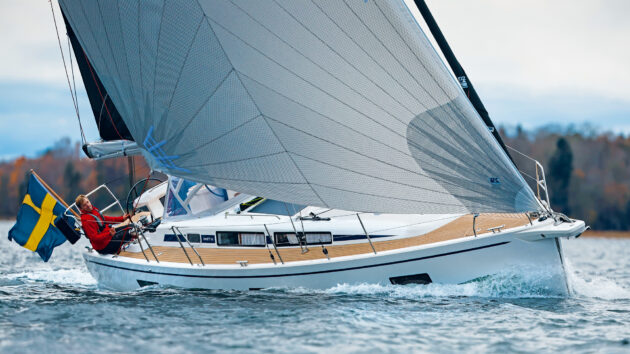
The Linjett 36 balances powerful performance with proper cruising qualities. Photo: Paul Wyeth
It is also striking that in 52 years Linjett has built just 10 models. It’s little surprise then that the design of these boats is fairly conservative and timeless. So if you think cruising yachts aren’t what they used to be, then this one might just pique your interest.
Having said all that, the new 36 is a marked evolution from her 1ft-longer predecessor, the Linjett 37. A more vertical stem and transom, wider beam, especially aft, higher topsides and, in a first for Linjett, an integral bowsprit, as well as more subtle touches like moulded bulwarks, flush hatches and, below the waterline, a retractable bowthruster, all make this a thoroughly modern cruiser with a surprising amount of volume, despite her relatively slender lines and low coachroof. She has also joined the 43 and the 39 in having twin wheels, while the smaller 34 still has the option of a tiller in place of the single wheel.
Nevertheless, it is pleasing to find a boat without pronounced hull chines, huge bows, and sunpads galore. More telling, however, is the underwater profile. A single rudder, deeper hull, with more rounded bilge and plenty of rocker at the bow and stern make this a slippery hull that will cope when loaded up with cruising kit. Unlike performance cruisers designed to plane, her sparkle is unlikely to fade much when fully loaded.
The pay off is that she’ll heel more initially, becoming increasingly solid as her 40% ballast ratio comes into effect, thanks to a 1.95m lead keel to which 250kg was added when the yard found a way to take that weight out of the boat’s superstructure, improving an already solid vessel.
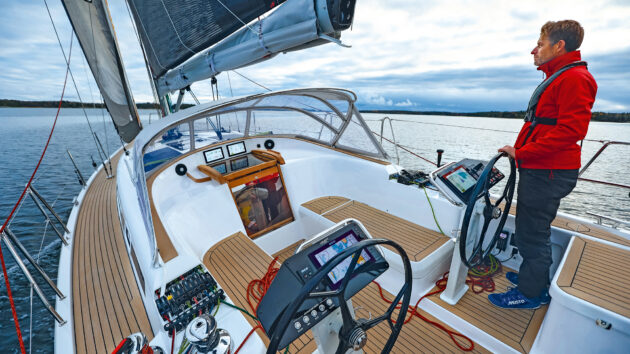
The cockpit is well set up for shorthanded cruising and offers good shelter. Photo: Paul Wyeth
Heading for Arholma
As day dawned over the Stockholm archipelago, we were greeted by a stunningly beautiful but hopelessly still morning. After a morning dip in the chilly Baltic and a strong coffee, we snaked our way out towards Arholma at the northern end of the Stockholm archipelago.
Summer houses and saunas punctuated low wooded shores. Eider ducks flew away and a curious seal dived as we approached, our wake distorting glassy reflections of the clouds. Still, it was a good chance to see what the 40hp 3 cylinder Yanmar engine could do with a 3-bladed folding Flexifold prop on the saildrive (8.3 maxing out at 3,000rpm, and a very adequate 7 knots at a much more civilized 2,100rpm).
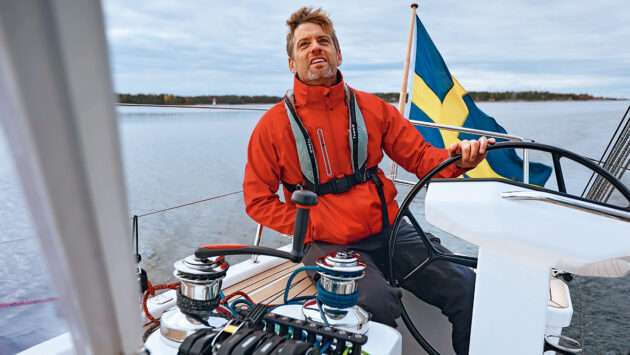
Everything is within easy reach for the helm while giving space for crew to help. Photo: Paul Wyeth
Cockpit layout
The cockpit is well laid out for shorthanded sailing – all lines are led aft to the coamings ahead of the wheels, where a bank of 10 clutches either side offer control over everything from outhaul and cunningham to halyards and reefing lines.
The inboard winches on our boat were powered, while the outboard winches (both Andersen 46ST) were manual, and used for trimming the genoa and gennaker; Spinlock deflectors can take any line to either winch without straining the clutches. Furling of both the genoa and Code Zero is handled by electric below deck furlers, the latter built into the bowsprit; a stainless steel ladder slots into the side of this to assist boarding and mooring to rocks.
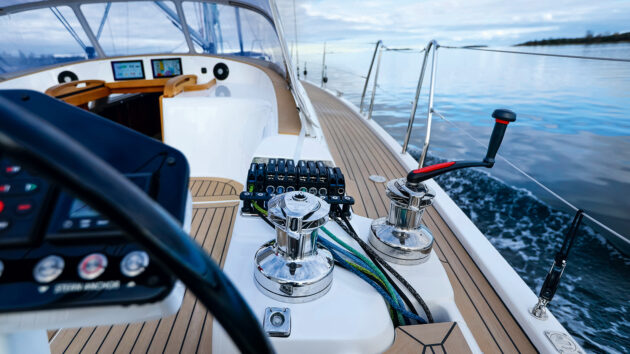
Line deflectors allow any line to be used with either winch. Photo: Paul Wyeth
Back in the cockpit, lines, clutches and winches are easily reached from behind the wheel, with space ahead of it for crew to handle lines without getting in the helm’s way. Twin composite wheels adorn the pedestals, which are carefully angled to make the chartplotter visible whether standing or sitting behind the wheel.
I was also pleased to see a repeater chartplotter and B&G Nemesis instrument display forward so that crew (or watchkeepers sheltering in warmth inside the drop down tent) can view what’s going on, and even con the boat from here.
Unlike open-transomed boats, you can sit behind the wheel thanks to the lazarette lockers, or outboard on the coamings, under which are huge rope bins, making it easy to keep lines tidy and winch handles stowed, while a 48:1 purchase backstay gives good control over the keel-stepped Selden 9/10ths fractional rig.
A large gas bottle is housed in a sealed locker within the port aft lazarette, with space for spares in the bow locker. A third smaller lazarette is under your feet as you walk between the seat to the small sugarscoop bathing platform and deck shower – in many ways a more convenient solution than a large and cumbersome bathing platform that must be lowered to be of use. This being the Baltic, the stern anchor, roller and windlass are a permanent installation.
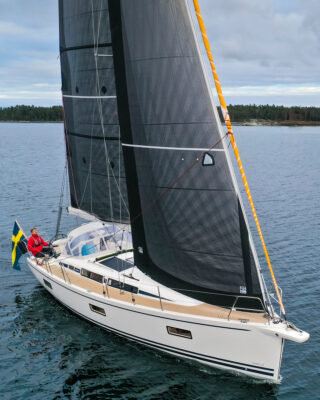
This is the first Linjett model with an integrated bowsprit. Photo: Paul Wyeth
The remaining cockpit stowage in a vast locker under the starboard bench seat includes shelving, boxing-in above the 150L diesel tank, and hanging space for waterproofs – accessed also via the heads and kept warm by the diesel heater located in this locker.
It being late autumn, we left the sprayhood up but still had excellent visibility. Forward of this is the traveller for the German mainsheet that keeps the cockpit clear while allowing for proper sail trim. Moving about on deck is unhindered by clutter, with short genoa tracks ahead of inboard chainplates, unusual these days but which allow for a large 140% genoa if you don’t want a Code Zero.
A self-tacking jib track will also come as standard for use with a working jib or partially furled 110% genoa. Fuller bow sections have enabled Linjett to offer a truly vast forepeak for a 36-footer. A deck-mounted windlass ensures a decent fall and more than enough space for the 60m of 8mm chain on the test boat, while leaving space for two offwind sails and a pile of fenders.
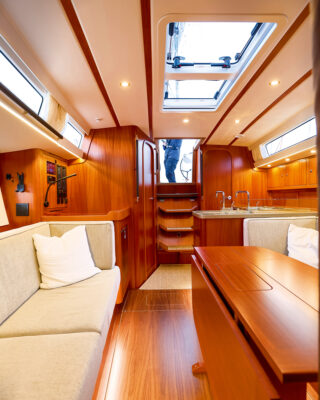
Movement at sea is aided by good grab holds and rounded corners. Floorboards are all screwed down. Photo: Paul Wyeth
Chasing zephyrs
Having reached the outer edge of the skerries to find no more wind, we anchored for lunch – Finland just 40 miles away – to wait. The faintest zephyr was enough for us and the boat began to slip silently along, boatspeed matching the true wind speed of 2.5 knots.
As apparent wind touched 10 knots, boatspeed climbed to 4.6 knots at 28-30º to the apparent wind. We weren’t fully laden by any means, but water and fuel tanks were full, proving that in light airs at least, this is an extremely slippery boat.
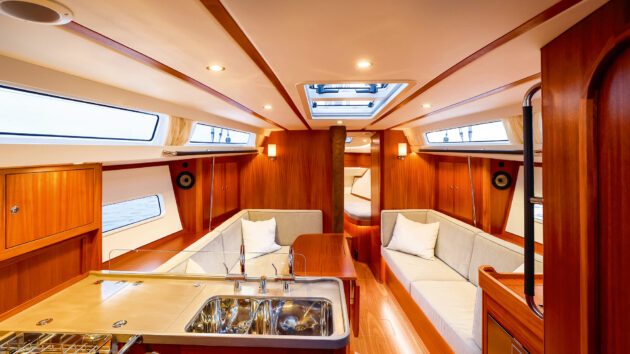
The accommodation is beautifully finished, with a comfortable saloon, large galley and a chart table. All windows are made of toughened glass – the hull windows get a double layer. Photo: Paul Wyeth
It wasn’t until day two of the test, having spent a most comfortable night aboard, that the wind gave us anything real to play with, though that a mere 5-8 knots true. Still, the boat wasn’t complaining and with 12-13 knots across the deck, we nudged 6-6.5 knots 28º to the apparent, and wangled 5.4-5.6 knots at 25-27º. The 36 may be beamier than her forebears, but she is no less weatherly.
The neutral helm came to life at over 4 knots boat speed, and with a little heel on, the boat started whispering through the wheels, which were precise and direct. It’s a delight to be able to tweak control lines from the wheel; only headsail sheeting angles weren’t easily adjustable.
Heading for home with the Code Zero set, we made it as high as 55º to the apparent, hitting 7.2 knots boatspeed in just 8-10 knots true wind. It was a tiny glimpse of what the boat could do, and it left me wanting more.
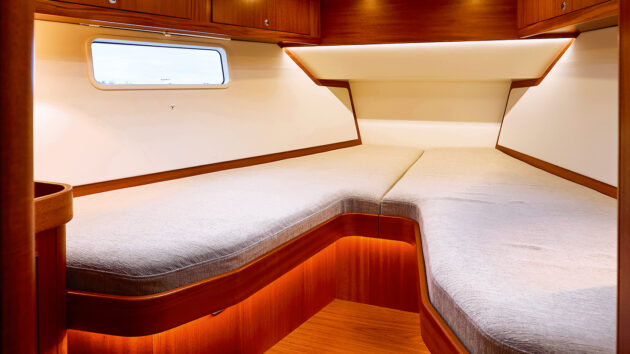
An infill turns the forward berths into a large double, measuring 210cm x 210cm. Stowage is excellent, as is light and ventilation. Photo: Paul Wyeth
Warm comforts
It may have been beautiful out on the water, but it wasn’t warm. Thankfully, the diesel heater had been running silently all day and down below was cosy and comfortable. Despite using power for heat, hot water, light, navigation and winches, there was more than enough power for 12V and 240V supply thanks to the 400Ah of lithium batteries at the heart of the domestic systems (200Ah is standard, and up to 600Ah, or 7.8kWh, is an option).
Keeping these topped up is a high-output 230A (3kW alternator, capable of sustained output thanks to its water cooling. Coupled with the 260W of deck- mounted solar, this would be sufficient to have induction cooking and do away with gas entirely. For owners opting for electric propulsion, there’s also space for a range-extending diesel generator.
Power aside, Linjett clearly know what cruising aboard for extended periods entails. The L-shaped galley, at the foot of the companionway, has two deep sinks, a large fridge, a two-burner oven with solid crash bar, and more stowage than you can shake a stick at, and of course space for a Nespresso machine.
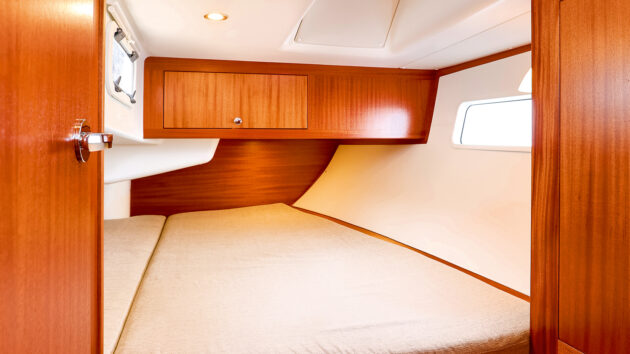
You only notice the narrower stern in the aft cabin’s curved berth. Photo: Paul Wyeth
Open the galley drawers and you discover they are made of solid oak, with dovetailed corners and soft-close runners. Corian worktops fiddles have milled recesses to make them into proper handholds. A dorade vent above the stove can be supplemented by an opening hatch in the toughened glass windows, while the toughened glass splashback is strong enough to fall against at sea without breaking.
The fit-out is in traditional mahogany (light oak is an option), all beautifully finished with solid-wood framing around lockers and edges, while white hull linings, and stainless-and-leather grab holds give a crisp, modern touch. Fittings are all of the highest standard, with dimmable lights and USB ports.
Well-placed grab holds ensure easy movement underway, taking you to the standing chart table opposite the galley, with a second fridge below it; a forward-facing table is an option which would then overhang the starboard settee to maintain sufficient length for a 190cm seaberth. There’s plenty of room for small items and charts, though I’d like a plotter or instrument repeater here. In reality, below-deck nav will be done on a tablet mirroring the plotters on deck.
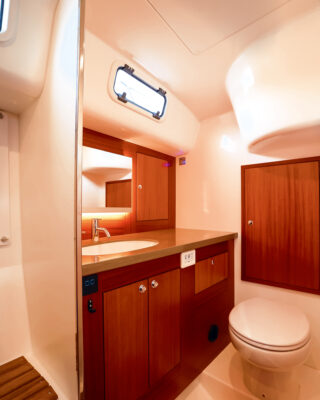
The heads has a separate shower and a heated hanging locker. Photo: Paul Wyeth
The large solid timber table, with nicely rounded corners and deep bottle stowage, is going to have drawers added in later hulls. At 190cm, straight settees either side are long enough for seaberths; the port one has a slight curve against the forward bulkhead, though not quite a full L-shape for putting your feet up. Space below the settees is given over to one of the 150L water tanks on the port side (a second 150L tank is in the bilges), with batteries and electrical distribution to starboard (meaning they are far enough forward to power the bowthruster without additional batteries).
Light pours in through the long toughened glass coachroof windows, twin opening deck hatches and the hull windows.
Floorboards are all screwed down and felt-edged to prevent noise underway. The bilge sump is deep thanks to the moulded keel stub (far stronger than a flat tray), while structural resilience is increased by a stepped keel-hull joint – mechanically stronger with no single line of weakness; there are a lot of rocks in Sweden, after all.
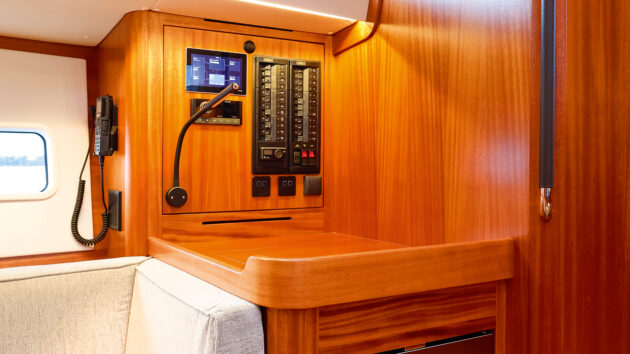
The standing chart table has a fridge below. You can opt for a forward facing table instead. Photo: Paul Wyeth
Hull frames are laminated in place, as is the joinery, while the hull is vacuum-infused in vinylester resin, with solid laminate in high-load areas and around through-hull fittings. The deck is hand-laid up for a high gloss finish with no print through of the fibreglass.
Another benefit of the fuller bow is the forward cabin’s berth; moved aft by the bow locker, the foot of the bed is a metre wide, 210cm at the head end and 210cm long overall, with an infill to make this a large double.
Overhead lockers line either side, while tall lockers sit above drawers aft, with more drawers under the berth and further bin stowage around the optional bowthruster – a serious bit of kit that isn’t necessarily required on a single-rudder 36-footer. It can be retrofitted if you did want it. The sliding cabin door means no space is taken by the arc of a hinged door.
I slept very well indeed in here and loved waking up to see the water around me through the hull windows, the blinds for which were neatly recessed into the bottom of the lockers above. Standing headroom is good throughout, with 195cm for most of the accommodation, and 185cm in the cabins.
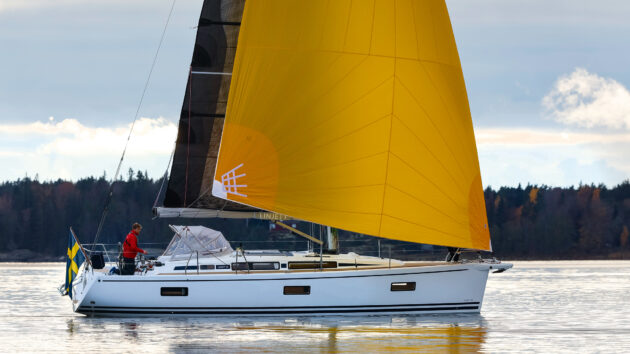
The Linjett 36 is quietly modern and beautifully built, with the finest of craftsmanship. Photo: Paul Wyeth
The aft cabin has an almost rectangular 200cm by 160cm double berth, again with its own hull window, overhead lockers, two opening hatches and bin stowage seat, plus drawers beneath the bunk.
There is no option for a third cabin on this boat, the yard preferring to focus on a luxurious-feeling heads compartment, the forward end of which includes space for an enclosed shower, and aft, an electric toilet and lockers. The mirror, tucked under the side deck, angles up to make it usable when standing and sitting. You also have access to the cockpit locker, in which there is a rail for sailing gear and is heated by the diesel heater to allow it all to dry quickly.
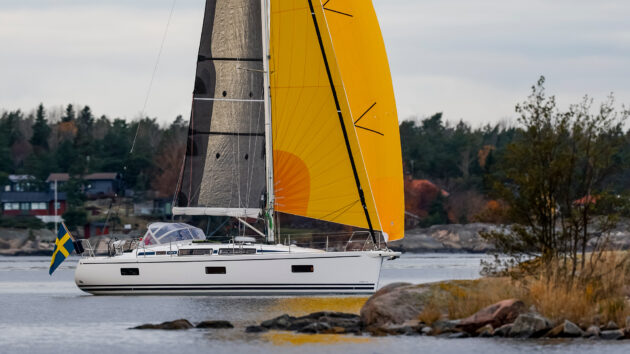
In light airs at least, this is an extremely slippery boat. Photo: Paul Wyeth
Linjett 36 specifications
Price as tested: £585,000 inc VAT
LOA: 11.50m / 37ft 9in
LWL: 10.20m / 33ft 6in
Beam: 3.66m / 12ft 0in
Draught: 1.95m / 6ft 5in (Shoal 1.80m / 5ft 11in)
Displacement: 6,800kg / 14,991 Lbs
Ballast: 2,850kg / 6,283 Lbs
Sail area (main + 107% genoa): 73.1m2 / 787 sq ft
Bal/disp: 41.9%
Disp/length: 178.9
SA/D Ratio: 20.7
Engine: Yanmar 40hp
RCD: Category A
Designer: Linjett Design Team
Builder: Rosättra Båtvarv
Enjoyed reading this?
A subscription to Yachting Monthly magazine costs around 40% less than the cover price, so you can save money compared to buying single issues.
Print and digital editions are available through Magazines Direct – where you can also find the latest deals.
YM is packed with information to help you get the most from your time on the water.
-
-
- Take your seamanship to the next level with tips, advice and skills from our experts
- Impartial in-depth reviews of the latest yachts and equipment
- Cruising guides to help you reach those dream destinations
-
Follow us on Facebook, Twitter and Instagram.
Note: We may earn a commission when you buy through links on our site, at no extra cost to you. This doesn’t affect our editorial independence.
Having made the pilgrimage to the wilds of Sweden, it was surprising to discover the huge number of Linjetts that flock back to their origins every winter. Those in the know clearly stay loyal to the yard, and for good reason. The Linjett 36 is quietly modern, ruggedly capable, and beautifully built with the finest of craftsmanship. This is a proper, serious cruising boat that could take you absolutely anywhere while being a delight to sail. She’d be perfectly happy in the Med, though that’s probably not her natural habitat. For a boat that will relish a challenging passage to windward, or cocoon their crew in comfort as wind and rain lash across the deck, this is a boat that is well suited to the vagaries and beauty of northern Europe.